
Quantum Chemical Characterization of Catalytic Ester Decarbonylation: Olefins from Biomass
Synthetic transformations of carboxylic acids into olefins are of paramount importance since bio-mass derived carboxylic acids could then be a renewable source for polyolefin syntheses. An important goal, then, is to develop catalytic transformations that sustainably transform these structurally diverse acid educts into olefin products with high selectivity. Production of olefins via transition-metal-catalyzed decarbonylation of bio-derived carboxylic acids is one approach that has been explored and demonstrated to be possible with low toxicity, and tolerant of diversity.1-2. As a subclass, linear α-olefins (LAOs) are important commodity chemicals that find utility in a wide range of industrial applications. LAOs are usually generated from petroleum, which is a nonrenewable and depleting resource. A green and sustainable approach would be to produce LAOs by decarbonylative dehydration of fatty acids, which are inexpensive and renewable.
Direct routes for the conversion of carboxylic acids to olefins typically proceed with high activation energies. However, carboxylic acid derivatives such as esters are more reactive and can serve as key precursors in carboxylic acid transformations, and in particular transition-metal-based catalysts have been shown capable of transforming them to high-value olefins. However, controlling selectivity for terminal alkene formation is a major challenge. A highly selective, palladium-catalyzed decarbonylation of p-nitrophenyl esters of fatty acids to their corresponding LAOs has been very recently developed.3 A cooperative ligand system including phosphines and N-heterocyclic carbenes is reported to exhibit enhanced selectivity to terminal olefins. Herein, we investigate the decarbonylation mechanism of p-nitrophenylbutyrate to rationalize the switching reactivity and selectivity trends based on either individual or cooperative roles of phosphine and heterocyclic carbene ligands. The primary goal of the project is to elucidate the origin of terminal alkene A selectivity vs the thermodynamically more stable internal alkene B which can be generated as an undesirable alternative product (Scheme 1).
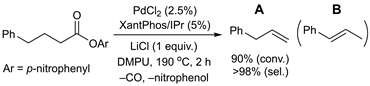
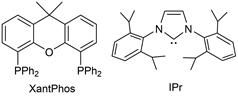
Scheme 1. Pd-catalyzed decarbonylation of p-nitrophenylester to α-olefins. XantPhos and IPr ligands comprise the dual ligand system.
To gain mechanistic insight at the atomic level of detail, we performed density functional theory (DFT) modeling. We focused on the Pd-catalyzed decarbonylation of p-nitrophenylbutyrate in order to fully characterize reaction coordinates for the formation of terminal A and internal B alkene products and to explain the roles of the ligands in promoting α-selectivity. To assess selectivity, we have thoroughly compared the competing reaction mechanisms using three ligand systems: IPr, XantPhos, and a mixture of IPr and XantPhos. Calculations suggest that the bulkiness of IPr combined with the bidentate nature of XantPhos prompt a rapid decoordination of the terminal alkene, thus precluding the alkene isomerization pathway.
References
- Rodriguez, N.; Goossen, L. J., Decarboxylative coupling reactions: a modern strategy for C-C-bond formation. Chemical Society Reviews 2011, 40 (10), 5030-5048.
- Le Nôtre, J.; Scott, E. L.; Franssen, M. C. R.; Sanders, J. P. M., Selective preparation of terminal alkenes from aliphatic carboxylic acids by a palladium-catalyzed decarbonylation–elimination reaction. Tetrahedron Letters 2010, 51 (29), 3712-3715.
- Alex John, Levi T. Hogan, Marc A. Hillmyer and William B. Tolman, Olefins from biomass feedstocks: catalytic ester decarbonylation and tandem Heck-type coupling, Chem. Commun., 2015, 51, 2731.
See more of this Group/Topical: Catalysis and Reaction Engineering Division