
Introduction
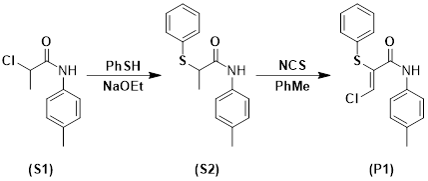
Figure 1. Synthesis of (Z)-3-chloro-2-(phenylthio)-N-(p-tolyl)acrylamide
Traditionally the majority of active pharmaceutical compounds have been
manufactured at large plant scales using batch methodologies. Continuous
manufacturing is becoming an increasing attractive alternative due to apparent
benefits such as smaller manufacturing footprints, increased process safety,
lower manufacturing costs and increased supply-chain flexibility. In this work,
a new approach to the design of continuous manufacturing platforms is being
presented which is not restricted to using such conventional equipment but
which is based around bespoke design and manufacture. As a model compound,
2-chloro-N-(4-methylphenyl)propanamide (S1),
a precursor in the multi-step synthesis of (Z)-3-chloro-2-(phenylthio)-N-(p-tolyl)acrylamide (P1, Figure 1) is used. The aim of this
work is to design a combined continuous reaction to crystallization process for
S1 and overcome the
existing challenges between the two process.
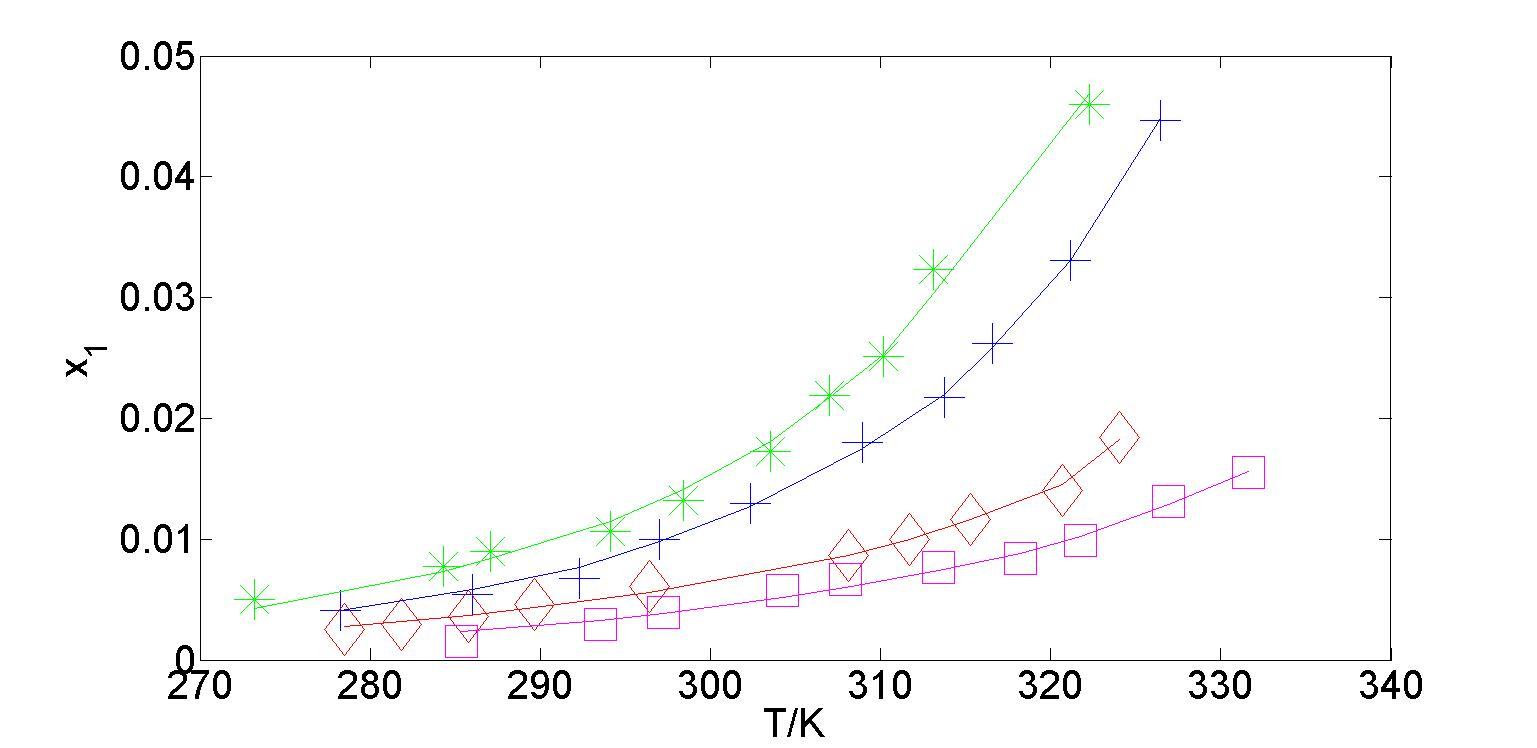
Figure 2. Solubility data of S1 in toluene + hexane mixtures: *, w2 = 1; +, w2 = 0.8; ◊, w2 = 0.6; □, w2 = 0.4; ─, Phase
Equilibria with NRTL equation calculated. w2 is the
mass fraction of toluene in binary toluene + hexane mixtures.
Design
of Continuous Reaction and Crystallization Process Reaction:
Using a modified procedure
developed by Li et al2, a
batch process is employed where a-chloropropionyl
chloride (12 mmol) was added dropwise to a suspension of p-toluidine (10 mmol) in toluene (20 mL) at 0oC and the
resulting solution was heated to reflux for 1 h with vigorous stirring. After cooling, the solvent was removed under
vacuum and the resulting off white solid was collected by filtration and washed
thoroughly with cold cyclohexane. Spectral data of the obtained product matched
that reported in the literature3. Therefore, it has been decided to
use toluene as the reaction solvent as it can also be used as a crystallization
solvent based on the solubility studies. However, this developed procedure
produces a small amount of HCl as a by-product, which can be problematic for
reaction product purity and its subsequent crystalisation steps. Therefore, it
is decided to run the reaction in a novel 3D printed continuous biphasic
reaction system in the presence of aqueous sodium hydroxide to neutralize HCl
salt. The design of the biphasic reactor is based on the specific needs of the
reaction which is capable of achieving extremely high dispersion rates between
the two phases under the very low Reynolds numbers typically encountered in the
pharmaceutical industry (Re < 5). Process steps are quantified in detail using methods
such as computational fluid dynamics (CFD) leading to tailored equipment
designs which can be manufactured with high precision using metallic 3D
printing. The biphasic reactor is coupled with liquid-liquid separation such
that both unit operations are designed using fundamental engineering principles
combined with numerical analyses (based upon the requirements of the specific
process), prior to being 3D printed and combined to create a bespoke, sealed,
hard-piped manufacturing system. Reaction
to Crystallization: From the liquid-liquid separator, the organic phase is
transferred in the feed/dissolution tank while aqueous phase goes to waste. In
situ FTIR (React IR 15, Mettler Toledo) is used on the feed/dissolution tank to
determine the concentration of S1
prior to crystallization and the crystallization kinetic data obtained
(explained below) enables the adjustment of crystallization parameters for
better control and set up of the process. Crystallization:
Using
the solubility curve obtained from solubility studies for toluene, a
continuously operated single stage mixed suspension, mixed product removal
(MSMPR) crystallizer with intermittent withdrawal via dip pipe using an
automated pressure supply4-6 is set up for the cooling
crystallization of S1. Acquisition
of reliable kinetic correlations that describe how rates of nucleation and
growth vary over the design space for the crystallization process is necessary
for enabling robust prediction of crystallizer performance. Therefore, simple
extraction of the growth and nucleation parameters from the single stage MSMPR
operating at steady state is performed using the population balance model.
Comprehensive experimental data for model fitting and parameter estimation is
obtained by varying crystallizer operating conditions (temperature,
supersaturation and suspension density) to induce changes in the rate-affecting
variables for growth and nucleation. FBRM is used for real-time monitoring of
size distribution and identification of steady state and hence enabling
on-demand adjustment of operating conditions to transition multiple
steady-states for rapid acquisition of kinetic data while PVM (ParticleView
V819, Mettler Toledo) provides microscopy quality images in real time to
monitor the crystal habit. Malvern Mastersizer is used as an offline analysis
to determine the crystal size distribution (CSD) at steady-state while the
concentration of mother liquor at steady-state is determined gravimetrically.
By estimating the six kinetic parameters for crystal growth and nucleation,
accurate prediction of CSD and concentration results at steady-state can be
achieved. References: [1] Mullin, J. W. Crystallization; Butterworth-Heinemann,
1997 [2] Li, X.; Wang, D.; Wu, J.; Xu, W. Novel Approach to 3‐Methyl‐1H‐quinoxalin‐2‐ones.
Synthetic communications 2005, 35 (19), 2553. [3] Murphy, M.; Lynch, D.; Schaeffer, M.; Kissane, M.; Chopra, J.;
O'Brien, E.; Ford, A.; Ferguson, G.; Maguire, A. R. Investigation of the
synthetic and mechanistic aspects of the highly stereoselective transformation
of [small alpha]-thioamides to [small alpha]-thio-[small
beta]-chloroacrylamides. Organic &
Biomolecular Chemistry 2007, 5 (8), 1228. [4] Hou, G.; Power, G.; Barrett, M.;
Glennon, B.; Morris, G.; Zhao, Y. Development and Characterization of a Single
Stage Mixed-Suspension, Mixed-Product-Removal Crystallization Process with a
Novel Transfer Unit. Crystal Growth &
Design 2014, 14 (4), 1782. [5] Power, G.; Hou, G.; Kamaraju, V. K.;
Morris, G.; Zhao, Y.; Glennon, B. Design and optimization of a multistage
continuous cooling mixed suspension, mixed product removal crystallizer. Chemical Engineering Science 2015, 133, 125. [6] Morris, G.; Power, G.; Ferguson, S.;
Barrett, M.; Hou, G.; Glennon, B. Estimation of Nucleation and Growth Kinetics
of Benzoic Acid by Population Balance Modeling of a Continuous Cooling Mixed
Suspension, Mixed Product Removal Crystallizer. Organic Process Research & Development 2015, 19 (12), 1891.
See more of this Group/Topical: Process Development Division