
Templated Synthesis of Polymer - Gold Nanocomposites with Pluronic Gels
Gold nanoparticles with uniform size and shape have many applications in a variety of fields such as biomedical, sensing and plasmonic materials. Frequently, ordered assemblies of nanoparticles are sought to fabricate practical devices utilizing the unique properties of these nanoparticles. For example, assemblies of gold nanoparticles with complex shapes can show emergent behavior such as metamaterials. Obtaining fully 3 dimensional assemblies of gold nanoparticles with macroscale ordering has been a significant challenge. One of the methods to create such ordered structures is the in situ formation of nanoparticles within polymer matrices, especially block copolymer matrices which act as templates for the formation of nanoparticles and their assembly. Nucleation and growth of the nanoparticles in the polymer matrices can be tuned by pH, choice of reducing agent, concentrations of reactants involved and the reaction temperature. Ordered nanoparticle assemblies also typically require high concentration of monodisperse nanoparticles in the assembly. In this regard, we present some results on the formation of high concentration of monodisperse gold nanoparticles in Pluronic gels. Pluronic block copolymers solutions in water are known to form liquid crystal lattices at high polymer concentration at room temperature, and the formed liquid crystals have been used to template the formation of mesoporous inorganic oxides. In addition, Pluronic is also known to reduce chloroauric acid to gold nanoparticles in solutions. Here we present the formation of gold nanocomposites at high concentration in Pluronic solutions and gels. Different conditions were tested for the formation of uniform gold nanoparticles without the loss of gelation behavior of the polymer at room temperature. Effect of pH and added reducing agent on the kinetics of the redox reaction, gelation, nanoparticle yield and morphology were studied. Basic pH was found to aid both the gelation, and fast redox reaction. Fast reduction resulted in the formation of uniform gold nanoparticles in the gel with diameter of 9.4 ± 1.9 nm. Under other tested conditions, formation of gold triangles and rods was observed. Addition of trisodium citrate to the gel was found to improve the results of the reaction considerably relative, but was found to be not as effective as synthesis at high pH with sodium hydroxide. Our results indicate a competition between Pluronic and added reducing agents for reducing gold ions which can be tuned by adjusting solution pH. Differences in observed results with pH and added salt were explained on the basis of Hofmeister effect and the effect of pH on the hydration of PEO blocks and the redox reaction. SAXS and cryoTEM will be used to characterize the assembly of the particles in the gels. Using these results we aim to achieve controlled and selective deposition of metal nanoparticles and metal films in domains of Pluronic block copolymer gels.
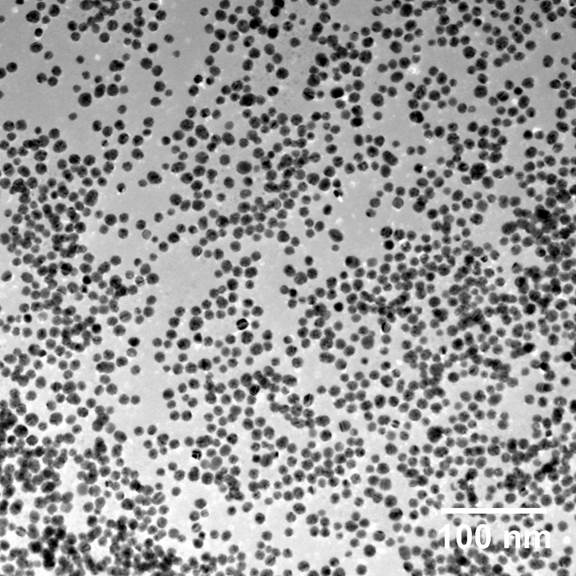
Figure 1: TEM images of gold nanoparticles synthesized in 22.7 wt% Pluronic gels in 54mM sodium hydroxide with 1.6mM HAuCl4. The particles have a narrow size distribution (9.4 ± 1.9 nm).
See more of this Group/Topical: Materials Engineering and Sciences Division