
1 Introduction
Fluoride salt-cooled high temperature nuclear reactors (FHRs) and molten salt nuclear reactors (MSRs) have potential advances in terms of their compact size, high thermal efficiency, modular design, and passive safety features that project them to have economic advantages in the future electricity market [1]. These factors are largely enabled by the unique properties of the proposed molten salt coolants. Molten fluoride salt mixtures have high thermal conductivity and heat capacity, low viscosity, low vapor pressure, high boiling point, and chemical stability under radiation fields [2]. In particular, the 2LiF:BeF2 mixture, known as flibe, is being actively investigated as a coolant for FHRs, and as a coolant and fuel solvent for MSRs.
Infrared (IR) spectroscopic measurements have been used to investigate molten fluoride salts to reveal the presence of complexes or covalent structures. This data can be useful in answering questions about speciation of impurities such as corrosion, fission, and neutron activation products, and in making predictions about transport and reaction mechanisms and kinetics. In addition, IR spectrum data can be particularly valuable as inputs into modeling radiative heat transfer. Radiative heat transfer in semi-transparent (i.e. participating) media is important to understand at the high operating temperature of FHRs and MSRs. The spectroscopic study of molten salts is quite challenging in practice, specifically for fluoride salts, considering their high melting points and degree of corrosive attack of window materials. Such characteristics pose a constraint for the design of melt holder materials, and window selection.
This article reviews IR studies of fluoride melts in general; the experimental methods employed and the data obtained are discussed. Currently, no IR spectrum data for flibe is reported in literature, though there have been Raman studies. The results of recent molecular dynamics (MD) models of flibe are reported, which will be instrumental in guiding future IR experimental measurements. The goal of the paper is to outline the state of the art of IR spectroscopy in fluoride salts studies and discusses whether these studies can be used to study covalent structures and radiative properties of flibe salt.
2.1 Review of Experimental Methods
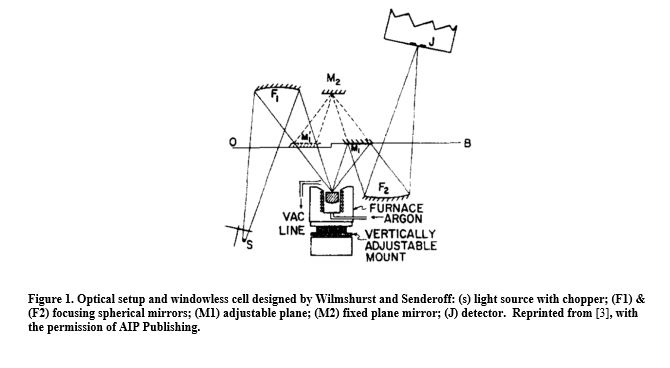
Wilmshurst and Senderoff developed a method in which they reflected a monochromatic beam of IR light of varying wavelength from the surface of a molten salt sample and measured the reflected light’s intensity (Figure 1)[3]. Through the relation of the complex reflectivity and complex coefficient of refraction, and applying the Kramers-Kronig (KK) technique, the absorption coefficient and refractive index were then obtained for the melt [4]. The absorption coefficient was the desired result so that the peak locations of observed spectra could be correlated to vibrational modes of hypothesized melt species.
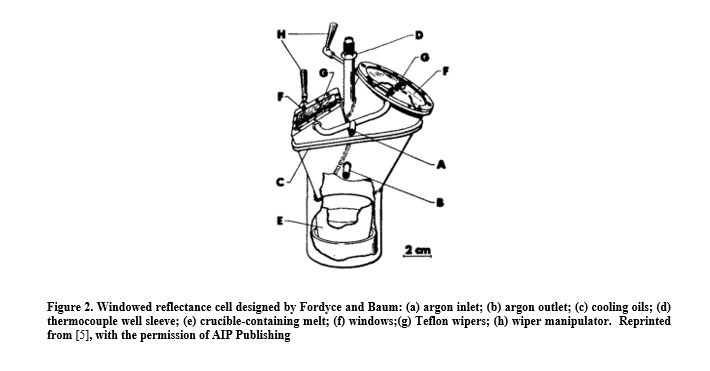
Fordyce and Baum used an identical optical arrangement and their measurements relied on the same principles and analysis as above, but they developed a different optical cell due to the high vapor pressure of their melts (Figure 2)[5]. The melt was contained in a nickel crucible, which was then contained in an Inconel vessel that had two windows made of KBr or CsI. The windows were angled such that the incident IR light would hit the melt and reflect out of the cell towards the detector. In addition, they employed an Ar flushing system and Teflon wipers to minimize the vapor deposits on the windows.
Barker developed a windowless cell which was capable of measuring both reflectivity and absorptivity, depending on the opacity of the sample [6]. The optical setup consisted of a pair of plane mirrors on either side of a central spherical mirror, which collected light reflected from the optical cell. For opaque liquids, the incident light would hit the melt surface, and just the reflected component would be detected, enabling reflectivity measurements. For semi-transparent liquids both the transmitted and reflected components could be detected due to a submerged Pt mirror. Through separate measurements of the melt reflectivity and depth, plus calculation of the index of refraction, the absorption coefficient could then be obtained.
2.2 Review of Experimental Data
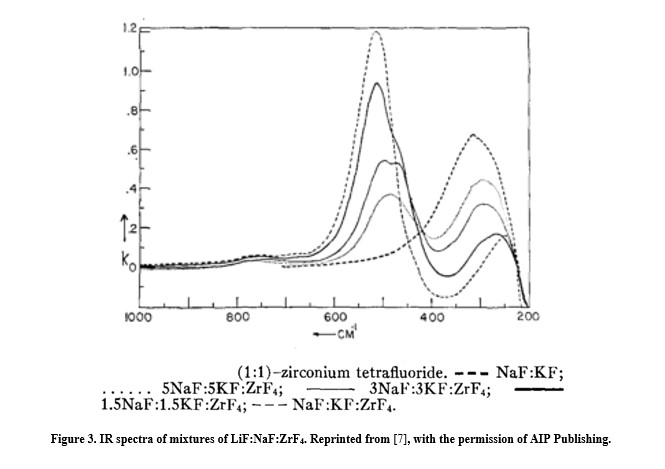
Using the previously mentioned reflectance setup [3], Wilmshurst collected data on mixtures of LiF, KF, NaF, and ZrF4 [7]. An interesting result was observed when ZrF4 was added to a NaF:KF mixture (Figure 3). At high concentration of ZrF4, there was a single large peak at 520 cm-1, but as the concentration decreased, a second peak appeared around 480 cm-1. The authors argued that in pure form ZrF4 will form a quasi-lattice structure, but that addition of Na+ and K+ cause a breakdown in the lattice and formation of a complex ion, such as ZrF62-.
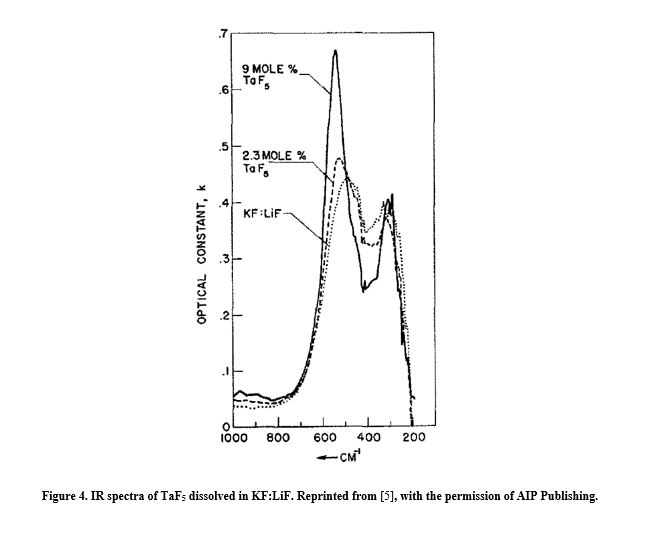
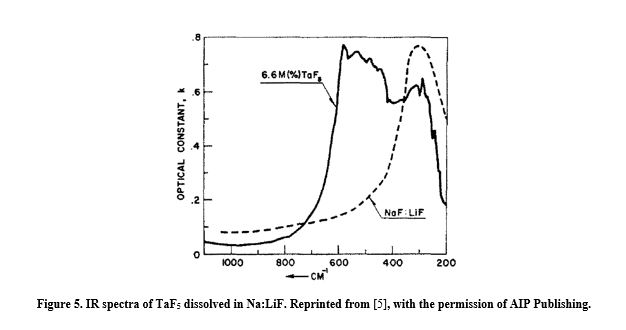
Fordyce used an adaptation of Wilmshurst’s reflectance cell to obtain IR spectra of Ta(V) dissolved in binary mixtures of KF, NaF, and LiF [5]. First, spectra of Ta(V) were obtained at varying concentration in KF:LiF (Figure 4). Next, each cation was replaced with Na+ and the procedure was repeated for the resultant melts (Figure 5). The observed spectra were compared with IR spectra of solid, crystalline K2TaF7, CsTaF6, and TaF5. It was found that with K+ present, the melt spectra approximated that of K2TaF7, and without that of CsTaF6, which are known to consist of TaF72- and TaF6- complexes, respectively.
Mead measured reflection and emission IR spectra of LiF at 30˚ C above and below the melting point (1143˚ C) using the setup of Barker [8]. Using classical oscillator (CO) theory, the optical constants of the melt were calculated and compared to the experimental data. The CO-calculated reflection spectra agreed well with the measured. The KK-derived absorption data varied compared to the previous study by Wilmshurst, and this was attributed to extrapolation errors in the latter’s KK integral.
2.3 Review of Modeling Data
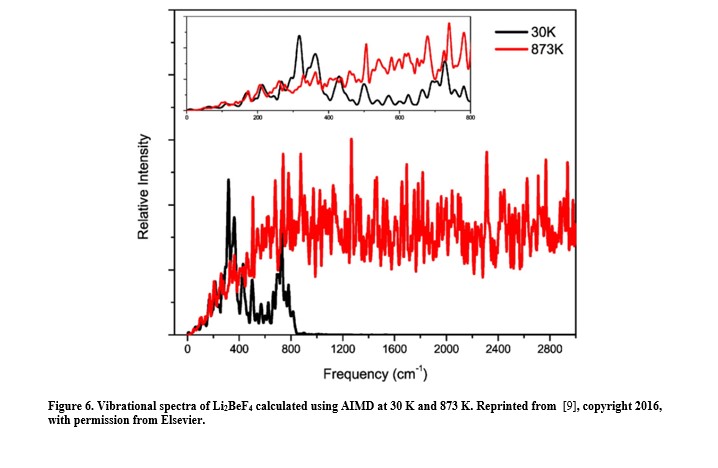
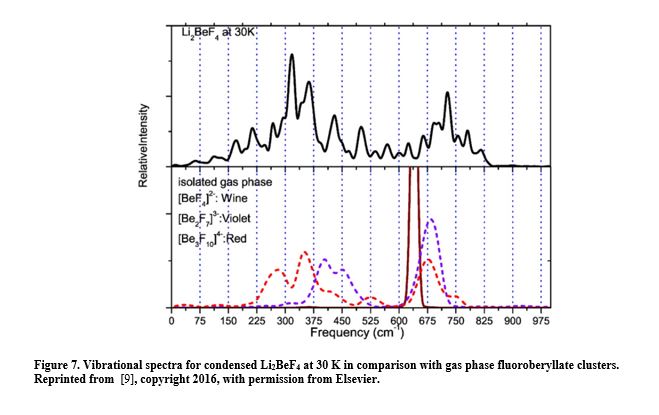
Dai et al. investigated the IR spectrum of flibe using ab initio molecular dynamics (AIMD) based on density functional theory (DFT)[9]. The aim was to compare this method with the results obtained by Salanne et al., who used a polarizable ionic interaction potential model [10]. Vibrational spectra were obtained via both AIMD and normal mode analysis (NMA) for the following local structures in the gas phase at 30 K: BeF42-, Be2F73-, and Be3F104-. The AIMD method was used again to calculate the vibrational spectra of Li2BeF4 at 30 K and 873 K (Figure 6). The high temperature spectrum displayed a lot of noise, so a low temperature spectrum was useful to identify distinct bands. The spectrum at 30 K showed similar features with the individual gas phase results, which suggested the existence of these structures in the liquid phase (Figure 7).
3 Conclusion
This review has demonstrated how different groups of researchers have successfully studied fluoride melts via IR spectroscopy. The difficulty of these endeavors has been emphasized, with regards especially to melt containment and background thermal radiation. However, the successful studies have shown to be quite powerful in their identification of both dissolved melt species and the bulk species complex structure. In addition, with recent modeling advances, there is potential for more theoretical studies based on MD and DFT to support experimental results. Therefore, IR spectroscopy appears to be a powerful and effective tool to address current research questions regarding the complex melt structure and radiative heat transfer parameters.
4 References
[1] C. Andreades, R. O. Scarlat, et al., ‘Reheat-Air Brayton Combined Cycle Power Conversion Design and Performance Under Nominal Ambient Conditions’, J. Eng. Gas Turbines Power, vol. 136, no. 6, p. 62001, (2014).
[2] P. Sabharwall, M. Ebner, et al., ‘Molten salts for high temperature reactors: University of Wisconsin molten salt corrosion and flow loop experiments – Issues identified and path forward’, no. March, p. 33, (2010).
[3] J. K. Wilmshurst, ‘Infrared Spectra of Highly Associated Liquids and the Question of Complex Ions in Fused Salts’, J. Chem. Phys., vol. 39, no. 7, pp. 1779–1788, (1963).
[4] T. S. Robinson and W. C. Price, ‘The Determination of Infra-Red Absorption Spectra from Reflection Measurements’, Proc. Phys. Soc. Sect. B, vol. 66, no. 11, pp. 969–974, (2002).
[5] J. S. Fordyce and R. L. Baum, ‘Infrared-Reflection Spectra of Molten Fluoride Solutions: Tantalum (V) in Alkali Fluorides’, J. Chem. Phys., vol. 44, no. 3, pp. 1159–1165, (1966).
[6] A. J. Barker, ‘A Compact, Windowless Reflectance Furnace for Infrared Studies of Corrosive Melts’, J. Phys. E., vol. 6, no. 3, pp. 241–244, (1973).
[7] J. K. Wilmshurst, ‘Infrared Spectra of Molten Salts’, J. Chem. Phys., vol. 39, no. 10, pp. 2545–2548, (1963).
[8] D. Mead, ‘Comparison of the Optical and Dielectric Properties of Crystalline and Molten Lithium Fluoride’, J. Phys. C Solid State Phys., vol. 7, pp. 445–453, (1973).
[9] J. Dai, H. Han, et al., ‘First-principle investigation of the structure and vibrational spectra of the local structures in LiF-BeF2 Molten Salts’, J. Mol. Liq., vol. 213, pp. 17–22, (2016).
[10] M. Salanne, C. Simon, et al., ‘A first-principles description of liquid BeF2 and its mixtures with LiF: 2. Network formation in LiF-BeF2’, J. Phys. Chem. B, vol. 110, no. 23, pp. 11461–11467, (2006).
See more of this Group/Topical: Nuclear Engineering Division - See also ICE