
Introduction
Biomass pyrolysis is a suitable pathway for the production of 2nd generation biofuels.1 During pyrolysis, one of the major products is pyrolysis oil. Due to its high water content, high corrosivity and other negative properties, pyrolysis oil needs intensive upgrading prior usage as fuel for combustion engines.2 To achieve those standards, an upgrading step is necessary. One way to do so is hydrodeoxygenation (HDO).
BiomassPyrolysisRefinery3
An overall concept for the production of 2nd generation biofuels based on liquid phase pyrolysis (LPP) is the BiomassPyrolysisRefinery concept. In the first step, lignocellulosic biomass is pyrolysed in vacuum gas oil to produce an unpolar oil, pyrolysis oil and pyrolysis char through the bioCRACK process4. In the second step, the intermediate products are upgraded5,6. The bioCRACK process was successfully operated in pilot scale (100 kg/h lignocellulosic feed) over two years. HDO of LPP oil has already been performed continuously in the temperature range of 350°C to 400°C and at liquid hourly space velocities of 0.5 h-1 to 3 h-1. To fulfill the requirements of a refinery integration, co-processing of LPP oil and refinery intermediates has to be investigated.
HDO of LPP oil and refinery intermediates
To perform co-processing in lab scale, a paraffin mix and LPP oil were used. HDO was carried out in a plug flow reactor of Parr Instrument Company on an inline-sulfided metal-oxide catalyst. Operating parameters were 121.1 bar hydrogen pressure and 400°C. Overall LHSV was 1 h-1, with 75 wt.% paraffine mix and 25 wt.% LPP oil in the feed.
In Figure 1 the boiling ranges of the HDO products are compared to the boiling range of the paraffin feed. As the paraffin feed is already highly hydrogenated, only cracking reactions occurred. It can be seen, that 25 wt.% LPP oil didn’t have a heavy impact on the product quality.
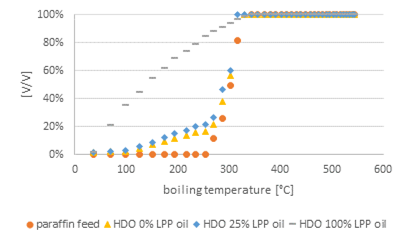
Figure 1: Boiling ranges of HDO products compared to the paraffin feed
1 A. Demirbas, Appl. Energy, 2011, 88, 17–28.
2 Q. Zhang, J. Chang, T. Wang and Y. Xu, Energy Convers. Manag., 2007, 48, 87–92.
3 N. Schwaiger, R. Feiner, H. Pucher and L. Ellmaier, 2015, 1–8.
4 J. Ritzberger, P. Pucher and N. Schwaiger, 2014, 39, 1189–1194.
5 H. Pucher, N. Schwaiger, R. Feiner, P. Pucher, L. Ellmaier and M. Siebenhofer, Energy Res., 2014, 31, 3205.
6 R. Feiner, N. Schwaiger, H. Pucher and L. Ellmaier, 2013, 43, 1–6.
See more of this Group/Topical: Fuels and Petrochemicals Division