
Abstract
Chemical looping combustion (CLC) technology is being perused as a promising clean and high efficiency method of power generation [1]. This technology has already been researched extensively for gaseous fuels, but has more recently drawn interest in solids fuel. The basis of CLC is to supply oxygen to the fuel reaction process via solid “oxygen carriers” preventing air from the reaction. The “oxygen carrier” is oxidized in an air reactor which is separate from the fuel reactor and then looped through the fuel reactor where it is reduced, thus providing pure oxygen for combustion of the solid fuel. As a benign benefit of the CLC process is the potential for significant reduction to carbon capture penalties due to the flue gas consisting of mainly CO2 and H2O. Therefore, the H2O in the flue gas can be condensed leading to efficient separation and capture of the CO2.
One issue with solid fuel CLC is that typical combustion beds are estimated to produce 1% of unburnt carbon in the flow stream. In a CLC reactor, the ash/char has the potential to be carried to the air reactor along with the oxidizer material resulting in an efficiency penalty. Therefore, the US DOE has a set a goal to demonstrate that over 90% of the unburnt carbon can be separated from the oxygen carrier being transported back into the air reactor. To meet this objective, multiple fluidized bed technologies are being pursued. Among them is a bubbling bed to measure steady state elutriation rates. Elutriation rates of binary materials in bubbling beds have been studied in the past [2], but most consist of a batch process methodology that only investigate transient elutriation rates. Steady state elutriation rates are need to assess the separation performance of a continuous process.
To investigate the steady state elutriation process of a binary mixture a cold flow bubbling bed riser model was constructed. A rendering of the bed is provided in Figure 1 which consists of a 180 cm riser with a 10 cm diameter and a distributor plate with 32 holes with 0.159 cm diameters. A cyclone is in series with exit port of the riser to drive elutriated particles into a collection bin. To achieve quasi steady state conditions three overflow ports of about 15, 25, and 36 cm heights are built into lower portion of the riser to maintain consistent fluidized bed heights as binary solids mixtures are continuously screw fed into the system. Digital scales are used in both the cyclone collection and the overflow bins to measure the elutriation rate of particles and the bed overfill. The particles considered for this effort consist of a plastic ZQ-17 “Day-glow” to simulate unburnt carbon, and two different sizes of glass beads (P-0230 and P-0337) with the particle properties given in Table 1 to simulate potential size ranges of oxygen carriers. Parameters currently considered for investigation include varying the gas velocity within the region of bubbling for the glass beads and varying the concentration of the day-glow particles between 1% and 5% of the total mass.
Current test methodology consists of prefilling the bed to a desired static bed height with the particle mixture. A constant fed rate was set to feed the same mixture into the bed while a constant gas flow was supplied. The system is operated for a set period of time to allow steady state conditions to be reached with the goal of measuring the time dependent weight of the elutriated particles. The gas velocities considered for these tests should be within the bubbling regime of the glass bead particles.
A series of preliminary runs have been performed with a mixture of P-0337 with 5% ZQ-17 particles by mass at gas velocities of 45 and 62 cm/sec. Both of these velocities are within the bubbling regime of the P-0337 particles. The mixture feed rate the system was 1.5 g/sec to maintain a desired fluidized bed height of 25 cm for both runs. Initial results show promising separation performance. Figure 2 shows the system prefilled with the mixture prior to running the system post run. The ZQ-17 is yellow so the post image run clearly demonstrates that this material was entrained and achieved some elutriation based on material that adhered to the surfaces and the a nominal 0.635 cm sedimentation on top of the bed.
Steady state elutriation rates are needed to assess the performance of continuous particle separation techniques. A cold flow bubbling bed was designed and built to achieve this in order to help achieve the NETL DOE goal of 90% carbon removal from oxygen carriers in a CLC. Initial results show promise in separation of fines analogous to carbon from larger particles.
References
[1] H.E.J. Andrus, J.H. Chiu, P.R. Thibeault, A. Brutsch, Akstom’s calcium oxide chemical looping combustion coal power technology development, Proceedings of the 34th International Technical Conference on Clean Coal and Fuel Systems, May31 – June 4, 2009 (Clearwater FL).
[2] E.R. Monazam, R.W. Breault, J.M. Weber, K. Layfield, Elutriation of fines from binary particle mixtures in bubbling fluidized bed cold model, Powder Technology 305 (2017) 340-346.
Table 1 – Particle physical properties where SMD is sauter mean diameter).
Material | Size Range (μm) | Density (kg/m3) | Sphericity (-) | Ut_estimated (m/s) | |||
Max | Min | SMD | Largest | Smallest | |||
Glass Beads (P-0230) | 600 | 430 | 550 | 2500 | 0.94 | 4.25 | 0.13 |
Glass Beads (P-0337) | 850 | 600 | 707 | 2500 | 0.94 | 6.31 | 0.24 |
Day-glow (ZQ-17) | 60 | 20 | 39 | 1200 | 0.74 | 0.18 | 1.4E-4 |
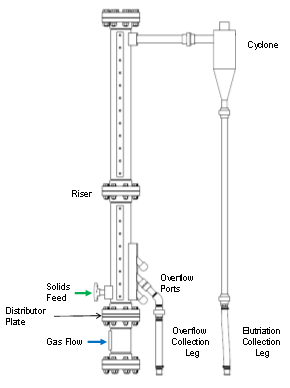
Figure 1 – Schematic of 10 cm diameter continuous bubbling bed
|
|
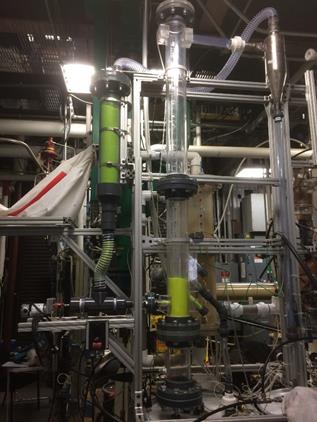
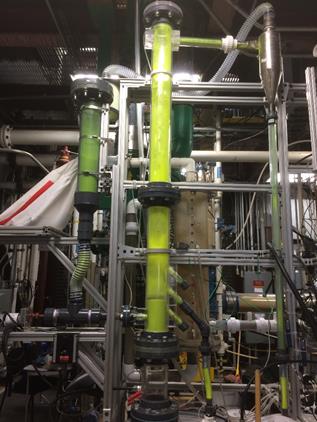
Figure 2 – Continuous bubbling bed, Left: pre-run, Right: Post run
See more of this Group/Topical: Separations Division