
Ultrasound-assisted crystallization in a two-stage continuous MSMPR crystallizer system
Zhenguo Gao 1,2※ Dan Zhu 1,2※ Yuanyi Wu 1 Sohrab Rohani 1* Junbo Gong 2, Jingkang Wang 2
1. The University of Western Ontario, Department of Chemical and Biochemical Engineering, London, Ontario N6A 5B9, Canada
2. Tianjin University, School of Chemical Engineering and Technology, Tianjin, 300072, P. R. China
※ Authors have contributed the same on this paper.
* Corresponding author. Email: srohani@uwo.ca
Keywords: Ultrasonic irradiation, Continuous crystallization, Crystal size distribution
Introduction
Continuous pharmaceuticals manufacturing is an attractive method to improve product quality, consistency and also process efficiency and robustness. Since the promotion proposed by U.S. Food and Drug Administration (FDA) to integrate continuous manufacturing into pharmaceutical production and the practices implemented by leading pharmaceutical companies e.g. Vertex and Novartis, there has been a growing interest in transforming a batch production plant into a continuous process in pharmaceutical industry (Adamo et al., 2016; Mascia et al., 2013). Compared with a batch process, which contains many intermittent steps, a continuous process shows its advantages in better product quality and consistency, greater process robustness and safety, lower cost and higher efficiency. Continuous crystallization as a key unit operation to optimize solid product quality e.g. purity, polymorphism, size/size distribution and stability, has been attempted in several geometries. Sigle stage or multistage mixed suspension mixed product removal (MSMPR) crystallizers have been studied to optimize the process efficiency and product quality (Alvarez et al., 2011; Wong et al., 2012). A continuous tubular crystallizer has shown potential application because of optimizing mixing performance, supersaturation profile and diminishing shear force. Oscillatory baffled crystallizer (OBC) has been successfully commercialized and various strategies such as seeded, self-seeded, laminar, plug flow etc., have been studied (Besenhard et al., 2015; McGlone et al., 2015).
Studies have proven that ultrasonic irradiation affects nucleation and growth during crystallization process (Castro and Priego-Capote, 2007; Bhangu et al., 2016). The shock wave caused by cavitation of ultrasonic irradiation can promote nucleation at a lower supersaturation level and a shortened induction time. This promotes nucleation, which would result in a smaller size crystal. The ultrasonic irradiation would also help to separate crystals at high surface tension to prevent agglomeration (Narducci et al., 2011). Thus, with the help of ultrasound, a smaller crystal size and a narrower crystal size distribution (CSD) would result in a short time. In general, bigger crystals with narrower CSD are preferred considering purity and downstream processing in pharmaceutical industry. Therefore, in this study, a two-stage continuous MSMPR crystallizer series is used in which uniform small crystals are produced in the first stage and further grow in the second stage. In the present study, large α-form L-glutamic acid crystals around 150 μm were obtained with a narrow CSD and a higher process efficiency.
Experiments and Discussions
The two-stage continuous MSMPR crystallizer series was built to optimized the CSD of α-form L-glutamic acid (Alfa Aesar, USA) in this study. The schematic of experimental setup is shown in Figure 1. The first step was to prepare the saturated solution (3.0 g/L) in the feed tank, and then flowed through (50 mL/min) the two-stage MSMPR crystallizers with the help of two peristaltic pumps. The first stage MSMPR crystallizer was coupled with an ultrasonic processor (20KHz, 14-30W, VCX 500, Sonic & Materials Inc., USA) to promote nucleation and also to optimize the size and population of crystals by tuning the residence time and the intensity of ultrasonic irradiation (with and without pause). A magnetic stirrer (200 rpm, Cimarec+TM, Thermo Fisher Scientific, USA) was used to provide moderate mixing to keep the crystals suspended. In-situ focused beam reflectance measurement (FBRM, S400, Mettler Toledo, USA) was used to measure the size/chord length and population/FBRM counts per sec to characterize the crystal slurry in the two-stage MSMPR crystallizers. There was a moderate mechanical stirring (200 rpm, a four-bladed stirrer, 45° blade angle) in the second stage MMSPR crystallizer. Further characterizations like scanning electron microscope, laser scattering crystal size measurement etc., were conducted to characterize the crystalline product and optimize the performance of the system.
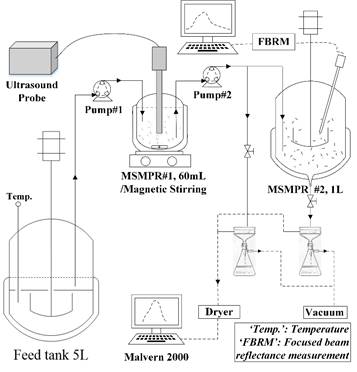
Figure 1. Schematic of experimental setup of two-stage ultrasound assisted MSMPR crystallizer series.
With the help of ultrasonic irradiation, the nucleation occurs easily (short induction time and lower supersaturation level required). As shown in Figure 2, there are four lines that indicate the free energy required by primary nucleation, secondary nucleation, nucleation under ultrasonic irradiation and crystal growth, respectively. The primary nucleation requires the highest free energy in contrast to crystal growth which requires the least free energy. This shows that primary nuclei are difficult to generate as well as hard to control. Crystals grow in any supersaturated solution. In this system, the ultrasound-assisted nucleation occurred in the first stage MSMPR crystallizer, which required lower free energy compared with primary and secondary nucleation (Jiang, 2012). In the second stage MSMPR crystallizer, secondary nucleation will not occur in the crystal slurry since the free energy required was not sufficient. In the presence of moderate mechanical stirring in the second stage, there is a difference of required free energy for nucleation between those two stages, as shown in Figure 2. Thus, the transferred crystal slurry from first stage to second would not generate secondary nucleation appreciably because of higher free energy required with the moderate mechanical mixing. The crystals from the first stage with narrow distribution would further grow in the second stage without significant breakage. The inserted images (a) and (b) are micrographs of the crystals at the outlet of the two stages. Uniform crystals around 35µm were obtained under paused ultrasonic irradiation (15s on, 10s off, 15W, residence time one minute) in the first stage, and the crystals grew to 150 µm without obvious breakage and agglomeration.
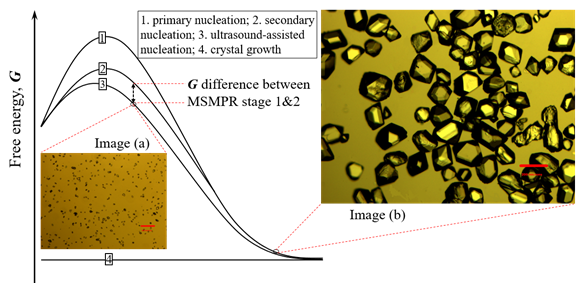
Figure 2. Schematic analysis of free energy required by different kinds of nucleation processes and corresponding operation point in the two-stage MSMPR crystallizer system. Image (a) and (b) are crystals at the outlet of the first stage and the second stage MSMPR crystallizer. The scale bar is 200 microns.
Conclusions
In this study, a two-stage continuous MSMPR crystallizer system was used to optimize the CSD of α-form L-glutamic acid and to improve the process efficiency with the help of ultrasonic irradiation. The final product crystals around 150 µm were obtained with a narrow crystal size distribution. The total residence time in this system was 5 to 15 minutes, which is an obvious improvement of process efficiency with the help of ultrasonic irradiation. With the improved crystal qualities and process efficiency, challenges still exist in continuous crystallization process: i) a long time may be required to reach steady state; ii) any unexpected process malfunction may cause the shut down of the whole production process; iii) there is a limited application in small scale, low output systems, especially for newly released drugs. The properties of model compound are highly dependent on the design of continuous crystallization process and operation recipe.
Acknowledgments
The authors acknowledge the financial support provided by the Natural Science and Engineering Research Council (NSERC) of Canada and the China Scholarship Council.
References
Adamo, A., Beingessner, R.L., Behnam, M., Chen, J., Jamison, T.F., Jensen, K.F., Monbaliu, J.-C.M.C., Myerson, A.S., Revalor, E.M., Snead, D.R., Stelzer, T., Weeranoppanant, N., Wong, S.Y., Zhang, P., 2016. On-demand continuous-flow production of pharmaceuticals in a compact, reconfigurable system. Science 352, 61–7.
Alvarez, A., Singh, A., Myerson, A., 2011. Crystallization of Cyclosporine in a Multistage Continuous MSMPR Crystallizer. Cryst Growth Des 11, 4392–4400.
Besenhard, M., Neugebauer, P., Ho, C.-D., Khinast, J., 2015. Crystal Size Control in a Continuous Tubular Crystallizer. Crystal Growth & Design 15, 1683–1691.
Bhangu, S., Ashokkumar, M., Lee, J., 2016. Ultrasound Assisted Crystallization of Paracetamol: Crystal Size Distribution and Polymorph Control. Cryst Growth Des 16, 1934–1941.
Castro, M.D., Priego-Capote, F., 2007. Ultrasound-assisted crystallization (sonocrystallization). Ultrason Sonochem 14, 717–724.
Jiang, S., 2012. An Examination of Sonocrystallization Kinetics of L-Glutamic Acid. University of Leeds.
Mascia, S., Heider, P.L., Zhang, H., Lakerveld, R., Benyahia, B., Barton, P.I., Braatz, R.D., Cooney, C.L., Evans, J.M., Jamison, T.F., Jensen, K.F., Myerson, A.S., Trout, B.L., 2013. End-to-end continuous manufacturing of pharmaceuticals: integrated synthesis, purification, and final dosage formation. Angew. Chem. Int. Ed. Engl. 52, 12359–63.
McGlone, T., Briggs, N., Clark, C., Brown, C., Sefcik, J., Florence, A., 2015. Oscillatory Flow Reactors (OFRs) for Continuous Manufacturing and Crystallization. Organic Process Research & Development 19, 1186–1202.
Narducci, O., Jones, A.G., Kougoulos, E., 2011. Continuous crystallization of adipic acid with ultrasound. Chem Eng Sci 66, 1069–1076.
Wong, S., Tatusko, A., Trout, B., Myerson, A., 2012. Development of Continuous Crystallization Processes Using a Single-Stage Mixed-Suspension, Mixed-Product Removal Crystallizer with Recycle. Cryst Growth Des 12, 5701–5707.
See more of this Group/Topical: Separations Division