
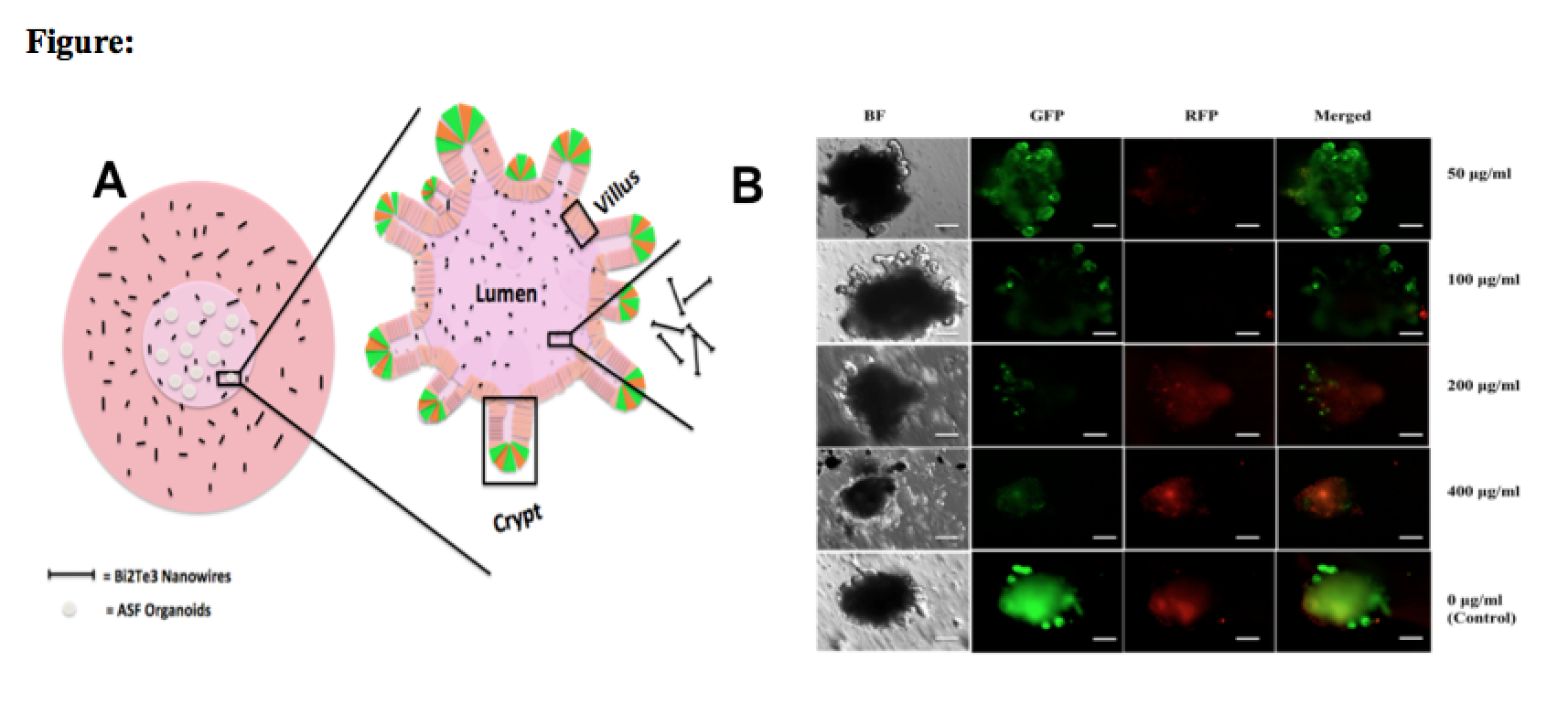
Introduction: Telluride nanowires have many potential applications owing to their unique electronical, optical, and thermal properties. However, their use in medical applications is seldom considered due to the unclearness of their nanotoxicity. In this study, we demonstrated a case study on Bi2Te3 nanowires. Through live/dead cell viability testing and surface area analysis, we showed that 50 μg/mL Bi2Te3 exerts minimum influence on shrinking crypts. Figure A is a scheme of the experiment.
Methods: Primary small intestinal crypts were isolated from mouse small intestine. A 10mm small intestine was taken out and cut in pieces of 1 mm to 2 mm in length and washed five times using ice-cold PBS. Crypts were isolated, implanted within Matrigel on a pre-incubated 24-well plastic plate. Nanowires were added on the seventh day of growth.
Results: Figure B shows the live/dead cell images, where green indicates live cells and red indicates dead cells. Upon comparing the merged images of each concentration with those of the control, 200 μg/mL and 400 μg/mL showed more cells stained red and less cells stained green, which indicates that most of the cells were unhealthy. 50 μg/mL showed no significant difference compared with the control, which further indicates nanowires at 50 μg/mL pose the least harm to organoids and can be used as the optimal concentration.
Conclusions: We have demonstrated that Bi2Te3 nanowires at 50 μg/mL possess minimal cytotoxicity for organoids. Due to the toxicity of nanowires, concentration intake is limited. Because of their small size, nanowires can be constructed into any desired shape. They could be engineered into a microvillus-like shape for nutrition supply. Certain types of nanowires with unique thermoelectric properties could be incorporated into organoids and provide electrical/thermo potential, which can be utilized to manipulate the functionality of organoids.
Figure:
See more of this Group/Topical: Food, Pharmaceutical & Bioengineering Division