
Polymer electrolyte membrane fuel cells (PEMFCs) have received significant attention in recent years due to high efficiency and low emissions. The proton exchange membrane (PEM) is one of the key components that of significant importance to the fuel cell performance, which is electron insulating while proton conductive and should prevent the crossover of fuels and oxidant, as well as stable in the fuel cell operation environment[1]. Radiation induced graft (RIG) is a versatile method to modify pre-existing polymers to introduce a variety of desired functionalities, and has been studied to prepare PEM[2].
In this work, PEM was prepared by RIG polymerization of styrene onto FEP base polymer followed by sulfonation using chlorosulfonic acid. The graft polymerization was performed by immersing the FEP films into a series of styrene solutions and submit to the 60Co radiation source. The sulfonated FEP-g-polystyrene membranes exhibited much higher proton conductivity than Nafion 211 as shown in Fig.1(a). And the membrane prepared in 40%v/v solution showed better fuel cell performance than Nafion 211 under the same test conditions in Fig.1(b).
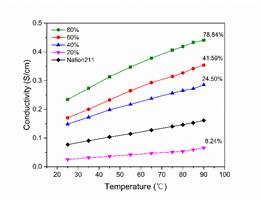
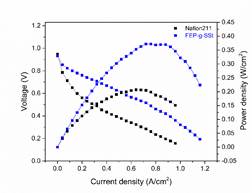
Fig.1 (a) Proton conductivity of the sulfonated FEP-g-polystyrene grafting in solutions of different concentration in comparing with Nafion 211. The corresponding degrees of graft were listed alongside. (b) Polarization curve of the sulfonated FEP-g-polystyrene in comparison with Nafion 211, catalyst loading is 0.6mgPt/cm2 and H2/air was used in the fuel cell test.
Also elucidation of the mechanism of membrane degradation is an active area of research. Current papers have proposed a degradation mechanism that involves attack of oxygen radicals on susceptible groups in the polymer backbone [3].In this work, Fenton¡¯s test was conducted using 30% H2O2 and 10ppm Fe2+. And the membranes were also tested in fuel cell operation conditions. The resulting solution of Fenton test and water collected at the anode and cathode were analyzed for fluoride ion content using an ion chromatography system. XPS, FTIR and SEM were also used to characterize the degraded membrane.
Previous work has suggested that hydroxyl free radicals can attack polymer end groups having H-containing terminal bonds (such as -CF2COOH) that are formed during membrane processing[4]. Here we would use quantum chemical simulations to elucidate degradation mechanism of the sulfonated FEP-g-polystyrene membrane suffered to the ¡¤OH and ¡¤OOH radical attack by searching the transition state of different reaction pathways.
Keywords: radiation induced graft, FEP-g-polystyrene, chemical degradation, quantum chemical calculation
Acknowledgements: This work was supported by the Intergovernmental International Scientific and Technological Innovation Cooperation Key Projects (2016YFE0102700) and National Natural Science Foundation of China (51573083).
[1] Zhang L, Chae S, Hendren Z, Park J, Wiesner MR. Recent advances in proton exchange membranes for fuel cell applications. Chem Eng J, 2012, 204-206: 87-97.
[2] Gubler L. Polymer Design Strategies for Radiation-Grafted Fuel Cell Membranes. Advanced Energy Materials, 2014, 4(3): 1441-1443.
[3] Healy J, Hayden C, Xie T, Olson K, Waldo R, Brundage A, Gasteiger HA, Abbott J. Aspects of the Chemical Degradation of PFSA Ionomers used in PEM Fuel Cells[J]. Fuel Cells, 2005, 5(2):302-308.
[4] Curtin DE, Lousenberg RD, Henry TJ, Tangeman PC, Tisack ME. Advanced materials for improved pemfc performance and life. Journal of Power Sources, 2004, 131(1-2), 41-48.
See more of this Group/Topical: Transport and Energy Processes