
Enhancing the Oxidation of Toluene with External Electric Fields: a Reactive Molecular Dynamics Study
Shen Tan, Tao Xia, Yao Shi, and Yi He*
College of Chemical and Biological Engineering, Zhejiang University, Hangzhou, 310027, P. R. China
*Corresponding author: yihezj@zju.edu.cn
Tuning chemical reactions with external electric field (Efield) has long been a desirable goal for researchers. Molecular simulation methods based on reactive force fields (ReaxFF) is recently developed for the study of chemical reactions in large systems at a micro-scale. To this end, the effects of Efields on chemical reactions were studied with the ReaxFF MD simulations by using the oxidation of toluene as a model system. We observed that Efields may greatly enhance the oxidation rate of toluene. The initial reaction time of toluene is also reduced remarkably in Efields. A stronger Efield leads to a faster oxidation rate of toluene. Further studies reveal that the applying of Efields may results in the oxidation of toluene at 2100 K which is otherwise not able to happen when Efield is not at present. The oxidation rate of toluene at 2100 K in Efield is comparable with the oxidation rate of toluene at 2900 K when Efield is not applied. In addition, Efield was observed to significantly enhance the occurrence of the initial radical generation for different pathways of toluene oxidation but it does not seem to favor any of the pathways. Finally, Efields do not seem to enhance the polarization of toluene during its transition state, which suggests that a polarizable charge equilibration method (QEq) method might be needed to take the effects of Efields into consideration.
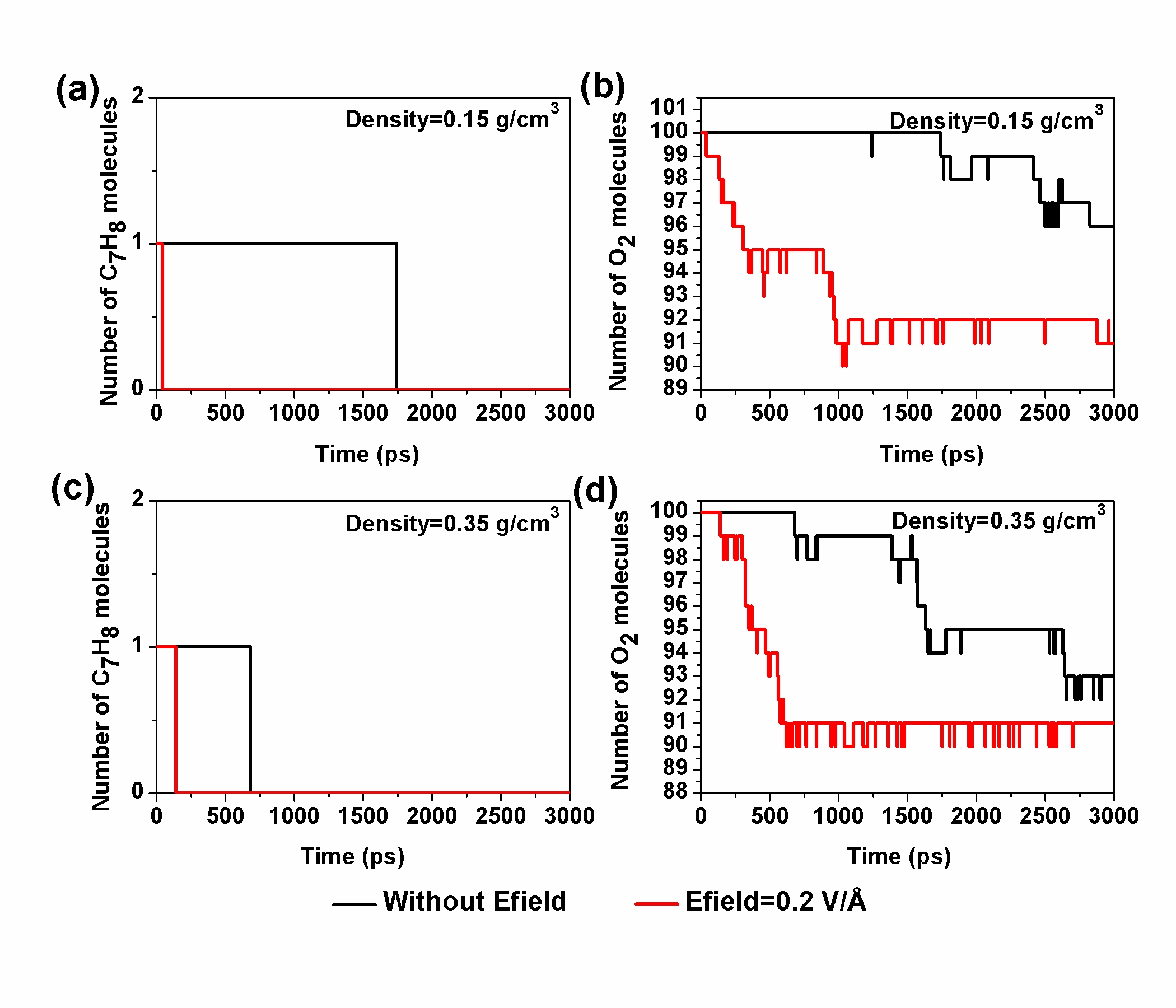
Figure. 1 Evolution of the toluene and oxygen molecules at density ¦Ñ = 0.15, 0.35 g/cm3, Efield = 0, 0.2 V/Å (ReaxFF NVT-MD simulation, T = 2500 K, toluene/oxygen = 1:100).
See more of this Group/Topical: Computational Molecular Science and Engineering Forum