
Pervaporation has been a significant technology in recent years with wide industrial applications in organic dehydration especially for separating azeotropic, close-boiling, isomeric and heat sensitive liquid mixtures. Among these organic-water systems, ethanol dehydration is one of the most challenging problems as an azeotrope can be formed when traditional distillation is employed. Complete separation is hardly to achieve. In comparison, utilizing membranes for pervaporation can greatly reduce the energy consumption and realize desired separation effect. Compared with inorganic materials, organic membranes have already been applied in the water-ethanol separation field due to their prominent superiorities such as extensive availability of raw materials, facile processability, and suitability for large-scale production.
Conventional hydrophilic polymers used for ethanol dehydration mainly include poly(vinyl alcohol) (PVA), chitosan (CS), polyacrylonitrile (PAN), polyacrylic acid (PAA), and sodium carboxymethyl cellulose (CMCNa) [1, 2] etc. Among them, PVA, applied for commercial areas already, was the most attractive and economical material, since its high hydrophilicity, facile film-forming ability, thermal and chemical-resistance, and low manufacturing cost. However tiny free volume, low selectivity, and poor stability in aqueous solution made its pervaporation performance not as satisfactory as expected.
To obtain an ideal performance of ethanol dehydration, the difference of physical and chemical properties in ethanol and water must be fully exploited, the most distinct of which is polarity. Meanwhile, in order to ensure a higher flux, a novel organic membrane should possess large free volume, attracting water molecules and allowing it to pass quickly while rejecting ethanol molecules. Considering above factors, polymers with higher charge densities are likely to have the potential to meet these requirements. Focusing on this, the polyelectrolyte complexes (PECs), which have been paid close attention in recent years, are an promising candidate to be selected to prepare novel pervaporation membranes for ethanol dehydration.
PECs are a sort of multicomponent polymers with many ionizable groups in backbones, which could be applied in many fields such as gene/DNA delivery, drug release, protein adsorption, microencapsulation, pervaporation, and fuel cells [3, 4]. Because of their both good hydrophilicity and ionic cross-linking structure, the former can ensure a larger flux, while the latter favors a higher selectivity by limiting the excessive swelling and the counterions loss. Therefore, they are a kind of excellent material and very suitable for ethanol dehydration. Nevertheless, traditional strategies to prepare polyelectrolyte complex membranes (PECMs), i.e., layer-by-layer assembly and excessive acid blending method [5], could not realize notable pervaporation performance owing to the underutilization of charges of ionized groups. Thus, new methods to synthesize innovative PECM have been constantly explored in scientific community.
For the past few years, Zhao et al. [6, 7] proposed a new route, so-called protection-deprotection, to fabricate soluble and processable PECs, and homogeneous polyelectrolyte complex membranes (HPECMs). As it worked out the key question of PECs, many distinguished properties, i.e., no glass transition, high hydrophilicity, tunable surface charge, and structural stability could be further developed to design novel functional materials. Along this way, several kinds of needle-like PECs, sizes of which ranged from 300 to 700 nm, and HPECMs based on CMCNa for polyanions were synthesized [8-12]. Preferable performances were already obtained in ethanol, isopropanol, acetone, and dioxane dehydration compared with these of membranes prepared by conventional methods.
However, in view of particle characteristics, the larger size and the anisotropy of needle-like PECs cause the nonuniform distribution of long-range arrangement as well as charge densities, which will weaken dehydration performance to a certain extent. In contrast, we speculate that smaller sphere-like PEC particles can avoid these problems ingeniously. It is believed that tiny spherical PECs should possess higher charge density, spatial isotropy, and long-range homogeneity. All of these are beneficial to enhance pervaporation performance of HPECMs. By controlling operating conditions, such as temperature and stirring speed, the conformation of polyelectrolytes in solution will change and PECs with different morphologies can be further generated [13, 14].
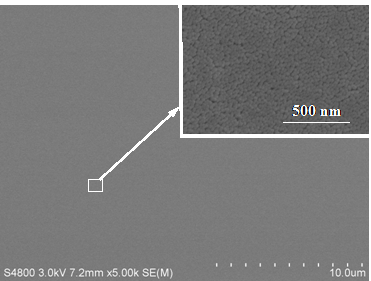
Fig. 1. FESEM image of HPECM0.31 surface with a magnified top-view insert.
The effect of conformation and morphology of HPECMs on pervaporation performance in ethanol dehydration was researched. Based on sodium carboxymethyl cellulose (CMCNa) and poly(diallyldimethylammonium chloride) (PDDA), a series of sphere-like PEC particles with a diameter between 30-50 nm, and HPECMs with tunable compositions or ionic complexation degrees (ICD) were prepared, as shown in Fig. 1. The properties of HPECMs were varied obviously with ICD ranging from 0.23 to 0.57. With the increase of ICD, water contact angles decreased while the tendency of Zeta potential was just opposite, indicating that both the hydrophilicity and charge densities were strengthened. This was exactly contrary to the characteristics of those needle-like PECs and HPECMs. When subjected to ethanol dehydration, sphere-like morphology HPECMs revealed more superior pervaporation performance and desired anti-trade-off phenomenon, as seen from Fig. 2. The flux increased rapidly, while the water content in permeate remained basically unchanged and were always kept above 99.30 wt% in the range of 17-70 ºC. For HPECM0.31 and HPECM0.57, the permeation fluxes were 2.25 kg·m-2·h-1 and 2.93 kg·m-2·h-1, and the water concentration in permeate reached up to 99.35 wt% and 99.38 wt%, respectively, with 10 wt% water in feed at 70 ºC. Under the premise of maintaining similar separation effect, the flux of spherical morphology HPECMs in this work was nearly as twice as that of needle-like HPECMs and about 10-15 times higher than that of traditional PVA and CS membranes. Interestingly, the HPECMs flux of this study was even much bigger than part of inorganic membranes and hybrid membranes, almost 1-2.5 times higher, and the selectivity was also outstanding to the majority of them. Moreover, excellent separation effect, good repeatability and stable performance could be continuously retained in practical operation. All these results implied that sphere-like PEC particles and isotropic HPECMs were indeed in favor of enhancing pervaporation performance in ethanol dehydration.
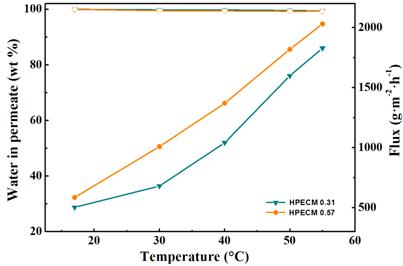
Fig. 2. Effect of operating temperature on flux (solid) and water in permeate (hollow) of
HPECM0.31 (triangle) and HPECM0.57 (circle) for ethanol dehydration with 10 wt% water in feed.
Acknowledgements
This work was supported by the National Natural Science Foundation of China (Grant No. 21136008).
References
[1] Bolto B., Hoang M., Xie Z. L. A review of membrane selection for the dehydration of aqueous ethanol by pervaporation. Chem. Eng. Process. 50 (2011) 227-235.
[2] Chapman P. D., Oliveira T., Livingston A. G., Li K. Membranes for the dehydration of solvents by pervaporation. J. Membr. Sci. 318 (2008) 5-37.
[3] Tsai H., Chen W., Kuo C., Lee K., Lai J. Study on the pervaporation performance and long-term stability of aqueous iso-propanol solution through chitosan/polyacrylonitrile hollow fiber membrane. J. Membr. Sci. 309 (2008) 146-155.
[4] Kishimura A., Koide A., Osada K., Yamasaki Y., Kataoka K. Encapsulation of myoglobin in PEGylated polyion complex vesicles made from a pair of oppositely charged block lonomers: A physiologically available oxygen carrier. Angew. Chem. Int. Ed. 46 (2007) 6085-6088.
[5] Zhao Q., An Q. F., Ji Y. L., Qian J. W., Gao C. J. Polyelectrolyte complex membranes for pervaporation, nanofiltration and fuel cell applications. J. Membr. Sci. 379 (2011) 19-45.
[6] Zhao Q., Qian J. W., An Q. F., Yang Q., Zhang P. A facile route for fabricating novel polyelectrolyte complex membrane with high pervaporation performance in isopropanol dehydration. J. Membr. Sci. 320 (2008) 8-12.
[7] Zhao Q., Qian J. W., An Q. F., Gui Z. L., Jin H. T., Yin M. J. Pervaporation dehydration of isopropanol using homogeneous polyelectrolyte complex membranes of poly(diallyldimethylammonium chloride)/sodium carboxymethyl cellulose. J. Membr. Sci. 329 (2009) 175-182.
[8] Zhao Q., Qian J. W., An Q. F., Gao C. J., Gui Z. L., Jin H. T. Synthesis and characterization of soluble chitosan/sodium carboxymethyl cellulose polyelectrolyte complexes and the pervaporation dehydration of their homogeneous membranes. J. Membr. Sci. 333 (2009) 68-78.
[9] Wang X. S., An Q. F., Zhao Q., Lee K., Qian J. W., Gao C. J. Homogenous polyelectrolyte complex membranes incorporated with strong ion-pairs with high pervaporation performance for dehydration of ethanol. J. Membr. Sci. 435 (2013) 71-79.
[10] Wang X. S., An Q. F., Liu T., Zhao Q., Hung W., Lee K., Gao C. J. Novel polyelectrolyte complex membranes containing free sulfate groups with improved pervaporation dehydration of ethanol. J. Membr. Sci. 452 (2014) 73-81.
[11] Jin H. T., An Q. F., Zhao Q., Qian J. W., Zhu M. H. Pervaporation dehydration of ethanol by using polyelectrolyte complex membranes based on poly (N-ethyl-4-vinylpyridinium bromide) and sodium carboxymethyl cellulose. J. Membr. Sci. 347 (2010) 183-192.
[12] Liu T., An Q. F., Zhao Q., Lee K., Zhu B. K., Qian J. W., Gao C. J. Preparation and characterization of polyelectrolyte complex membranes bearing alkyl side chains for the pervaporation dehydration of alcohols. J. Membr. Sci. 429 (2013) 181-189.
[13] Starchenko V., Muller M., Lebovka N. Growth of Polyelectrolyte Complex Nanoparticles: Computer Simulations and Experiments. J. Phys. Chem. C. 112 (2008) 8863-8869.
[14] Muller M., Reihs T., Ouyang W. Needlelike and Spherical Polyelectrolyte Complex Nanoparticles of Poly(L-lysine) and Copolymers of Maleic Acid. Langmuir. 21 (2005) 465-469.
See more of this Group/Topical: 2017 International Congress on Energy