
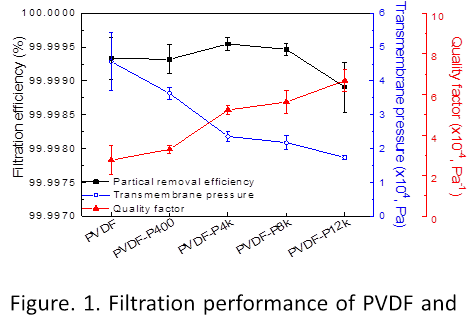
The particulate matter (PM) air pollution has become a global issue in the last few decades. Various techniques, such as electron spun air filters have been developed to remove PM from the air. However, limited studies focused on filtration of small particles ( < 0.3 mm) which are more toxic to human. Compared to conventional fibers filter media, hollow fibers feature of self-supported properties with tunable pore sizes, making hollow fibers a good candidate for filtration processes. Until now, limited studies have worked on particle-laden gas filtration using hollow fibers. This study reveals as the first attempt to apply hollow fibers for air filtration of ultrafine particles. The asymmetric polyvinylidene fluoride - polyethylene glycol (PVDF-PEG) hollow fibers with high gas permeance have been developed. In order to increase the gas permeance of hollow fibers for air filtration, different molecular weight of PEGs was added into spinning dopes. The addition of PEGs facilitate the formation of loosely connected cross-section and porous outer skin, thus enhances the gas permeance for air filtration. Under the inside-out testing mode, all PVDF-PEG hollow fibers display excellent filtration efficiency of 99.999% against polydispersed NaCl particles with a geometric mean size of ~30 nm (Figure 1). This study may provide useful insights for developing hollow fibers for air filtration with the optimal operation conditions.
 |
See more of this Group/Topical: Environmental Division