Production of Hydrogen-rich SynGas from
Steam Reforming of Acetone over Ni-Co-Mg-Al Hydrotalcite Catalysts
Sanchari Basu and Narayan C.
Pradhan
Department of Chemical Engineering,
Indian Institute of Technology,
Kharagpur - 721302, India.
E-mail:88sanchari@gmail.com,
ncp@che.iitkgp.ernet.in
Abstract
In
present time, the world is witnessing gradual exhaustion of conventional fossil
fuels.This is driving us to look for alternate sources of energy. Hydrogen is a
potential source of green energy. Today the most common process for hydrogen
generation is the catalytic steam reforming of smaller hydrocarbons and
alcohols such as methane, ethane, methanol, ethanol, glycerol, etc. The
prominent catalysts for steam reforming are nickel supported on various oxides,
hydrotalcites, etc. There are very few work reported on steam reforming of
acetone, which is a low-cost by product of the cumene route for phenol. Also,
acetone is an important intermediate in ethanol and acetic acid steam
reforming. So, acetone steam reforming process can provide a better
understanding of ethanol and acetic acid steam reforming processes.
In
the present work, the steam reforming of acetone has been investigated over Ni-Co-Mg-Al
hydrotalcite catalysts. The catalysts were made by varying the Ni:Co mole ratio
(0.33, 1 and 3). Co-precipitation
method was used to prepare the catalysts. The synthesized catalysts were
characterized by XRD, N2-BET, FESEM-EDS, FTIR and H2-TPR
techniques. CHNS analysis was performed to estimate the extent of carbon
deposition on the spent catalyst. The steam reforming activity was evaluated in
a continuous packed bed reactor at atmospheric pressure. The operating
parameters were temperature, 450 oC - 550 oC;
water/acetone molar ratio, 6 and space-time, 12.10 kg cat h/kmol acetone. The
reactant and product compositions were determined by gas chromatography. Initially,
the experiments were conducted at 550oC to compare the activities of
different catalysts as shown in Figure 1. All the catalysts exhibited around
99% conversion. The methane selectivity was very less
for all the catalysts. However,
a maximum hydrogen selectivity of ~ 80% was obtained over Ni-Co-Mg-Al
(0.33). Therefore, all further experiments were conducted over Ni-Co-Mg-Al
(0.33) catalyst. The effect of temperature is shown in Figure 2. The conversion
of acetone was >90% throughout the temperature range. The selectivity of
hydrogen increased with temperature up to 500 oC and remained
constant beyond this temperature. The selectivity of CO2 and CO was
high initially and decreased at high temperature. The catalyst did not show any
considerable selectivity for CH4. The stability test was carried out
for 4 h at 500 oC and water/acetone mole ratio of 6. The time-on-stream
behavior of the catalyst is shown in Figure 3. As can be seen from Figure 3, there
is very little change in conversion over a period of 4h. Therefore, the
catalyst is quite stable at the reforming conditions.
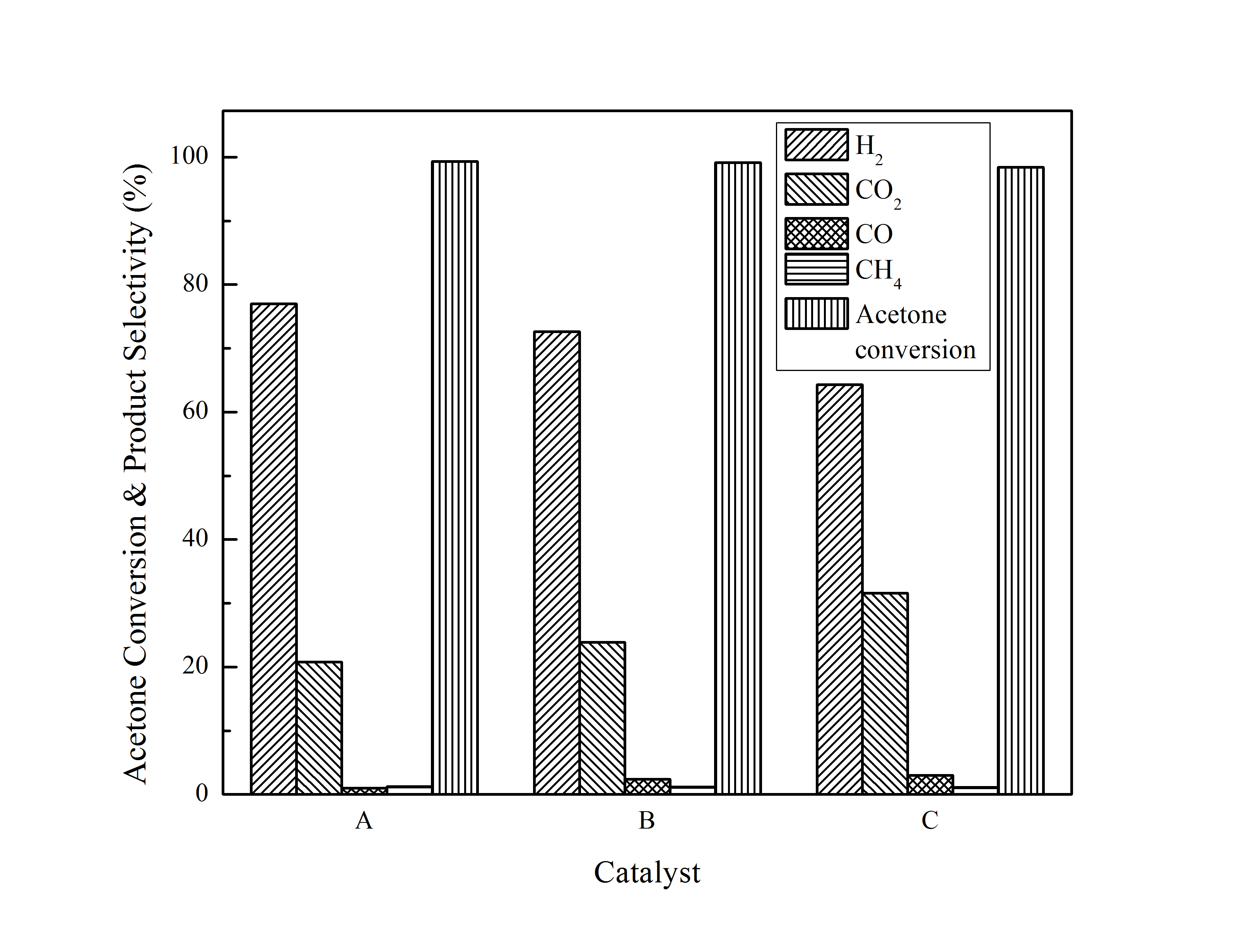
Figure
1: Activity of different catalysts at 550 oC.
Water:Acetone
= 6:1 (molar), Space-time = 12.1 kg cat h/kmol acetone;
A: Ni-Co-Mg-Al (0.33), B: Ni-Co-Mg-Al(1) &C:
Ni-Co-Mg-Al(3)
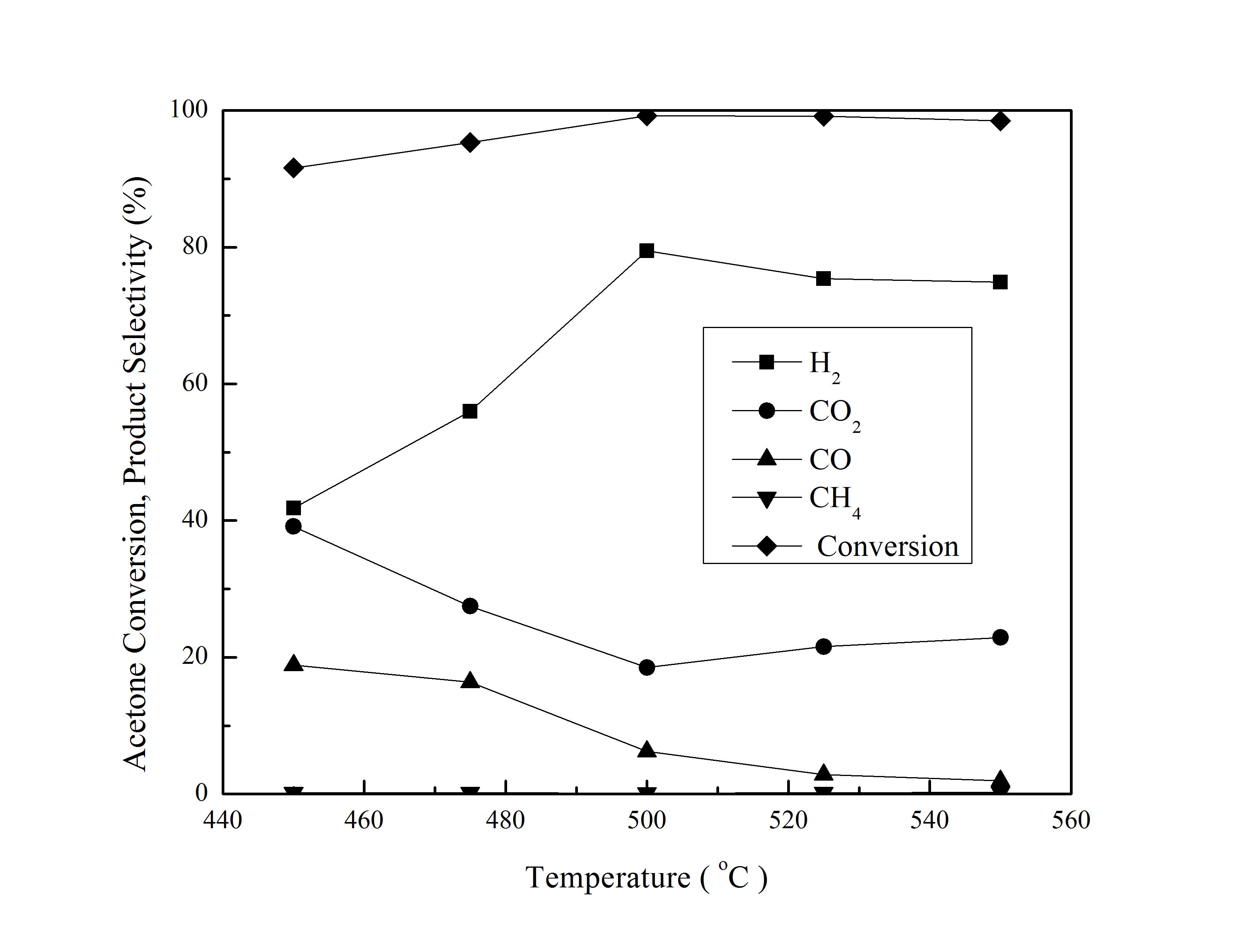
Figure
2: Effect of temperature on acetone conversion and product selectivity.
Water:Acetone
= 6:1 (molar), Space-time = 12.1 kg cat h/kmol acetone;
Catalyst: Ni-Co-Mg-Al (0.33)
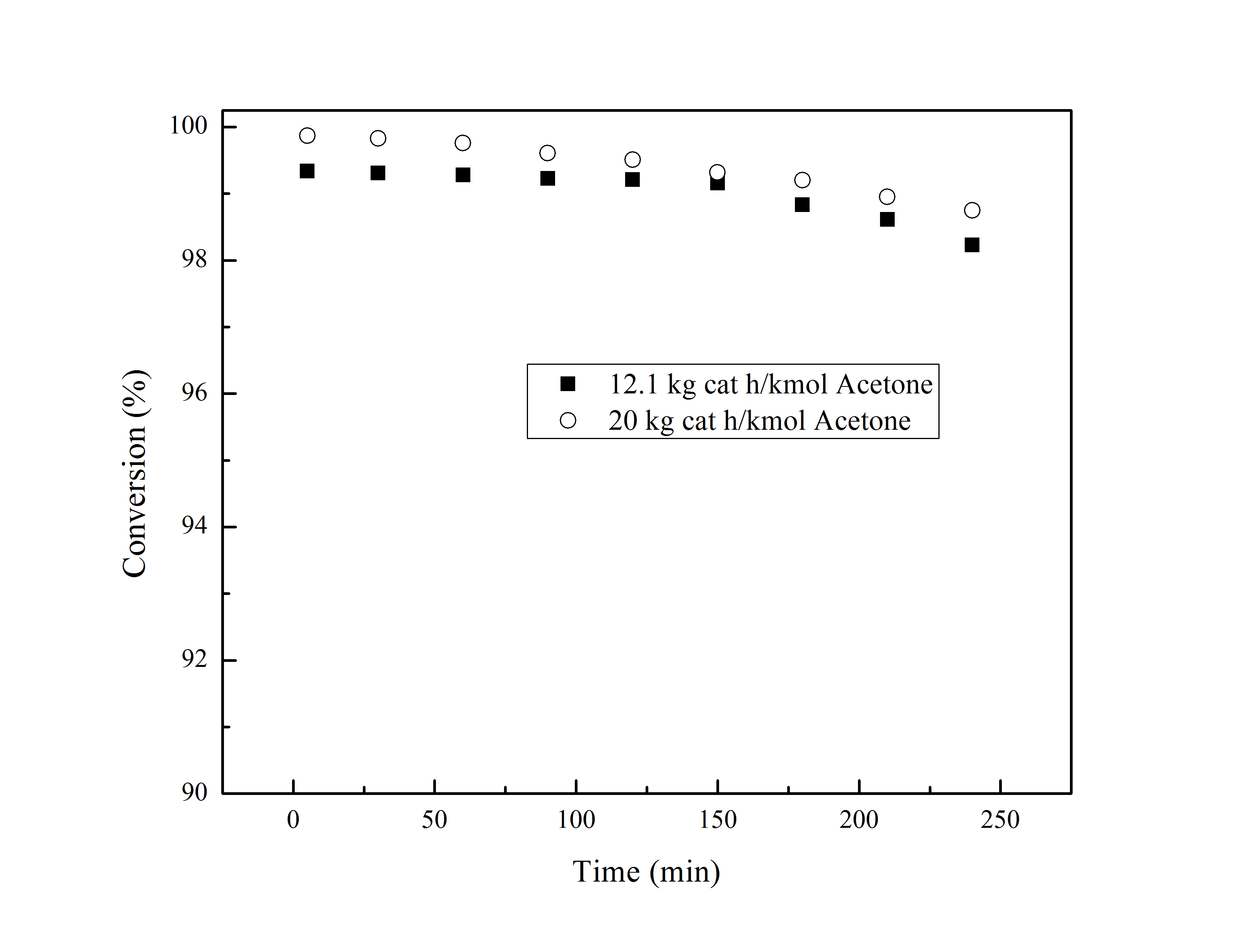
Figure
3: Time-on-stream behavior of the Catalyst A
References
1.
Braga A. H., Sodre E. R.,
Santos J. B. O., Marques C. M. D. P, Bueno J. M. C., Steam
reforming of acetone over Ni- and Co-based catalysts: Effect of the composition
of reactants and catalysts on reaction pathways. Applied Catalysis B: Environmental, 195 (2016)16-28.
2.
Guil-Lopez R., Navarro R.M., Ismail
A.A., Al-Sayari S.A., Fierro J.L.G., Influence of Ni environment on the
reactivity of Ni-Mg-Al catalysts for the acetone steam reforming reaction. International Journal of Hydrogen energy,
40 (2015) 5289-5296.
3.
Hu X., Zhang L., Lu G., Pruning
of the surface species on Ni/Al2O3 catalyst to selective
production of hydrogen via acetone and acetic acid steam reforming. Applied Catalysis
A: General, 427(2012) 49-57.
4.
Navarro R. M.,
Guil-Lopez R., Ismail A. A., Al-Sayari
S. A., Fierro J. L. G., Ni- and PtNi-catalysts supported on Al2O3
for acetone steam reforming: Effect of the modification of support with Ce, La
and Mg. Catalysis
Today, 242 (2015) 60-70.
5.
Sun J., Mei D., Karim A.M., Datye A.K.,
Wang Y., Minimizing the formation of coke and methane on Co nanoparticles in
steam reforming of biomass-derived oxygenates. ChemCatChem, 5 (2013) 1-5.
