
Cadmium zinc telluride (CZT) crystals are widely used for advanced gamma ray detectors due to their room temperature operability and high band gap. In order to achieve the high carrier mobility and lifetime properties necessary for its functionality, precise crystal growing techniques are required. CZT is traditionally grown via the gradient freeze method, where molten CZT is directionally solidified in a cylindrical ampoule by drawing it through a temperature gradient, thus encouraging growth of single crystalline material. Directional solidification methods such as this result in complex transport phenomena, as the translating solid-liquid interface induces thermal-buoyancy driven flows, and a non-unity segregation coefficient leads to inhomogeneous concentration gradients. One problem that commonly arises during gradient freeze growth of CZT is the accumulation of thermodynamically supercooled liquid near the solidification interface. This occurs due to local compositional and thermal inhomogeneity created by the growing conditions, which results in constitutional supercooling. Such supercooling promotes an unfavorable morphological instability, changing the solid-liquid interface from planar to cellular. The subsequent cellular morphology can result in the entrainment and entrapment of melt, resulting in micron-sized tellurium-rich inclusions that reduce detector performance and require lengthy annealing process to remove.
The accelerated crucible rotation technique (ACRT), which repeatedly rotates the crucible back and forth, has been shown to result in a lower density of these tellurium-rich particles and dramatically improve detector performance. Under suitable operating conditions, ACRT dramatically changes the patterns of flow in the melt, inciting new rotational phenomena such as Ekman flows and Taylor-Gšrtler instabilities. Enhanced convection also impacts the thermal and solutal fields. Conventional wisdom asserts that ACRT works by homogenizing the composition in the melt. However, little is actually understood from a thermodynamic and mechanistic perspective on how the ACRT works to reduce constitutional supercooling, and, in turn, tellurium-rich inclusions in the crystal. Additionally, little is known on how to select the optimal rotation schedule to achieve high-quality material.
We aim to address these questions using a comprehensive computational model of the flow, heat, and mass transfer within the CZT growth system. We employ an in-house, Galerkin finite-element code with elliptic mesh generation that allows for the computation of flow patterns, thermal field, composition, and interface shape. Using the results from our simulations, we are able to track the quantity and locations of locally supercooled melt. We will show that, contrary to the conventional wisdom, ACRT does not necessarily homogenize the melt, but rather disrupts the local compositional field, which, in turn, affects the thermodynamic stability of the melt. Moreover, we have developed a thermodynamically-consistent metric that allows for the systematic evaluation and optimization of ACRT schedules. Optimal ACRT schedules and generalized ACRT recommendations for this geometry will be presented.
Figures
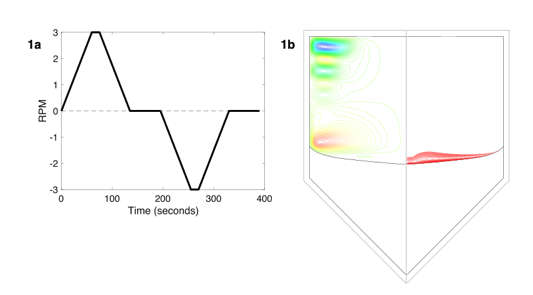
Fig. 1: a) One example of an ACRT scheme, with four distinct regimes: acceleration, constant, deceleration, and stopped, repeated in the opposite direction, and b) a typical result of the streamlines (left) and thermodynamically undercooled regions (right) in the system during the deceleration regime.
This work is supported by the Department of Energy, National Nuclear Security Administration, under Award DE-NA0002565; no official endorsement should be inferred.
See more of this Group/Topical: Engineering Sciences and Fundamentals