
Methane is the major component and the most stable hydrocarbon of natural gas. We have investigated the catalytic cracking of methane as an alternative route for the production of carbon nanofibers (CNFs) and COx-free H2 (Scheme 1). Mono and bimetallic Ni, Fe, Co catalysts were prepared on SiO2 support by incipient impregnation technique. The effect of doping of metals (Ni-Fe, Ni-Co and Fe-Co) with different mole ratios on the activity and stability of the reaction is investigated here. The performance of the catalyst is evaluated at a constant temperature (T = 650 °C) with a flow rate 70ml/min. (30% CH4/N2). After the catalyst screening, catalyst regeneration study was performed on the most stable catalyst. The physico-chemical characteristics are evaluated by XRD analysis, TPR, H2-chemisorption, HR-TEM and BET surface areas of fresh and used forms of catalysts. XRD and TPR analysis of the fresh catalysts confirmed the alloy formation in the bimetallic catalysts. TEM characterization of the spent catalyst indicated that carbon deposits on the catalyst in the form of hollow cylindrical filaments or carbon nanotubes, with the metal particle located on the tip of each filament. It was also observed that bimetallic catalysts produce a carbon nanotube with a smaller diameter compared to the monometallic ones. A detailed study on the structural characteristics and the mechanism of carbon nanotube formation is in progress.
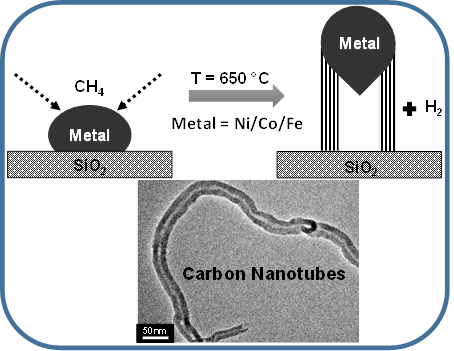 |
Scheme 1: Catalytic decomposition of CH4 into COx free hydrogen and carbon nanotubes
See more of this Group/Topical: Catalysis and Reaction Engineering Division