
Statistical Evaluation of Modeling Approaches of Drug Release Profiles for HPMC Matrix Tablets
Wenzhao Yang1, Jin Zhao2, Jamie Curtis-Fisk2, Karen Balwinski2, True Rogers2, and Shrikant Khot2
(1) The Dow Chemical Company, Herbert D. Doan R&D Center, Midland, Michigan, 48674, USA
(2) Pharmaceutical Excipients R&D, Dow Food, Pharma & Medical, Midland, MI 48674
Matrix tablets containing hypromellose or hydroxypropyl methylcellulose (HPMC) are widely used in oral drug delivery modulate drug release over time. Drug release kinetics is primarily influenced by the kinetics and extent of polymer swelling and erosion, and drug (or active pharmaceutical ingredient (API)) dissolution, diffusion, and/or erosion through the polymer matrix. Mathematical modeling of drug release profiles has been developed in the past to enable pharmaceutical scientists to design and optimize matrix tablet formulations 1 2 3 4. This research focuses on using statistical analyses to compare and assess the suitability of various models for METHOCEL™ Premium HPMC matrices.
Linear mixed model (LMM) without empirical models and two-stage model (TSM) with empirical models were used to develop predictive models. Multiple regression methods (Stepwise Regression, Partial Least Square and Generalized models) in JMP were applied to incorporate drug property factors for modeling drug release rate in TSM. The dataset analyzed included API with solubility ranging from 0.2 to 1000 mg/ml and API concentration from 12.5 to 50 wt%, HPMC grades of METHOCEL™ K100M, METHOCEL™ K4M, METHOCEL™ K100LV and HPMC concentration from 20 to 40 wt%. The two models were compared based on the split validation approach using the regression coefficient (r2) and mean square error (MSE). The LMM has better overall prediction accuracy compared to the TSM. However, TSM outperformed LMM in predicting drug release rate during the first two hours following introduction to dissolution media. It has also been found that the fitting parameters of empirical models such as Korsmeyer-Peppas and Peppas-Sahlin models have strong correlations as shown in Figure 1. In addition to the drug characteristics, the effect of polymer viscosity grade and API concentration were found as key impacting factors in the model.
The predictive model developed here provided mechanistic insight into kinetic release profile of HPMC matrices. This can be used to aid pharmaceutical scientists with efficient and streamlined formulation design and in vitro drug release experimentation to deliver desired modified-release performance. A more comprehensive model will be further developed to predict the effect of key controllable variables such as type and concentrations of fillers, polymer concentrations, and compression force.
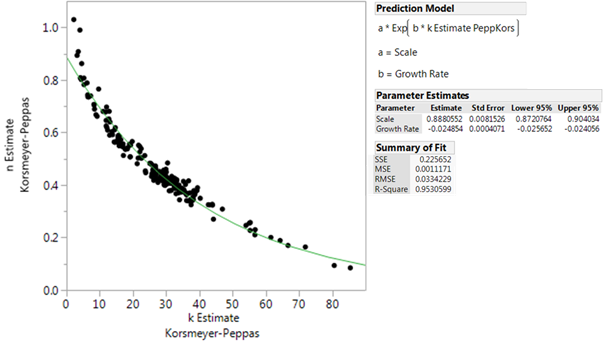
Figure 1. Correlation of fitting parameters of Korsmeyer-Peppas Model.
References
1 J Sipemann and N Peppas, "Mechanism of drug release from delivery systems based on HPMC," Adv Drug Deliv Rev 48, 139 (2011).
2 N. A. Peppas and B. Narasimhan, J. Cont. Rel. 190, 75-81 (2014).
3 LS Koester, GG Ortega, P Mayorga, and VL Bassani, "Mathematical evaluation of in vitro release profiles of hydroxyl propyl methylcellulose matrix tablets containing carbamazepine associated to cyclodextrin.," Eur J Pharm Biopharm 58, 177–179 (2004).
4 MC Gohel and MK Panchal, "Novel mathematical method for quantitative expression of deviation from the Higuchi model.," AAPS Pharm Sci Tech 1 (1-6) (2000).
See more of this Group/Topical: Pharmaceutical Discovery, Development and Manufacturing Forum