
CFD simulation about isobutane alkylation catalyzed by ionic liquid in cyclone reactor
Shuiqiang Duan, State Key laboratory of Heavy Oil Processing, China University of Petroleum-Beijing
Mengzijing Chen, State Key laboratory of Heavy Oil Processing, China University of Petroleum-Beijing
Rui Zhang, State Key laboratory of Heavy Oil Processing, China University of Petroleum-Beijing
Xianghai Meng, State Key laboratory of Heavy Oil Processing, China University of Petroleum-Beijing
Haiyan Liu, State Key laboratory of Heavy Oil Processing, China University of Petroleum-Beijing
Zhenbo Wang, State Key laboratory of Heavy Oil Processing, China University of Petroleum-East China
Zhichang Liu*, State Key laboratory of Heavy Oil Processing, China University of Petroleum-Beijing
Key Words: CFD, cyclone reactor, ionic liquid, isobutane alkylation
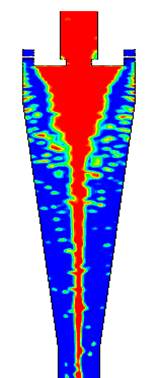
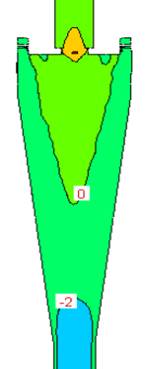
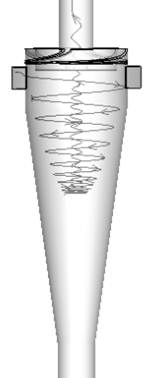
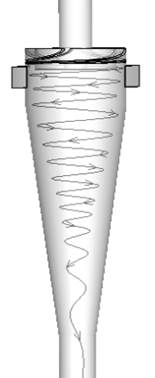
Cyclone reactor1 is a new and promising device which is suitable for the fast chemical reaction and separation for liquid-liquid system. Ionic liquid catalyzed isobutane alkylation is one of the typical liquid-liquid reaction and the products need separating quickly to decrease byproducts. In this study, a computational fluid dynamics (CFD) simulation of liquid-liquid two phase flow was carried out about cyclone reactor. The multiphase model and the turbulence model were described by the volume of fluid model and Reynolds stress model, respectively. The vertical velocity distribution, tangential velocity distribution, velocity vector plot and pressure distribution were obtained according to the simulation. The locus of zero vertical velocity (LZVV) and the representative streamline of the ionic liquid and organic were also attained. The location and morphology of the ionic liquid/organic interface were acquired and a pseudo-steady organic phase core was observed after the organic phase had entered into the cyclone reactor about 0.8s.
(a) (b) (c) (d)
Figure 1. (a) the organic phase core at 0.8s(y=0,z/x=5); (b) the locus of zero vertical velocity(y=0,z/x=5); (c)(d) the streamline of the organic phase and ionic liquid(z/x=5)
Acknowledgement
Financial support was provided by the Natural Science Foundation of China (Nos. 21425626, 21436001 and 21276275), the National Science and Technology Support Program of China (2014BAE13B01), and the Science Foundation of China University of Petroleum, Beijing (No. 2462015QZDX03).
References
[1] Zhenbo Wang; Zhichang Liu; Chunming Xu; Aqiang Chen; Rui Zhang. C.N. Patent 201 410 137 641.1
See more of this Group/Topical: Catalysis and Reaction Engineering Division