
The role of external acidity of hierarchical ZSM-5 zeolites in n-heptane catalytic cracking
Xiaoxiao Zhang, Dang-guo Cheng*, Fengqiu Chen and Xiaoli Zhan
College of Chemical and Biological Engineering, Zhejiang University, 38 Zheda Road, Hangzhou 310027, China
Abstract: The hierarchical ZSM-5 zeolites, which contain meso-/or macroporosity in addition to the intrinsic microporosity, is expected to enhance the bulky molecular diffusion and accessibility of acid sites. These sites, distributed in the internal surface (micropore) or external one (including external surface and mesopore), play different roles in the chemical reaction. To explore the effect of internal/external acidity on the reaction, in this study, a series of hierarchical ZSM-5 zeolites with similar pore structures and different Si/Al ratios were synthesized. Tartaric acid was employed to poison the acidic sites in external surface selectively and extract aluminum from the framework. And catalytic cracking of n-heptane (the main compound of naphtha) was chosen as a model reaction. The results show that active sites located on the external surface tend to provoke the secondary reactions. This will lead to the coke formation and the selectivity decrease of ethylene and propylene. The lower Si/Al ratio of hierarchical zeolite is, the more external acid sites can be selectively eliminated. Therefore, the better catalytic performance can be achieved because of suppressing the secondary reactions of ethylene and propylene, as illustrated in Fig. 1.
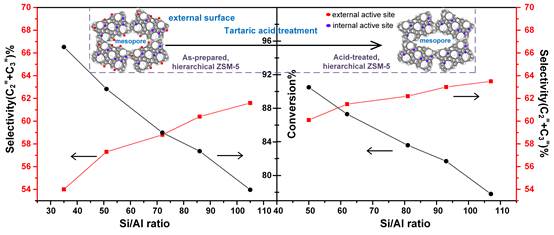
Fig. 1 The effect of external acid sites on catalytic cracking of n-heptane
* Corresponding author. Tel.: +86 0571 87953382; Fax: +86 0571 87951227
E-mail address: dgcheng@zju.edu.cn (D.G. Cheng) fqchen@zju.edu.cn (F.Q. Chen)
xlzhan@zju.edu.cn (X.L. Zhan) xxzhang@zju.edu.cn (X.X. Zhang)
See more of this Group/Topical: Catalysis and Reaction Engineering Division