
Introduction:
Desulfurization of fuels is mandatory to fulfill environmental regulations and to protect the environment. Sulfur levels of liquid fuels are in the range of 10 to 5000 ppm and depend on the type of fuel and their correlated legal requirements [1]. Hydrodesulfurization (HDS) is used for crude oil desulfurization to achieve the country-specific legal requirements. This HDS is the most prevalent and industrially relevant desulfurization process which operates at temperatures above 300 °C and more than 35 bar of H2 operating pressure. The HDS efficiency decreases with increasing molecular size of the refractory sulfur compounds and thus is inefficient for removing benzothiophene (BT) and especially dibenzothiophene (DBT) and its derivatives.
Fuel cells are one of the most effective tools to convert chemical to electrical energy. This technology is not only suitable for stationary approaches but is also a promising source of on-board electricity supply for all kinds of vehicles, ships, and aircraft. The advantages of fuel cells are in particular higher efficiency, reduced emissions, and lower noise generation in comparison to conventional combustion engines. This technology becomes very attractive when on-board fuel is used to produce hydrogen-rich syngas via reforming, which is subsequently fed to the fuel cell. However, the sulfur threshold limit for the reformer and the fuel cell are < 50 and < 1 ppm of total sulfur, respectively [2, 3]. Consequently, fuel cells as one of the most efficient tools for energy conversion are excluded from using the most common types of fuels.
Adsorptive desulfurization is a promising approach to provide the possibility of on-board desulfurization and thus operating fuel cells with commercial fuels. Several adsorbents have been investigated and published in recent years. However, adsorbents regeneration is still a major issue; especially after adsorption of dibenzothiophene (DBT). The aim of this work is to identify and prepare a highly thermal stable adsorbent for thermal on-board regeneration via hot exhaust gases.
Experimental section:
A silver based adsorbent was prepared by incipient wetness impregnation of gamma–Al2O3. The impregnated support was further dried and calcined in order to get Ag-Al2O3. This adsorbent was characterized via different methods including N2-physisorption, XRD, SEM, EDX, and ICP-AES. The adsorbent was further used in different experiments including equilibrium saturation, kinetics, and breakthrough experiments. The adsorptive desulfurization performance of Ag-Al2O3 was tested under different conditions and fuels such as jet fuel and diesel fuel. These fuels contained different concentrations of poly aromatic sulfur heterocycles (PASHs) in the range of 300 to 900 ppmw of total sulfur. In situ regeneration experiments were carried out with preheated air and simulated exhaust gas from a solid oxide fuel cell driven auxiliary power unit.
Results and discussion:
The overall adsorption mechanisms of PASHs were studied by relating experimental data with theoretical principles. High breakthrough adsorption capacities were observed for different PASHs like BT, DBT, and 4,6-dimethyldibenzothiophen dissolved in commercial fuels. The breakthrough adsorption capacity was in the range of 0.9 to 2.3 mg/g at 20 °C and atmospheric pressure depending on the type of PAHS. Within these investigations, the role of the acid base interaction (S-H) on the overall adsorption mechanism was identified. The results showed that the weak S-H interaction is a third mechanism beside the known pi-complexation (pi-Ag) and the direct metal sulfur interaction (S-Ag). Both pi-Ag and S-Ag interactions have a selectivity order of DBT > BT which is caused by a higher adsorption energy of DBT in comparison to BT. The S-H interaction is thus responsible for the shift of the final selectivity order to BT > DBT at equilibrium saturation conditions as confirmed by experiments. This result is further confirmed by density functional theory (DFT) calculations reported in the literature as well as by the hard and soft acid base (HSAB) theory proposed by Pearson. Consequently, pi-Ag and S-Ag interactions are the main adsorption mechanisms at breakthrough. In these two interactions, the silver cation (soft acid) interacts with the thiophenic ring or directly with the pi lone-pair of electrons of the sulfur atom (soft base) [4].
Additional equilibrium saturation experiments were carried out at -10 and 60 °C. The adsorption temperature showed no influence on the equilibrium saturation capacity in the case of DBT. For BT, the equilibrium saturation capacity at -10 °C stayed at the same level as at 20 °C. At 60 °C, the equilibrium saturation of BT decreased to the level of DBT and thus confirmed that the weak S-H interaction is only relevant for BT at equilibrium stage. At increased temperatures (60 °C) the S-H interactions is to week to contribute in the overall adsorption mechanism of BT. The stronger adsorption of DBT in particular makes it difficult to achieve full thermal regeneration without thermal destruction of the adsorbent. These are important findings in order to develop highly efficient regeneration strategies.
The lack of solvents requires thermal regeneration of the adsorbent in the case of on-board desulfurization units. This is the reason, why we studied the desorption mechanisms of PASHs from Ag-Al2O3 in the presence of air; and in particular of N2, O2, CO2, and H2O. In these investigations, thermal regeneration was carried out in a preheated gas mixture with increasing temperature. A final temperature of 450 °C was used in the first regeneration experiments. This temperature was sufficient for full thermal regeneration in flowing air after adsorption of BT on Ag-Al2O3. The same experiment was carried out with DBT and showed only 60% recovery of the breakthrough capacity after thermal regeneration. This result confirms the stronger adsorption of DBT in comparison to BT. Additional regeneration experiments were carried out at a final temperature of 525 °C. The results showed full thermal regeneration in flowing air after adsorption of DBT. This is an excellent result as full thermal regeneration after DBT adsorption has not been reported so far. The regenerated Ag-Al2O3 was further analyzed and showed no thermal induced destruction.
One problem of thermal regeneration is the source of hot regeneration gas as electrical heating would be inefficient and cost-intensive. To overcome this drawback, hot exhaust gases were identified as a source of hot regeneration gases. This is the reason why regeneration experiments were performed by using hot off-gas from a solid oxide fuel cell based auxiliary power unit; this gas is referred to as APU. The flow sheet of this novel regeneration strategy is illustrated in Fig. 1 (right).
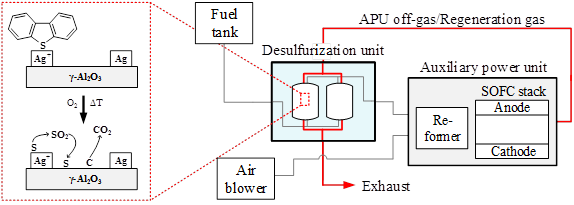
Fig. 1 Flow sheet diagram of novel regeneration strategy using hot APU off-gas for thermal regeneration of the adsorbent (right) and simplified scheme of the overall desorption mechanism of PASHs (left).
Excellent results were obtained with APU as regeneration gas. In these experiments, 100% regeneration was achieved over 5 cycles at a final temperature of 500 °C. The identified desorption mechanisms (Fig. 1 left) showed that CO2 in the regeneration gas has no negative influence on the overall regeneration experiment as it desorbs already at temperature above 100 °C. In addition, H2O was identified to have a positive influence on the thermal decomposition of adsorbed PASHs. This positive effect was proven by achieving full thermal regeneration at a final temperature of 450 °C with increased H2O content in the regeneration gas (12 vol.%). These findings even highlight the possibility to use hot exhaust gas from a combustion engine as regeneration gas in a hybrid vehicle based on low temperature fuel cells.
Conclusion:
Adsorptive desulfurization of liquid fuels is mandatory to provide the possibility to operate fuel cell with commercial fuels. Ag-Al2O3 was identified as excellent adsorbent for on-board desulfurization units. Investigations on the overall adsorption mechanism showed that the silver cations are the main active adsorption sites. Adsorption of DBT via pi-Ag and S-Ag interactions is stronger in comparisons to BT. Consequently, regeneration of these silver sites after adsorption of DBT is essential to achieve full regeneration.
Hot exhaust gas was identified as ideal regeneration gas for thermal in situ and on-board regeneration. The identified desorption mechanism showed that CO2 has no negative influence on the regeneration performance. Full thermal regeneration was reported for the first time after adsorption of DBT at a final temperature of 500 °C over 5 cycles. The final regeneration temperature could even be reduced to 450 °C by increasing the H2O content in the regeneration gas. All these findings showed excellent adsorption and regeneration performances of Ag-Al2O3 under a wide range of conditions including different fuels. Full on-board regeneration via hot exhaust gas, as reported, highlights the possibility to operate fuel cell with commercial sulfur containing fuels and thus achieve high efficiency in energy conversion combined with lowest emissions.
References:
[1] A. Samokhvalov, B.J. Tatarchuk, Catal. Rev. 52 (2010) 381-410.
[2] X. Xu, S. Zhang, P. Li, Y. Shen, Fuel Process. Technol. 124 (2014) 140–146.
[3] C. Hulteberg, Int. J. Hydrogen Energy 37 (2012) 3978-3992.
[4] R. Neubauer, M. Husmann, C. Weinlaender, N. Kienzl, E. Leitner, C. Hochenauer, Chemical Engineering Journal 309 (2017) 840-849.
See more of this Group/Topical: Topical Conference: Advances in Fossil Energy R&D