
The depletion of crude oil resources is the main reason for motivating the different waves of interests in renewable energies including light-voltage, wind energy, and biofuels [1]. Compared with bioethanol, biobutanol has several advantages such as higher energy density, lower volatility, higher boiling point (117.7 ºC) and flash point (29 ºC), plus amenability to the formation of blends with gasoline in any proportion [2]. Currently, biobutanol is mainly produced through the fermentation of renewable biomass. In the fermentation process, the severe inhibition and toxicity of butanol usually lead to a significant decrease in its yield [3]. To remove butanol from the fermentation system, several separation techniques such as distillation, adsorption, liquid-liquid extraction (LLE), gas stripping and pervaporation have been employed [1]. The pervaporation technique with low energy requirement, easy operability and harmless to microorganisms is a promising technology for efficient separation of butanol/water mixtures [4].
The pervaporation membranes have attracted broad attention recently. Zeolite beta adopts a truncated bi-pyramidal shape with three-dimensional 12-ring interconnected channel system with pore diameters of 0.71 * 0.73 nm and 0.56 * 0.56 nm [5]. Zeolite beta membranes have the application potential in both separation and catalysis. At present, zeolite beta membranes are usually synthesized using TEAOH as the structure directing agent in either a basic medium (without fluoride) or a near-neutral medium (with fluoride). In the basic medium, the synthesis gel is in a liquid state, which can be fully adsorbed into the seed layer of zeolite beta crystals. Nevertheless, the crystallinity and intergrowth between vicinal crystals in zeolite beta membranes synthesized as such are not satisfactory [6]. In contrast to the alkaline medium, zeolite beta membranes prepared in a near-neutral gel containing fluoride often exhibits a truncated bi-pyramidal morphology with high crystallinity. The fluoride ion rich gels possess extremely high viscosity and low fluidity, therefore, the zeolite beta membranes formed in the near-neutral medium are generally non-uniform, the adhesion strength of which on their supports are pretty low.
In the present work, we propose a two-step method to fabricate zeolite beta membranes on porous alpha-alumina substrates, in which the secondary growth procedure is performed in the basic medium without fluoride followed by that in the near-neutral medium with fluoride. As shown in Figure 1(b), an intergrown and dense crystal layer was formed with the thickness of ca. 1 µm on the alpha-alumina supported zeolite beta crystal layer (Figure 1(a)) after the first step. Then, the thin layer of zeolite beta crystals was put into the near-neutral medium of synthesis gels. After the second step, the formed zeolite beta membranes ensured cross-linking with typical truncated bi-pyramidal morphology shown in Figure 1(c). The total thickness of the membrane was only 2.5~3 µm. As illustrated in Figure 2, the BEA topology was well-defined reflections from the characteristic XRD diffraction peaks. The zeolite beta membrane exhibited three reflections corresponding to (101), (106), and (302), indicating that the synthesized membrane was preferentially (h0l)-oriented. The EPMA elemental analysis of the membrane was given in Figure 3. The concentration of aluminum was gradually decreased from the substrate surface to the outer surface of the zeolite beta membrane, which demonstrated that there does not exist a transition layer inside the membrane. The pervaporation fluxes of several pure components through zeolite beta membranes were checked at 298 K. The separation of TIPB/ethanol mixtures by pervaporation was also used to evaluate the membrane quality. It could be concluded that the synthesized zeolite beta membranes by our two-step method are dense and uniform, especially the preferentially (h0l)-oriented membranes were well intergrown with little defects.
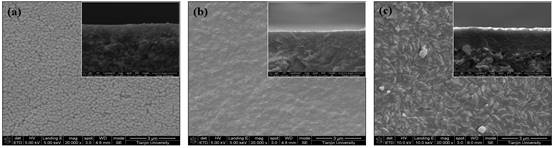
Figure 1 SEM images of the seed layer of beta crystals (a), zeolite beta membranes synthesized on the seed layer under the alkaline synthesis solution without fluoride (b, M1), and zeolite beta membranes synthesized on M1 under the near-neutral synthesis solution with fluoride (c, M2). Inset: cross-sectional view of the corresponding zeolite beta seed layer or membranes.
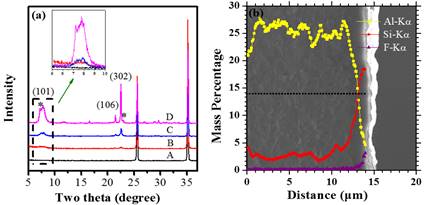
Figure 2 (a) XRD patterns of the substrate, seed layer and zeolite beta membranes. (A) alpha-alumina, (B) the seed layer, (C) zeolite beta membrane synthesized on the seed layer under the alkaline synthesis solution without fluoride (M1), and (D) zeolite beta membrane synthesized on M1 under the near-neutral synthesis solution with fluoride (M2). (b) EPMA elemental analysis of a (h0l)-oriented zeolite beta membrane. The detection limits for Al, Si, and F are about 0.001 wt%. EPMA elemental profile plotted in mass percentage versus distance with SEM image of the sample. The dashed line illustrates the EPMA scanning path.
Although zeolite beta membranes with little defects can be synthesized by the two-step method, their surface hydrophilicity/hydrophobicity is not satisfactory, and need to be improved to enhance the pervaporation performance. Mussel-inspired surface chemistry has attracted great interest due to its simplicity, versatility and wide applicability [7]. Herein, a facile method was proposed to functionalize the surface of zeolite beta membranes. A one-step procedure was developed to improve the surface hydrophilicity of zeolite beta membranes via co-deposition of polydopamine (PDA) and polyethyleneimine (PEI). Moreover, the PDA-functionalized surface of zeolite beta membranes could become hydrophobic after octadecylamine grafting via Schiff base reaction. The change in surface hydrophilic-hydrophobic properties was checked by contact angle measurements. As shown in Figure 3, the contact angle of synthesized zeolite beta membranes was ca. 80º (Figure 3(a)), which was awkward to be preferentially selective to either butanol or water. After hydrophilic modification, the average contact angle was decreased to ca. 40º (Figure 3(b)), leading to an increased hydrophilic surface. While the average contact angle would be increased to ca. 105º (Figure 3(c)) after hydrophobic modification, indicating that the surface of zeolite beta membranes became hydrophobic. The pervaporation performance of zeolite beta membranes before and after surface modification was demonstrated in Figure 4. The significant improvements in pervaporation of butanol/water mixtures were achieved by using the functionalized beta zeolite membranes. With respect to dilute butanol aqueous solution (5 wt% water, 70 ºC), the separation factor of the zeolite beta membrane after hydrophilic modification was increased from ca. 19 to over 420 while keeping the total flux at ca. 1.5 kg/ (m2 h). The pervaporation performance of surface hydrophobic modified zeolite beta membranes was measured for dilute n-butanol aqueous solution (5 wt% n-butanol, 70 ºC). The membrane after surface modification exhibited a total flux of ca. 1.3 kg/ (m2 h) with the separation factor of ca. 100, which increased from ca. 5. These results demonstrated that the surface property of zeolite beta membrane influenced the pervaporation performance when the membrane defects was little. Furthermore, the method we proposed endows the zeolite beta membrane with excellent surface properties, high separation factor and low flux reduction. Compared with current literature reports, the pervaporation performance of our zeolite beta membranes in this report was significantly enhanced for dilute and concentrated butanol aqueous solutions.

Figure 3 Static water contact angles of zeolite membranes. (a) without modification, (b) after hydrophilic modification, (c) after hydrophobic modification.
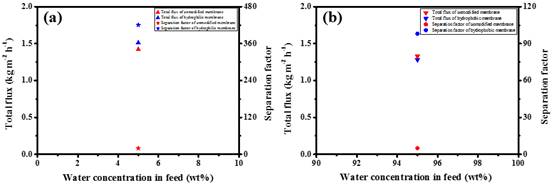
Figure 4 The enhancements in the pervaporation performance of beta zeolite membranes after surface modification. (a) after hydrophilic modification, (b) after hydrophobic modification.
Acknowledgements
This research was supported by the National Natural Science Foundation of China (Grant No. 21136008).
References
[1] Abdehagh N, Tezel F. H., Thibault J. Separation techniques in butanol production: challenges and developments. Biomass and Bioenergy. 60 (2014) 222-246.
[2] Liu G. P., Wei W, Wu H, Dong X. L., Jiang M, Jin W. Q. Pervaporation performance of PDMS/ceramic composite membrane in acetone butanol ethanol (ABE) fermentation¨CPV coupled process. Journal of Membrane Science. 373(1) (2011) 121-129.
[3] Fan H. W., Wang N. X., Ji S. L., Yan H, Zhang G. J. Nanodisperse ZIF-8/PDMS hybrid membranes for biobutanol permselective pervaporation. Journal of Materials Chemistry A. 2(48) (2014) 20947-20957.
[4] Li Y. K., Shen J, Guan K. C., Liu G. P., Zhou H. L., Jin W. Q. PEBA/ceramic hollow fiber composite membrane for high-efficiency recovery of bio-butanol via pervaporation. Journal of Membrane Science. 510 (2016) 338-347.
[5] Pham T. C. T., Kim H. S., Yoon K. B. Growth of uniformly oriented silica MFI and BEA zeolite films on substrates. Science. 334(6062) (2011) 1533-1538.
[6] Jakob A, Valtchev V, Soulard M, et al. Syntheses of zeolite beta films in fluoride media and investigation of their sorption properties. Langmuir. 25(6) (2009) 3549-3555.
[7] Lee H, Dellatore S. M., Miller W. M., Messersmith P. B. Mussel-inspired surface chemistry for multifunctional coatings. Science. 318(5849) (2007) 426-430.
See more of this Group/Topical: Materials Engineering and Sciences Division