
Chemical engineers are trained in a broad, multidisciplinary environment. This is necessary since they are typically employed in an industrial environment in which not only (chemical) engineering is key, but also knowledge of informatics, mechanics, economics and even human psychology. At Ghent University, in Belgium, our chemical engineering students are trained in every aspect of their future professional career. One of the more prominent, truly multidisciplinary courses in this respect is the ‘cross-course project’ in the third bachelor year. This is a mandatory, project-based course in which a group of students tackle a real-life industrially relevant engineering problem. Each year, new project topics are defined, based either on the actual need of an industrial partner or on a more fundamental problem encountered by a research institute. By simulating such an industrial setting, the students get a clear picture of their future professional career.
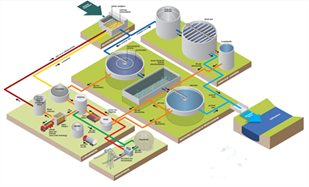
Figure 1: a schematic representation of a typical wastewater treatment plant [1]
One of the project topics was put forward by an industrial partner specialized in wastewater treatment. Apart from organic matter, domestic wastewater contains small, solid particles, mostly composed of cellulose fibers originating from toilet paper. Without specific actions, these fibrous particles would reach the aeration basin resulting in an extra load for the sludge in the basin. Aiming at creating added value, an extra fine-meshed sieve was installed upstream of the aeration basin, allowing the recovery of these solid particles. As a result, an additional solid stream was obtained, almost entirely composed of wet cellulose fibers. The challenge for the students was to propose and design a solution to valorize this cellulosic waste stream. As a result, not only the scientific feasibility of their solution needed to be evaluated, but also the economic and industrial feasibility.
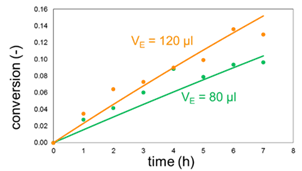
Figure 2: cellulose conversion measured at specific time intervals in a batch reactor. Solid lines represent the Michaelis-Menten kinetic model
After an initial brainstorm session, a two-stage conversion process was developed. In a first step, the cellulose fibers are hydrolyzed to glucose after which the glucose is fermented to bioethanol. The cellulose hydrolysis was performed using a mixture of commercially available cellulase enzymes in a lab-scale batch reactor. The reactant cellulose was provided by dissolving fresh toilet paper in water by stirring. During reaction, samples were drawn from the reactor mixture at well-defined time intervals and the unreacted cellulose was filtered from the mixture. For analytical purposes, sulfuric acid was added to the samples, which converted the glucose into hydroxymethylfurfural of which the concentration can be measured by UV-VIS absorbance [2]. By varying the reaction conditions, such as temperature and enzyme concentration, the kinetics of the enzymatic transformation could be mapped experimentally. These data were subsequently used to construct a Michaelis-Menten kinetic model. In the second stage of the process, glucose was converted into ethanol by the addition of baker’s yeast. To determine the enzymatic kinetics of the glucose, a similar approach was followed as in the first step. A second Michaelis-Menten kinetic model was constructed which could simulate the experimentally measured ethanol production rates quite well. In order to measure reliable kinetic data with a minimal experimental error, a critical mindset of the students in the lab was proven to be essential. Through trial-and-error, the students got aware of a number of potential sources of unreliability, e.g., cellulose fibers still present in the sample, poor cellulose solubility in water, undesired oxygen during fermentation.
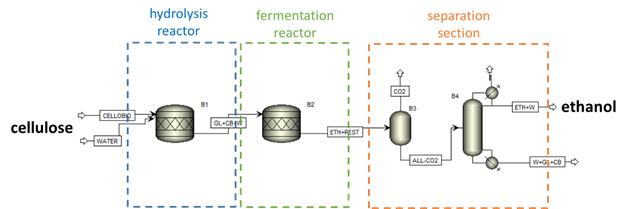
Figure 3: Aspen Plus® model of an industrial plant for the conversion of cellulose into glucose and further fermentation to ethanol
Using both kinetic models and industrial wastewater capacities, several preliminary commercial configurations were designed and evaluated via the process modelling software Aspen Plus®. Although this valorization step was feasible on the laboratory scale, some key challenges remain for its industrial application, e.g., the limited solubility of the cellulose and the loss of the homogeneous enzymes after reaction. Overall, the project resulted in a critical evaluation by the students of biomass as raw material in the chemical industry, expressing both opportunities and challenges of a bio-based society.
From a management perspective, the students worked as a synergetic team by appointing specific roles to every team member. They learned to be critical but also appreciated each other’s contributions. Apart from field work and reporting, the students had weekly meetings with the responsible professors and, sometimes, the industrial partner from which they received valuable feedback. Finally, their presentation skills were trained by having to present their progress twice, orally, for a broad audience of chemical engineers and students. The students also participated in an international Student Research Conference where they gave a presentation of their work, which earned them the first prize from both the jury as well as the audience.
[1] W. Noorderzijlvest. Available: www.noorderzijlvest.nl
[2] A. A. Albalasmeh, A. A. Berhe, and T. A. Ghezzehei, "A new method for rapid determination of carbohydrate and total carbon concentrations using UV spectrophotometry," Carbohydrate polymers, vol. 97, no. 2, pp. 253-261, 2013.
Acknowledgement
The authors would like to thank Bert Biesemans, Christophe Naessens, Laura De Saedeleer and Laura Truyens for their commitment and hard work during the project.
See more of this Group/Topical: Education Division