
Title: Passivity-Based High Gain Observer with Application to Reaction Heat Estimation
This work presents a passivity-based approach to estimate rapidly varying parameters in partially modelled dynamical systems. The proposed observer can be applied to a wide range of practical problems. The main assumption is that the measurements are not “too noisy” and that the interconnections between the system that is modeled and the un-modelled system has the same dimension as the observation vector. Noise is a problem since the observer uses derivatives. A trade-off occurs between the speed of parameter tracking and the noise level, as been stated in [1] where a sliding-mode differentiator is designed for noisy measurements. The observer is applied to estimate reaction heat in an unsteady state polymerization reactor. Some industrial results will be discussed.
Estimation of time-varying parameter is important for process control, process monitoring and fault detection. Luenberger theory [2] provides the foundation for observer design in linear systems. Kazantzis and Kravaris [3] generalized this theory to nonlinear systems using Lyapunov’s auxiliary theorem. One important assumption for these observers, the Kalman filter and the closely related moving horizon estimation schemes, is that the system dynamics are modeled. In many practical applications, it may be difficult to model the system dynamics completely.
In this work, we present the design of a passivity-based observer that can be applied to some classes of systems with un-modeled internal dynamics. To illustrate, consider the following problem:
 (1)
 (2)
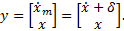 (3)
Equation
(1) represents the un-modelled dynamics, equation (2) represents the model and
equation (3) represents the measurement. The objective is to estimate the
time-varying interconnection parameter  .
The important point to note that is that the measurement vector includes the
measurement of x as well as the estimate
 of
the time derivative of
 .
The bounded signal
 represents
the uncertainty in the derivative estimate. The problem we consider is how to
infer the interconnecting parameter, through the measurement vector y
and model equations (2).
The proposed approach treats the parameter estimation problem as a control problem. In this approach, we construct and error between the observations and the output produced from the observer equation (2). The system is passive and fast tracking can be achieved by high gain feedback. A Lyapunov function argument in conjunction with the time derivative estimation due to Levant [1] provides theoretical justification for the application. The theory shows that there will be a trade-off between the accuracy of the tracking estimate and the noise level and that the error converges to zero in the limit of no noise. It is quite straightforward to generalize the theory to problems where the dynamics of system (1) has high order and the dynamics of system (2) are nonlinear as long as the input-output passivity condition is maintained.
The practical problem is motivated by an industrial application to polymerization reactor control. In this application, the monomer concentration is inferred by estimating the heat of reaction through a nonlinear energy balance written on the form of equation (2). The temperature and its derivative are estimated using a Savitzky-Golay filter. Simulation results and results from industrial trials show that the estimator converges quickly in semi-batch polymerization.
[1] Levant, Arie. Robust exact differentiation via sliding mode technique. Automatica 34(3): 379-384 (1998).
[2] Luenberger, David. An introduction to observers. IEEE Transactions on automatic control 16(6): 596-602 (1971).
[3] Kazantzis, Nikolaos, and Costas Kravaris. Nonlinear observer design using Lyapunov’s auxiliary theorem. Systems & Control Letters 34(5): 241-247 (1998).
See more of this Group/Topical: Computing and Systems Technology Division