
CFD-DEM modeling the effect of column size and bed height on minimum fluidization velocity in micro fluidized beds with Geldart B particles
Yupeng Xua, Tingwen Lia,b, Jordan Mussera, Xiaoxing Liuc, Guangwen Xuc, William A. Rogersa
a. National Energy Technology Laboratory, Morgantown, WV 26505, USA
b. AECOM, Morgantown, WV 26505, USA
c. State Key Laboratory of Multiphase Complex Systems, Institute of Process Engineering, Chinese Academy of Sciences, Beijing 100190, P. R. China
Micro fluidized beds (MFBs) were first put forward by Potic et al. to refer to fluidized beds with inner diameters of a few millimeters. These are ideal systems to study because they have a large wall area per unit reactor volume which promotes excellent mass- and heat-transfer. Additionally, smaller systems allow for measurement of small quantities of solid reactants. Applications of micro-fluidized beds include the Micro Fluidized Bed Reaction Analyzer (MFBRA) and Micro Membrane Fluidized Bed Reactor (MMFBR).
The fluidization characteristics of a given kind of particles in MFBs are different from those in ordinary-size fluidized beds due to much stronger wall effects. From the viewpoint of operating and controlling a MFB kinetic analyzer, knowing minimum fluidization and minimum bubbling velocities (Umf and Umb) enables researchers to determine suitable gas velocities so that fluidization in the MFB reactor can be maintained. Limited research has been conducted to understand the fundamental hydrodynamics of micro-fluidized beds.
The fluidization behavior of Geldart B particles in micro fluidized beds is investigated numerically using Computational Fluid Dynamics coupled with Discrete Element Method (CFD-DEM) available in the open-source Multiphase Flow with Interphase eXchanges (MFIX) code. The effects of different bed diameters (D) of 8 mm, 12 mm, 16 mm and various initial static bed heights (H) were examined. It is found that both decreasing the column diameter and increasing the bed height in a micro fluidized bed increases minimum fluidization velocity (Umf). The observed overshoot in pressure drop that occurs before the onset of fluidization decreases in magnitude with increasing column diameter, however there is less sensitivity to bed height. Overall, the numerical results agree qualitatively with existing theoretical correlations and experimental studies. The simulations show that both column diameter and particle-wall friction contribute to variations in minimum fluidization velocity. These two factors are coupled and hard to separate. The detailed influences of wall friction on minimum fluidization velocity are investigated for a prescribed column diameter of 8 mm by varying the wall friction from 0 to 0.4.
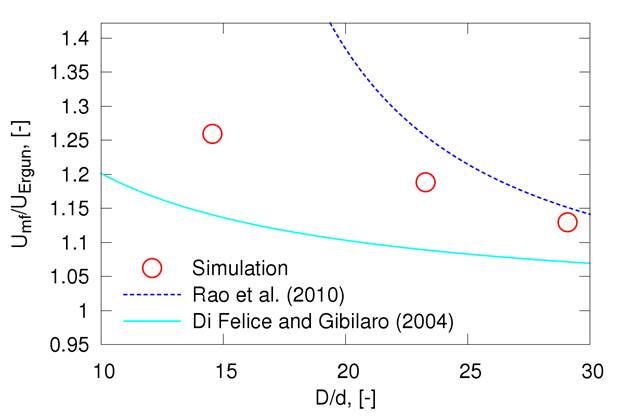
Fig.1. Influence of the column diameters on the minimum fluidization velocity (static bed height of 6.88 cm)
See more of this Group/Topical: Particle Technology Forum