
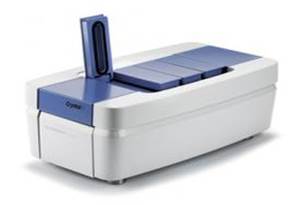
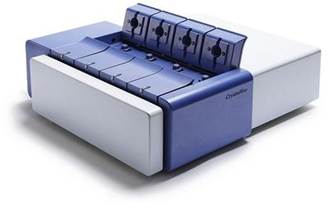
Initial experimental phases of crystallization process development are commonly carried out at very small scales, typically using 1-5mL vessels. The aims of these early phases of process development are to select a solvent based on solubility and crystal solid state. These activities are commonly conducted in high throughput reactor systems, such as the Crystal16® and Crystalline, from Technobis Crystallization Systems, as shown in Figure 1(a) and 1(b), respectively. However, for the development, validation and optimization of crystallization process models this data is usually not utilized and the selected solution system is probed experimentally and more quantitatively at much larger scales, typically between 100 – 1000 mL. A more quantitative usage of the data generated at small scale for the development of process models which may significantly reduce the number of larger scale experiments required, would aid in addressing the increasing constraints on time and materials in pharmaceutical development.
Solubility and metastable zone width (MSZW) experiments are routinely conducted with both experimental systems, shown in figure 1, with clear points (indicating the point of dissolution) and cloud points (indicating the on-set of nucleation in solution) utilised to indicate the MSZW for a given cooling rate, agitation rate and solute composition [2]. Through turbidity and temperature measurements, both experimental systems provide the ability to quantitatively determine MSZW and therefore, the primary nucleation kinetics of the solution system [2, 3]. In addition, the Crystalline system also has the added measurement capabilities of particle visualization, providing a number based representation of the particle size distribution (PSD), as shown in figure 2, and Raman modules for concentration and solid form monitoring. In-situ sizing via image analysis is also not prone to sampling issues possible with offline PSD measurements techniques like laser diffraction. In addition, the in-situ image analysis capabilities can be enormously beneficial in terms of aiding process understanding, providing crucial information for crystallization mechanism and model discrimination activities. The lack of probes inserted into the reaction vessel also leads to no cross contamination and no interference in the crystallization environment. All of these techniques are integrated into a small reactor with overhead stirring and refluxing capabilities, which can qualitatively mimic the likely vessel configurations at larger scales.
(a) (b)
Figure 1: Images of the (a) Crystal16® and (b) Crystalline experimental systems from Technobis Crystallization Systems [1].
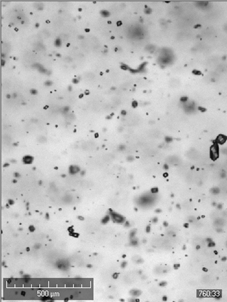
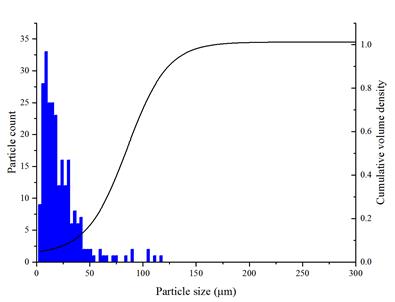
Figure 2: Particle visualization and calculated PSD based on images.
In this work, data from paracetamol and 3-methyl-1-butanol solutions at the micro-scale was utilized to estimate the crystallization kinetics of the model, including crystal growth and primary nucleation, enabling model development, as well as mechanism discrimination. The final predictions of the developed process model were compared with a previously developed and validated process model, which employed larger scale 1 L scale experiments. Cross-validation with FBRM, laser diffraction and online solute concentration data from the larger scale, 1 L was conducted. Although perfect agreement was not achieved, primarily due to scale and reactor dependent kinetic mechanisms, such as primary nucleation and secondary nucleation, the process model was in general qualitative agreement with the original model developed with larger scale experimental data. A key outcome of this work is an adapted process development workflow for the design, model validation and optimization of processing models for crystallization systems. This workflow enables crystallization process development with an order of magnitude lower demands for materials. In particular raw API, which may not be available in the early stages of process development. In addition, the design space for the process can be assessed early on, such a process robustness and viability of continuous processing, with less dependence on larger scale, more material intensive experiments. As a result, by utilizing commonly available micro-scale process data the material demands and requirements for larger scale experiments can be significantly reduced, leading to a step change in pharmaceutical process development efficiency and productivity.
References:
[1] Technobis Crystallization Systems, Our products, accessible online: https://www.crystallizationsystems.com/our-products, (2016).
[2] Mitchell, N.A, Frawley, P.J., Nucleation kinetics of paracetamol–ethanol solutions from metastable zone widths, J. Cryst. Growth, 312(19), 2740–2746, (2010).
[3] Kadam, S.S, Kulkarni, S.A., Ribera, R.C., Stankiewicz, A.I., ter Horst, J.H., Kramer, H.J.M., A new view on the metastable zone width during cooling crystallization, Chem. Eng. Sci., 72, 10–19 (2012).
See more of this Group/Topical: Separations Division