
An industrial process for the selective oxidation of methane under mild conditions would be highly valuable for controlling emissions to the environment and for utilizing vast new sources of natural gas. Methanotrophic bacteria utilize methane under nearly ambient conditions, suggesting a biochemical process for methane conversion could be more efficient, less capital intensive, and more scalable compared to current industrial practice. However, the industrial use of bioconversion for large-scale applications, especially those involving gas-to-liquid reactions, has been limited by poor mass transfer within stirred-tank reactors. We have embedded the enzyme particulate methane monooxygenase (pMMO) within a 3D printed hydrogel to create a mechanically robust and gas permeable material that overcomes mass transfer limitations to convert methane to methanol. Building up those findings, we also explored encapsulation of whole cells within our material to utilize the entire cell proteome to further oxidize methanol into additional chemicals and expand our production capabilities.
Methods: Biocatalysts including enzymes and/or dehydrated cells were immobilized in poly(ethylene glycol) (PEG) hydrogel during crosslinking by UV-initiated photopolymerization. The utilization of methane by the encapsulated biocatalysts was measured by an infrared-based methane detector over time and high pressure liquid chromatography was used to detect production of lactate and methanol. The stability of the encapsulated biocatalysts was investigated for at least 72 hours.
 Results and Discussion: We demonstrated
the ability to encapsulate biocatalysts within a gas-permeable hydrogel
material while retaining catalytic activity. Encapsulation within our material
allowed an increased surface area to volume ratio, thereby overcoming mass
transfer limitations and improving methane utilization. We investigated the stability of the encapsulated biocatalysts
over time as well as the effect of loading, hydrogel weight fraction, and surface
area to volume ratio on biocatalyst activity. We look forward to improving the activity of
the encapsulated biocatalyst, and eventually curing the hydrogel material within
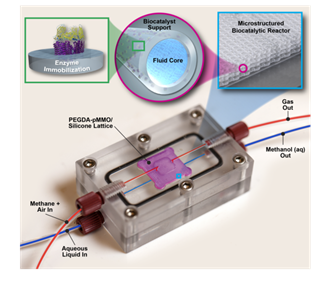
a poly(dimethyl siloxane) scaffold as part of a flow-through reactor, shown in
Figure 1, with which we have demonstrated continuous methane conversion using
encapsulated pMMO.
Figure 1: Schematic of enzyme immobilization within hydrogel in a structured polymer scaffold to create a gas-permeable biocatalytic material in a flow-through bioreactor.
This work was performed under the auspices of the U.S. Department of Energy by Lawrence Livermore National Laboratory under Contract DE-AC52-07NA27344.
See more of this Group/Topical: Topical Conference: Advances in Fossil Energy R&D