
Wetting on Strain Induced Microstructured Surfaces
Vartika Parihara, Soumen Dasb and Sunando Dasguptaa
aDepartment of Chemical Engineering, IIT Kharagpur 721302, India
bSchool of Medical Science and Technology, IIT Kharagpur 721302, India
E-mail: pari92vartika@gmail.com, sou@smst.iitkgp.ernet.in, sunando@che.iitkgp.ernet.in
Abstract
Wetting characteristics on hydrophobic micro-structured surfaces have remained a subject of eminent significance due to its characteristic properties and relevance in a plethora of industrial applications and scientific studies, such as anti-biofouling, self-cleaning and microfluidics etc1. Numerous processes for the fabrication and characterization of such specialty surfaces have been proposed and practiced2. However, most of them have limitations, i.e. they are inherently complex, intrinsically infrastructure dependent i.e. they require elaborate micro-fabrication facilities, and Most importantly, it is limited by the feature size of the available mask or the stamp3. Fabrication of microstructured surfaces with the controlled tuning of feature size has rarely been reported4. In this work, a new method for the fabrication of controlled dual scale roughened surfaces is reported involving relatively simpler processes compared to the existing processes5. The study enumerates a straightforward, masks-less process for the creation of microstructured surfaces, comprising of longitudinal wrinkles with controlled feature sizes. The microstructures result in the different wetting behavior of a sessile droplet with possible advantages in various applications. These wrinkles have been characterized by two morphological parameters, namely the amplitude and wavelength and they are found to be strong functions of the applied pre-strain. Wetting states over such wrinkled surfaces are observed to be governed by the underlying pattern of wrinkles. Modulation of the pre-strain leads to contrasting wetting regimes of Cassie-Baxter for high values of strain and Wenzel state for lower values of strain. The resulting equilibrium contact angles have been measured as a function of the buckle wavelength and amplitude. Thus, we have demonstrated a new and simple design paradigm, consisting of parallel grooves of appropriate aspect ratio with controlled anisotropic wetting.
The wrinkle process comprises stretching of a soft Polydimethylsiloxane(PDMS) (10:1) substrate and subsequent physical vapor deposition (sputtering)6, resulting in a hard metal (Nichrome) layer on the surface. Upon relaxation, sinusoidal wrinkles with a uniform wrinkle wavelength (λ) and amplitude (A) are formed due to the buckling instability (mismatch of strain in between the two materials) that relieves stresses in the form of sinusoidal undulation. Subsequently, after preparation of the surfaces, the topography is transferred on a PDMS (10:1) spin-coated, glass slide for enhancing the hydrophobicity on surfaces with anisotropic wetting behavior. The final structure of the fabricated micro wrinkles on a PDMS substrate is obtained as shown in the 3D Optical Surface Profiler (3D-OSP) image (Figure 1).
The variations in the buckle wavelength and amplitude are studied after complete relaxation of initial applied pre-strains on different samples. Effect of this varying topography on the wetting behavior is also studied by measuring the contact angles of 2µl DI water droplet for different substrates by using a Rame-Hart Goniometer. The contact angles measured on the substrate are shown along with the images of the sessile droplets in Figure 2. The images of the droplets are captured in two prime directions, i.e. along the wrinkles and across the wrinkles, demonstrating the strong anisotropic wetting behavior of the surfaces with nearly superhydrophobic behavior in a direction perpendicular to the direction of wrinkles on surfaces at high values of pre-strains.
Keywords: Microstructures, Superhydrophobic, Microfluidics, Contact Angle, Anisotropic Wetting.
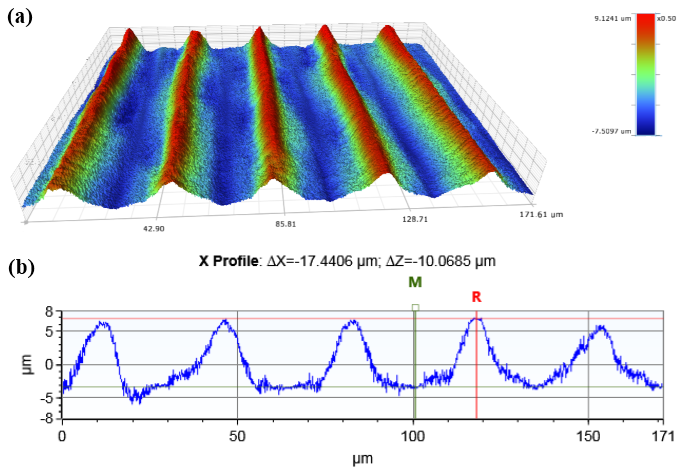
Figure 1. 3D optical surface profilometry
of the wrinkled PDMS surface for 50 % applied pre-strain; (a) 3D image, and
(b) corresponding surface profile.
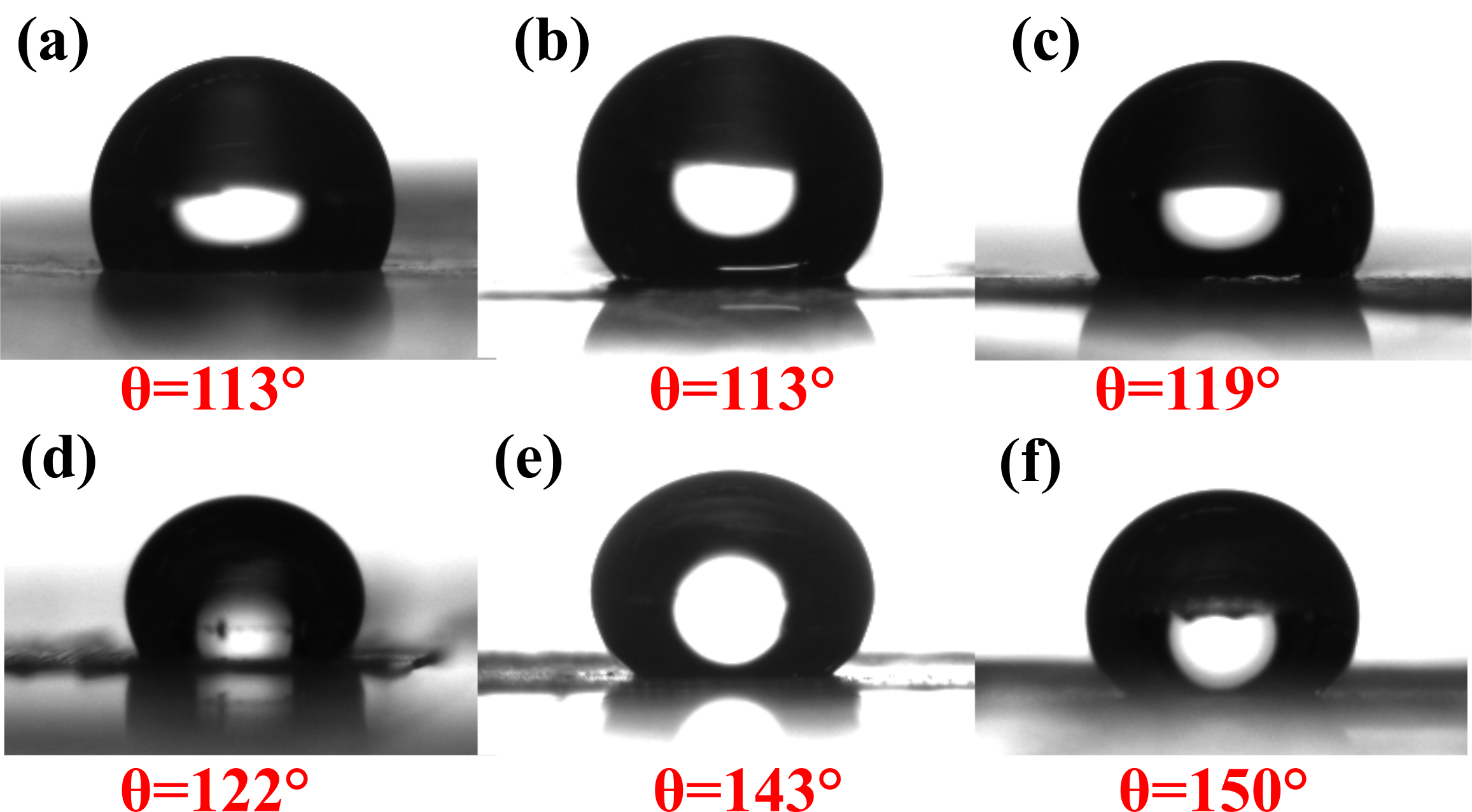
Figure
2. Contact angles subtended
by a DI water droplet of 2 µl volume on different surfaces. (a-c) shows
contact angles measured along the direction of wrinkles on surfaces with
pre-strains of 20%, 50%, and 80% respectively; whereas,
(d-f) shows contact angles measured perpendicular to the direction
of wrinkles on surfaces with pre-strains of 20%, 50%, and 80% respectively.
References:
1. Y. Y. Yan, N. Gao, and W. Barthlott (2011), “Mimicking natural superhydrophobic surfaces and grasping the wetting process: A review on recent progress in preparing superhydrophobic surfaces,” Adv. Colloid Interface Sci., vol. 169, no. 2, pp. 80-105.
2. B. N. Sahoo and B. Kandasubramanian (2014), “Recent progress in fabrication and characterisation of hierarchical biomimetic superhydrophobic structures,” RSC Adv., vol. 4, no. 42, pp. 22053-22093.
3. S. Chang and J. Yoon (2004), “arrays fabricated by a 3D diffuser lithography,” Opt. Express, vol. 12, no. 25, pp. 6366-6371.
4. S. L. Zhang et al. (2002), “Variation of Raman feature on excitation wavelength in silicon nanowires,” Appl. Phys. Lett., vol. 81, no. 23, pp. 4446-4448.
5. N. Bowden, S. Brittain, A. G. Evans, J. W. Hutchinson, and G. M. Whitesides (1998), “Spontaneous formation of ordered structures in thin films of metals supported on an elastomeric polymer,” Nature, vol. 393, pp. 146-149.
6. G. Bräuer, B. Szyszka, M. Vergöhl, and R. Bandorf (2010), “Magnetron sputtering - Milestones of 30 years,” Vacuum, vol. 84, no. 12, pp. 1354-1359.
See more of this Group/Topical: Engineering Sciences and Fundamentals