
Wax precipitates when waxy oil temperature decreases in pipeline transportation. A section of slurry (mixture of wax deposits and oil flow) may come into being when pigging is carried out for removing wax deposit, which can even lead to the getting stuck of a pig. So, it is necessary to find reliable tools to predict many variables related to the motion of a pig, such as the pig velocity, the pressure profile along the pipeline and the bypass flow rate, which are important to pigging efficiency and safety.
Reliable predictions of above variables demand appropriate models to handle (i) basic problems like the friction force between pipeline wall and pig, the resistant force of deposits and parameters of slurry formed in front of pig as well as (ii) the solution to combine the motion of pig, the motion of fluids and the motion of slurry.
To tackle these two problems, a mathematical model was developed to simulate the motion of a pig in waxy crude oil pipeline. In contrast with prior studies in which pigs moved in liquid and gas pipelines, wax deposits attached to pipeline wall was taken into consideration for the first time. So in addition with the fluid flow equations and dynamic equations of pig where key parameters like wax resistant force and friction force were obtained through experiments, a model to simulate the increasing slurry in front of pig was also established. All of them were solved together using the method of characteristics. Note that interaction between pig and fluid flow (or slurry) was described by mass conservation equations at boundaries. Combining pig motion with the pump operating characteristics, pig velocity and pipeline inlet pressure under any conditions of wax thickness can be obtained through the model (figure 1). Wax resistant force turns out to be two orders of magnitude smaller than pressure drop of the slurry section even when the thickness of wax deposits is 0.1m. Bigger diameter of bypass hole in the pig can, on one hand, reduce the viscosity of slurry which benefits the pig motion, while decrease pig velocity on the other hand, so an optimal diameter of bypass hole is recommended for the sake of pigging time consumed. According to the calculation results, when bypass diameter increases from 0.01m to 0.03m, the pressure drop of slurry decreases by nearly 15% after the pig moved for the same time.
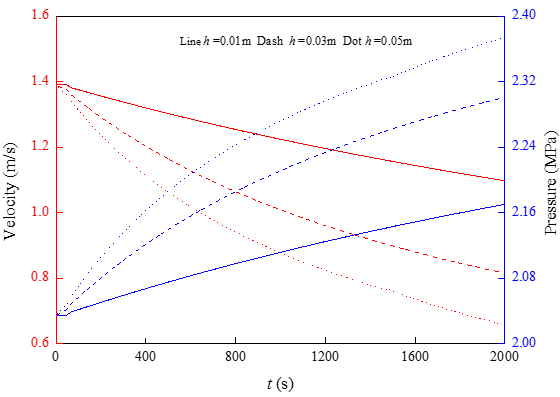
Figure 1 Time evolution of pig velocity and pipeline inlet pressure under different thickness of wax deposits (h)
Pigs would get stuck once the pipeline inlet pressure exceeds the available pumped pressure, so pipeline inlet pressure was taken as a criterion to judge whether a pig would get stuck (figure 2). Finally, sensitivity analysis in view of the effect of related parameters on the increasing rate of pipeline inlet pressure was performed and the results indicated an increasing sequence: thickness of wax deposits, friction force between pipeline wall and pig, viscosity of slurry.
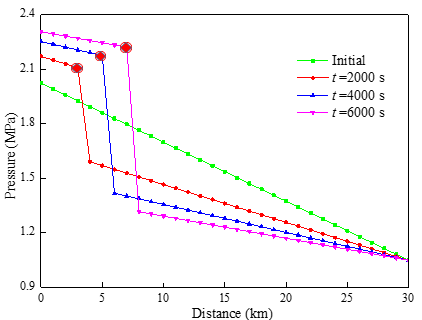
Figure 2 Illustration of pressure drop along the pipeline during pigging at different times (the red sign represents the pig position)
See more of this Group/Topical: Upstream Engineering and Flow Assurance Forum