
Fossil fuels are currently the primary source of energy and chemicals because of their high availability and energy content.1 However, the depletion of fossil fuels and environmental problems such as greenhouse gas emissions have triggered the development of biomass-based technologies, as biomass is the only source of renewable carbon.2 Those new technologies also bring novel value added chemicals by utilizing the functional groups which are already present in biomass molecules.3 Succinic acid (C4H6O4), a four-carbon dicarboxylic acid, is recognized by the Department of Energy (DOE) as one of the top biomass-derived platform chemicals.4 Its main applications include replacement of maleic anhydride as the C4 building block and synthesis of biodegradable and biobased polymers (Scheme 1).4 The traditional method for succinic acid production relies on fossil fuels. Fermentation has been proposed as a renewable alternative, yet low product concentration and high concentration of organic acid are still drawbacks.5,6
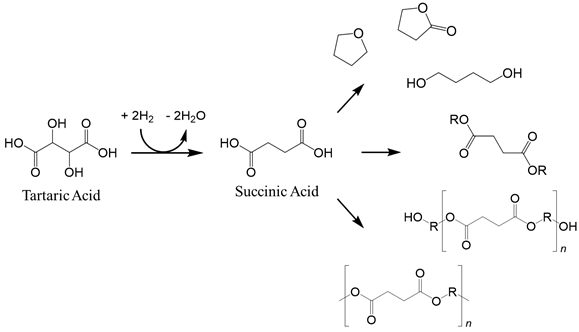
Scheme 1. Succinic acid synthesis and applications
We developed a novel one-step catalytic route to produce bio-succinic acid using biomass-derived tartaric acid (Scheme 1), in high yields. Tartaric acid, which is naturally produced in grapes, can be recovered from winery waste streams as a byproduct of wine industry.7 A liquid-phase system under hydrogen atmosphere comprised of molybdenum oxide catalyst supported on carbon black (MoOx/BC) is effective in catalyzing C-O bond cleavage of tartaric acid. The role of solvent was investigated to gain a better understanding of the reaction system. The MoOx/BC performance under different pre-reduction temperatures combined with characterization data such as temperature programmed reduction (TPR), X-ray powder diffraction (XRD), X-ray photoelectron spectroscopy (XPS) reveals that the high catalyst activity is correlated with the formation of specific Mo oxidation states. Finally, recyclability studies and structural characterization of the catalyst after reaction indicate that MoOx/BC remains active upon reuse.
References
(1) Beerthuis, R.; Rothenberg, G.; Shiju, N. R. Green Chem. 2014, 17, 1341–1361.
(2) Ruppert, A. M.; Weinberg, K.; Palkovits, R. Angew. Chemie - Int. Ed. 2012, 51 (11), 2564–2601.
(3) Corma, A.; Iborra, S.; Velty, A. Chem. Rev. 2007, 107 (6), 2411–2502.
(4) Carlson, A.; Coggio, B.; Lau, K.; Mercogliano, C.; Millis, J. Chemicals and Fuels from Bio-Based Building Blocks, 2016, 173–190.
(5) Cheng, K. K.; Zhao, X. B.; Zeng, J.; Wu, R. C.; Xu, Y. Z.; Liu, D. H.; Zhang, J. A. Appl. Microbiol. Biotechnol. 2012, 95 (4), 841–850.
(6) Bechthold, I.; Bretz, K.; Kabasci, S.; Kopitzky, R.; Springer, A. Chem. Eng. Technol. 2008, 31 (5), 647–654.
(7) Oliveira, M.; Duarte, E. 2016, 10 (1), 168–176.
See more of this Group/Topical: Catalysis and Reaction Engineering Division