
Membrane Assisted Antisolvent Crystallization for the Continuous and Accurate Control of Pharmaceuticals Manufacture
Xiaobin Jiang, Linghan Tuo, Gaohong He*
State Key Laboratory of Fine Chemicals, School of Chemical Engineering, Research and Development Center of Membrane Science and Technology, Petrochemical Energy-efficient Separation Technology Engineering Lab of Liaoning Province, Dalian University of Technology, Dalian, P. R. China
*Corresponding author: Email: xbjiang@dlut.edu.cn, hgaohong@dlut.edu.cn
Abstract
Different from batch process, membrane assisted antisolvent crystallization (MAAC) is proposed as a novel process to optimize pharmaceuticals manufacture significantly in recent year [1, 2]. MAAC could achieve continuous production and obtain the high quality of crystal product[3, 4].
In this work, without introducing vacuum and temperature gradient, the proposed MAAC process is operated under atmospheric pressure and isothermal conditions in the hollow fiber membrane module to achieve the continuous and accurate pharmaceuticals manufacture. Due to the high specific surface area of hollow fiber membrane module, the accuracy of the interfacial mass transfer rate is greatly higher than conventional antisolvent crystallization. The accurate mass transfer provides homogenous supersaturation through the membrane module, intensified micro mixing and more stable supersaturation gradient for nucleation and growth.
The driving force of MAAC is determined by the concentration difference, pressure difference and turbulence of membrane outside (shell side). Thus, the antisolvent permeation rate can be adjusted flexibly. As reported in the literature[5], an antisolvent liquid layer could be established on the membrane outer surface by regulating the process operation parameters. According to Bernoulli equation and liquid membrane renewal theory [6], high flow rate accelerates liquid membrane renewal and decreases pressure simultaneity. Thus, the interaction relationship of membrane inner and outer flow rates have obvious impact on solution mixing effect. Suitable flow rates keep nucleation occurring on the boundary layer of the liquid membrane, which would avoid membrane pore blockage and membrane fouling efficiently. Based on the advantages above, the continuous MAAC process could be adapted to the various requirements of pharmaceuticals during a production cycle, timely discharge and deal with the crystal produce could prevent tube blockage, which is one of the important problems of high viscosity pharmaceuticals in the convention batch manufacture process [7]. The proposed MAAC system is utilized in erythritol production to acquire crystals with desire morphology and size distribution (showed in Fig. 1). Crystals obtained by MAAC are obvious subuliform polyhedron shape, as a comparison, crystals obtained by conventional antisolvent crystallization are commonly spheroid or irregular shape. Moreover, the length-width ratio of MAAC crystals are closer to the simulated ideal morphology (MAAC: 1.49, conventional: 1.30, ideal: 1.52)[8]. The coefficient of variation (CV) of crystals decreases from 25.2 % (conventional) to 19.3 % (MAAC), which indicates narrower crystal size distribution.
With the stable and accurate mass transfer process controlled by the introduced membrane system, MAAC can be expected to expand the application and improve the performance of antisolvent crystallization in not only pharmaceuticals, but also food, biomacromolecule, fine chemicals fields.
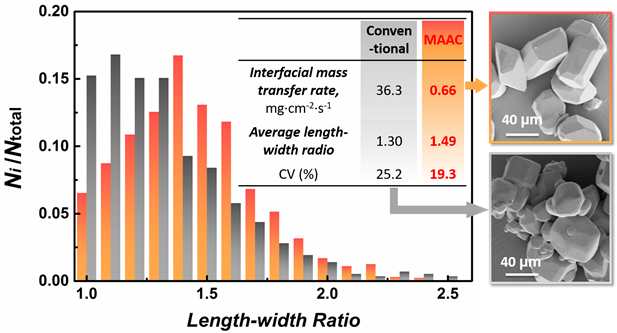
Fig. 1 Erythritol crystal size distribution, morphology, interfacial mass transfer rate and CV comparison between MAAC and conventional antisolvent crystallization.
Refrences
[1] Di Profio, G., Stabile, C., Caridi, A., Curcio, E., and Drioli, E., Antisolvent membrane crystallization of pharmaceutical compounds. J Pharm Sci, 98(12). 4902-13(2009).
[2] Lu, D., Li, P., Xiao, W., He, G., and Jiang, X., Simultaneous recovery and crystallization control of saline organic wastewater by membrane distillation crystallization. AIChE Journal, (2016).
[3] Drioli, E., Di Profio, G., and Curcio, E., Progress in membrane crystallization. Current Opinion in Chemical Engineering, 1(2). 178-182(2012).
[4] Zarkadas, D.M. and Sirkar, K.K., Antisolvent crystallization in porous hollow fiber devices. Chemical Engineering Science, 61(15). 5030-5048(2006).
[5] Ren, Z., Yang, Y., Zhang, W., Liu, J., and Wang, H., Modeling study on the mass transfer of hollow fiber renewal liquid membrane: Effect of the hollow fiber module scale. Journal of Membrane Science, 439. 28-35(2013).
[6] Chaturabul, S., Srirachat, W., Wannachod, T., Ramakul, P., Pancharoen, U., and Kheawhom, S., Separation of mercury(II) from petroleum produced water via hollow fiber supported liquid membrane and mass transfer modeling. Chemical Engineering Journal, 265. 34-46(2015).
[7] Blagden, N., de Matas, M., Gavan, P.T., and York, P., Crystal engineering of active pharmaceutical ingredients to improve solubility and dissolution rates. Adv Drug Deliv Rev, 59(7). 617-30(2007).
[8] Traini, D., Young, P.M., Jones, M., Edge, S., and Price, R., Comparative study of erythritol and lactose monohydrate as carriers for inhalation: atomic force microscopy and in vitro correlation. Eur J Pharm Sci, 27(2-3). 243-51(2006).
See more of this Group/Topical: Separations Division