
Optimal Design Strategy of an Aerated Stirred Tank Reactor Using Computational Fluid Dynamics and Bayesian Multi-Objective Optimization Combined Method
Seongeon Park, Minjun Kim, Jonggeol Na, Jinjoo An and Chonghun Han*
School of Chemical & Biological Engineering, Seoul National University, Seoul, South Korea
ABSTRACT
Optimal reactor design is still a poorly understood problem compared to process optimization problems, although the performance of a reactor greatly influences the efficiency of whole process. This is partly due to the inability of numerical reactor models to predict the non-ideal mixing behaviors. Nowadays, computational fluid dynamics (CFD) has emerged as a solution to overcome such limitations by reflecting the complex 3D hydrodynamics inside a reactor.
However, the optimization problem involving CFD simulation is difficult to solve, because the computational cost for runs of simulation is very expensive, and gradient information which may guide the parameter search is unavailable. Bayesian optimization (BO), a recently popularized gradient-free black-box global optimization algorithm, is a very promising approach for such problems. BO builds a surrogate model of the objective function based on the data points already explored, and exploits information from the model to decide where to search next.
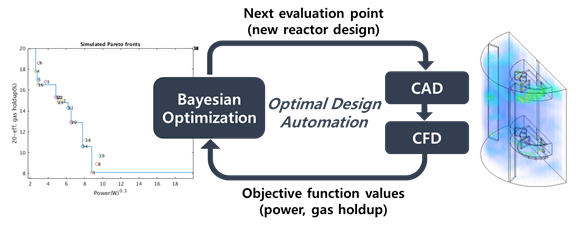
In this research, a strategy to find the optimal design of an aerated stirred tank reactor with two Rushton turbine impellers using CFD and BO combined method is proposed. A multi-objective extension of BO was employed in order to maximize the effective gas holdup and minimize the power consumption simultaneously. Six optimization variables to define the geometrical structure of the reactor were chosen: the aspect ratio of the tank, the impeller diameter to the tank diameter ratio, the clearance of each impeller to the tank height ratio, the gas sparger diameter to impeller diameter ratio and the sparger clearance to the tank height ratio. The CFD reactor model works as a black-box function of which the inputs are design variables and the outputs are objective function values. The reactor structure of Alves (2002) was chosen to be a base case and its experimental data were used to validate the CFD reactor model.
As a result, the algorithm found the best solutions, which comprise a Pareto front, within 50 iterations. Furthermore, the whole optimal design process could be automated without any need of human decision practices.
REFERENCE
Alves, S. S., et al., "Experimental and modelling study of gas dispersion in a double turbine stirred tank," Chemical Engineering Science, 57(3), pp. 487-496 (2002)
See more of this Group/Topical: Liaison Functions