
Continuous crystallization process for resolution of diastereomeric salts: Ibuprofen lysine case study
M. Simon1, R.C. Jones1, P. Donnellan1 and B. Glennon1
1Synthesis and Solid State Pharmaceutical Centre (SSPC), University College Dublin, School of Chemical and BioProcess Engineering, University College Dublin, Belfield, Dublin 4, Ireland
Keywords: diastereomeric salt, continuous crystallization, phase diagram
Introduction
More than half of the active pharmaceutical ingredients are found to be chiral[1]; hence, enantioseparation is of significant interest to the pharmaceutical industry.[2] In the case of a racemic mixture, typically only one enantiomer possesses the active therapeutic activity while the other is regarded as an impurity constituting 50% of the mixture.[3] This undesired enantiomer can cause undesired side effects[4] e.g., the tragic incident of the drug thalidomide in the 1960s, which resulted in physical birth defects (the R-enantiomer was proven to be a teratogen whereas the S-enantiomer was used to treat morning sickness for pregnant women).[5]
Crystallization is broadly applied at small and large scales to eliminate impurities, including enantiomeric impurities.[2] An in-depth understanding of the solid-liquid equilibrium (SLE) data in terms of phase diagrams is vital for devising and optimizing crystallization processes.[6]
One method to isolate high purity enantiomer from a racemic mixture is by diastereomeric salt formation. Racemic basic (or acidic) target compounds are reacted with optically active compounds such as enantiopure acidic (or basic) resolving agents to form a pair of diastereomeric salts that can [7] be separated by fractional crystallization.[8] The resulting salt is subjected to neutralization process to give a pure enantiomer. The crystallization process can be either kinetically (separation of salts depending on the rate of crystals formed) or thermodynamically (separation of salts depending on their solubility differences) controlled.[7, 9] Unlike enantiomers, diastereomeric salts do not possess symmetry.[10] The properties of diastereomeric salts are as follows: high solubility difference, distinct crystal morphology, good thermal stability, rapid dissolution rate, and varied inclination to crystallize.[11] The high solubility difference between the salt pairs is accomplished by the appropriate choice of resolving agents and/or a solvent system during the resolution.[12]
A systematic study of the diastereomeric salt formation of R-ibuprofen-S-lysinate (R-salt) and S-ibuprofen-S-lysinate (S-salt) were explored in the binary and ternary phase diagram using 94 wt% aqueous ethanol as a solvent. Based on the phase diagram, a continuous crystallizion process with crystal-free mother liquor exchange streams was devised.
Section 1: Solubility Studies
Thermodynamic data (binary and ternary phase diagram of the two diastereomeric salts in the solvent system at different temperatures) and kinetic properties (metastable zone widths in an appropriate solvent) are required to design appropriate crystallization process.[13] The ternary phase diagram of the salt pairs in 94 wt% aqueous ethanol were determined by classical isothermal and polythermal methods. The metastable zone widths of the pure salts were measured. The ternary phase diagram depicted in Fig. 1, confirms that the eutectic point exists at a salt composition of ~34:66 wt% R-salt:S-salt. The phase diagram and X-ray Powder diffraction patterns of the salt mixtures confirmed the formation of a simple eutectic behaviour in the system of the diastereomeric salts.
Section 2: Design of a Continuous Coupled Crystallization Process
The thermodynamic data depicted in Fig. 1 was used to design the resolution method to resolve both salts with high purity. The aim was to investigate the applicability of a continuous coupled MSMPR crystallizers for simultaneous separation of the diastereomeric salts by crystal growth with pure seed crystals. Crystal-free mother liquor exchange streams were operated continuously between the two MSMPR.
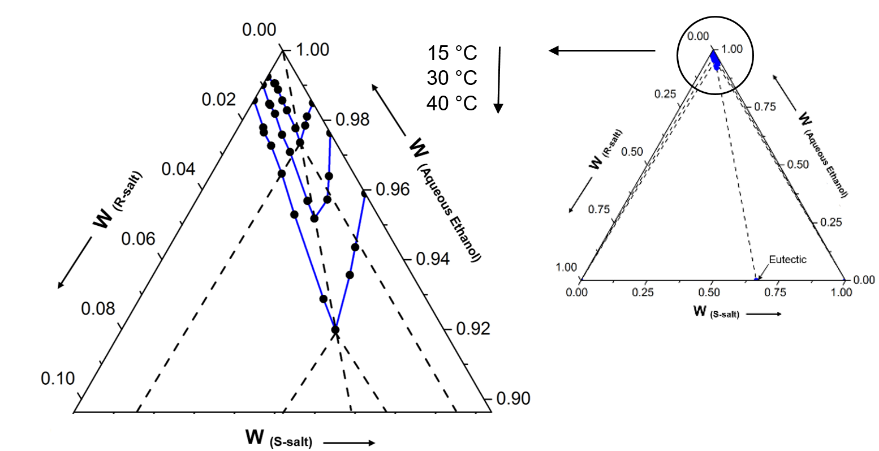
Figure 1: Ternary phase diagram of diastereomeric salts of ibuprofen lysine: R-salt & S-salt (axes in weight fraction (W); lines are guides to the eye; tie lines are drawn for 15 °C and 40 °C)
Acknowledgements:
The financial support of the Synthesis and Solid State Pharmaceutical centre (SSPC) and Science Foundation Ireland (SFI, 12/RC/2275) are gratefully acknowledged.
References:
[1] J. Chen and A. S. Myerson, CrystEngComm 2012, 14, 8326-8329.
[2] Y. Wang and A. M. Chen, Organic Process Research & Development 2008, 12, 282-290.
[3] B. S. Sekhon, Int J Pharm Technol Res 2010, 2, 1584-1594.
[4] A. Singh and A. S. Myerson, Journal of pharmaceutical sciences 2010, 99, 3931-3940.
[5] J. E. Rekoske, AIChE Journal 2001, 47, 2-5.
[8] P. R. Anandamanoharan, P. W. Cains and A. G. Jones, Tetrahedron: Asymmetry 2006, 17, 1867-1874.
[11] H. Wu and A. G. Jones, Chemical Engineering and Technology 2012, 35, 1031-1038.
See more of this Group/Topical: Separations Division