
Key words: hollow fibre membrane, direct-flow filtration, packing density, membrane fouling, fibre diameter, pumping pressure
Direct-flow (DF) filtration operating in capped hollow fibre membrane (HFM) modules with a regular intermittent backwash has become the dominant technology for potable water treatment. Since the capped-end design ensures no outlet flow from the module, the pressure drop along the feed channel is very small and smaller diameter fibres can be used. Our previous analytical investigation [1, 2] indicated that fibres with large inner diameter and small wall thickness were to be preferred. However the reason for the clear industrial preference for fibre diameters in the tight range 0.8mm to 0.9mm inner diameter (ID) and 1.3mm to 1.4mm outer diameter (OD) was not clear. Therefore, the underlying trade-off between the fibre diameters and other key design considerations, e.g. the module packing density was explored. This work presents an MATLAB model for simulating a constant flux, fixed pump-driving pressure DF-HFM filtration. The model was validated against our previous mathematical model resulting from solution of the Navier-Stokes equations. The new model provides a more practical method for investigating the solution space and here we present an analysis of the filtration process, including pressure drops, velocity profiles and the module productivities. Specifically this presentation focuses on the analysis of the effects of the fibre diameter and module packing densities on the overall filtration outputs. The modelling results (Figure 1) show that at fixed pumping pressure of 10 kPa (above outlet permeate pressure), 55% to 65% packing of 1.0mm to 1.2mm OD fibres generate higher outputs than other designs. However, a slightly higher OD range would be preferred if one wants to avoid the sharp decline of filtration throughputs which occur at higher packing densities. Given that the packing density is non-uniform this can be an advantage. Additional investigations that will be part of the presentation. There will include an exploration of the effect of fibre lengths and the effect of imposed flux.
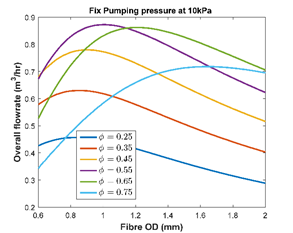
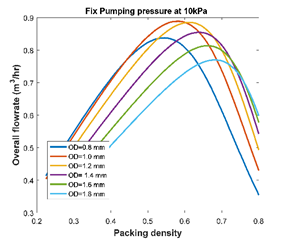
Fig. 1. The influence of packing density,  , and
fibre OD upon the overall module flowrate,
 at fixed pumping
pressure of
 above permeate outlet
pressure. The module had an inner diameter of 165mm
and a length of 1.6m.
[1] J. G. Herterich, Q. Xu, R. W. Field, D. Vella, and I. M. Griffiths, "Optimizing the operation of a direct-flow filtration device," Journal of Engineering Mathematics, pp. 1-17, 2016.
[2] Q. Xu, G. K. Pearce, and R. W. Field, "Pressure driven inside feed (PDI) hollow fibre filtraitons: Optimizing the geometry and operating parameters," Journal of Membrane Science [Submitted for publication], 2017.
See more of this Group/Topical: Liaison Functions