
UV-curable polymerization is widely used in industrial applications for different purposes, such as decoration, protection, and some other specific functions.1 Conventionally, petroleum-based materials are included in most UV-curing polymer.
This will be increasing environmental concerns and limit for fossil feedstock.2 Much effort has been devoted to explore renewable materials to substitute non-renewable organic chemicals.3 Among these, a cashew nut shell liquid (CNSL), is a kind of sustainable, low-cost and largely available natural resources, which is obtained as a byproduct of the cashew processing industry.4 Its extracted product, cardanol, is a phenol derivative, which has a meta-substituent of a C15 unsaturated hydrocarbon chain with one to three double bonds.5 This unique structure exhibits promising properties for making tailor-made polymers of high value.6
Cardanol can be reacted with epichlorohydrin (ECH) in order to introduce the epoxy group. Then the cardanol glycidyl ether is synthesized and used in the next step. The unsaturated double bonds in the molecular structure of the cardanol glycidyl ether can be oxidized by 3-Chloroperbenzoic acid to form epoxide groups. The epoxide groups of the product were reacted with acrylic acid in the presence of triphenyl phosphorus. High biomass content UV-curable epoxy acrylate oligomers were synthesized. Different contents of the modified Nano-silica were added into the epoxy acrylate oligomer to study the materials property variations.
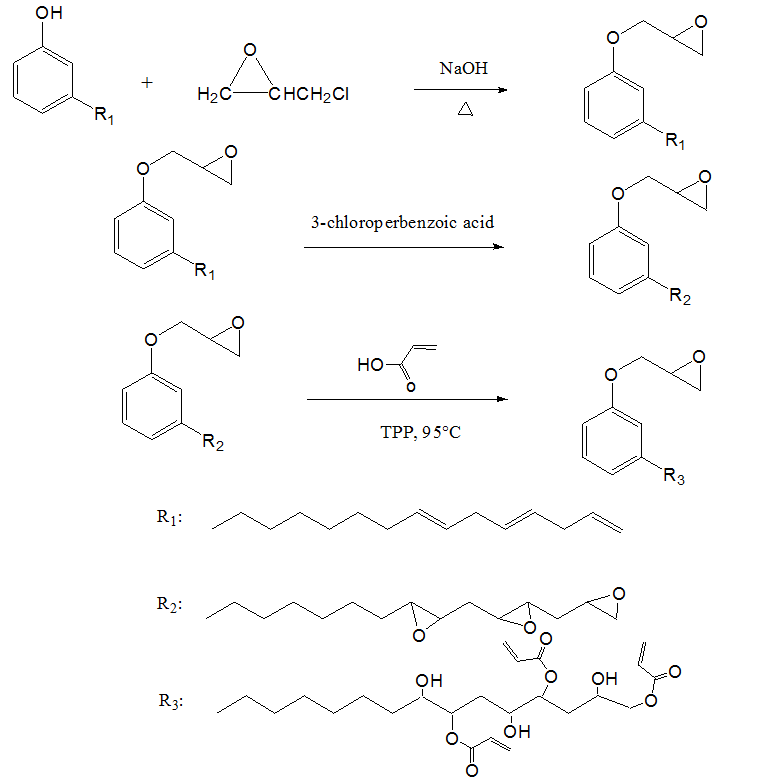
Fig 1 Synthesis sequence adopted for the preparation of cardanol-based epoxy acrylate oligomers
The structure of the prepared products was analyzed by a nuclear magnetic resonance (NMR) and (FT-IR) spectroscopy. The biorenewable content of UV-curable epoxy acrylate oligomers is about 58.8% ~ 60.9%. The UV-cured coatings have high gel content and good flexibility. The hardness value of the samples is form 3H to 5H. With the increasing of the modified Nano-silica content, the contact angle values on the cured film surfaces and surface energy showed a great changes. The presences of 0.75% (relative to the total mass) of the modified Nano-silica could lead to a large decrease in the surface free energy. The scanning electron microscopy (SEM) images were evident that the solubility of the UV-cured coatings was improved with a small amount of modified Nano-silica addition. We expect that our results will provide insight into the utilization of a new epoxy acrylate oligomer for adhesive and coating applications.
[1] H. Wang, W. Liu, Z. Yan, J. Tan and G. Xia-Hou, RSC Adv., 2015, 5, 81838-81846.
[2] R. Liu, X. Zhang, J. Zhu, X. Liu, Z. Wang and J. Yan, ACS Sustainable Chemistry & Engineering, 2015, 3, 1313-1320.
[3] R. Liu, G. Zhu, Z. Li, X. Liu, Z. Chen and S. Ariyasivam, Green Chem., 2015, 17, 3319-3325.
[4] K. I. Suresh and V. S. Kishanprasad, Ind. Eng. Chem. Res., 2005, 44, 4504-4512.
[5] J. Chen, X. Nie, Z. Liu, Z. Mi and Y. Zhou, ACS Sustainable Chemistry & Engineering, 2015, 3, 1164-1171.
[6] C. Voirin, S. Caillol, N. V. Sadavarte, B. V. Tawade, B. Boutevin and P. P. Wadgaonkar, Polym. Chem., 2014, 5. 3142-3162.
See more of this Group/Topical: 2017 International Congress on Energy