
Eirini Skylogianni1, Diego D. D. Pinto1, Hanna K. Knuutila1, Christophe Coquelet2
1 Norwegian University of Science and Technology (NTNU), Trondheim, Norway
2 Mines ParisTech, Fontainebleau, France
INTRODUCTION
Trouble-free operations and stringent environmental requirements in the oil and gas industry demand the removal of, among other, acidic constituents from natural gas. The presence of carbon dioxide (CO2) and hydrogen sulfide (H2S) increases corrosion, creates safety hazards for operations and results in an export gas of lower value. The most commonly used technology for acid gas removal is chemical absorption into aqueous amine-based solvents. When the selective removal of H2S over CO2 is desired, tertiary amines are preferred since hydrogen sulfide reacts instantaneously through a proton transfer while carbon dioxide cannot react directly with the amine (Versteeg et al., 1996). In our work, aqueous solutions of N-methyldiethanolamine (MDEA) are studied. This amine demonstrates high selectivity for H2S over CO2, degradation resistance, lower losses by vaporization because of its low vapor pressure and lower energy requirements during regeneration thanks to its low enthalpy of reaction (Kohl and Nielsen, 1997).
OBJECTIVE
Vapor-liquid equilibrium (VLE) data over a wide range of pressures, temperatures and concentrations of the various solvents used for acid gas removal are essential for the development of the thermodynamic models employed during the design and operation of the absorption and regeneration units. Plenty of equilibrium data are already available in the literature for the system CO2-MDEA-H2O, at various MDEA concentrations, pressure and temperature conditions since the use of amine-based solvents is also the dominant technology for CO2 capture from the flue gases emitted by fossil fuel power plants. Moreover, the effect of the co-existence of carbon dioxide and hydrogen sulfide to the acid gas solubility into an MDEA solution has also been studied. However, few experimental measurements of the solubility of H2S into aqueous amine solutions have been performed. In addition to this, to the authors’ best knowledge, there are not any available data for high MDEA concentrations (MDEA > 50 wt. %). The objective of this work is, therefore, to provide new experimental data for the system H2S-MDEA-H2O at pressures, temperatures and concentrations that have not been studied so far in the literature with focus on high pressures, as high-pressure processes are relevant to the offshore/subsea operations and long-distance transportation of natural gas. When needed, methane will be used for pressurization, as it is the main component present in natural gas. Therefore experimental data for the system H2S-CH4-MDEA-H2O will be also provided. Such data can be used to validate and/or extend existing models in terms of concentration and/or pressure and predict the thermodynamic behavior of the system accurately.
APPARATUS
A high-pressure equilibrium cell described by Dicko et al. (2010) is used for the experimental measurements of vapor-liquid equilibrium (Figure 1). A static-analytic method is employed utilizing two ROLSI® capillary samplers for fluid sampling (ARMINES, 2003), one for the vapor phase and one for the liquid phase. The VLE apparatus is designed for measurements with acid gases and organic sulfur compounds with different solvents and it allows for measurements at a pressure range of 0 – 10000 kPa and temperature range of 243 – 473 K. The analysis of the vapor and liquid phase samples is performed by means of gas chromatography. The apparatus is connected to a gas chromatograph which allows the analysis of the two phases samples and so the estimation of the respective molar compositions.
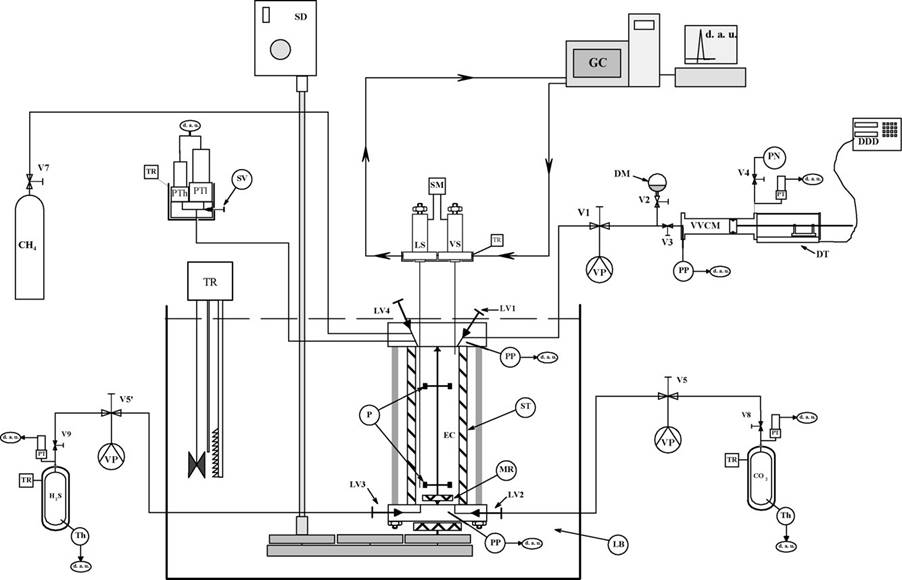
Figure 1: Flow diagram of the equipment. d.a.u.: data acquisition unit; DDD: displacement digital display; DM: degassed mixture; DT: displacement transducer; EC: equilibrium cell; GC: gas chromatograph; LB: liquid bath; LS: liquid sampler; LVi: loading valve; MR: magnetic rod; P: propeller; PP: platinum probe; PN: pressurized nitrogen; PT: pressure transducer; PTh: pressure transducer for high pressure values; PTl: pressure transducer for low pressure values; SD: stirring device; SM: sample monitoring; ST: sapphire tube; TR: thermal regulator; Th: thermocouple; Vi: valve; VP: vacuum pump; VS: vapor sampler; VVCM: variable volume cell for mixture.
RESULTS
In this paper, we are going to present experimental vapor-liquid equilibrium data for the system H2S-MDEA-H2O and CH4-H2S-MDEA-H2O at different loadings of the solution and at conditions relevant to the operating conditions of the absorber and the stripper (up to 100 bar and up to 120oC). A 50 wt.% MDEA solvent will be used for validation by comparing with available data from the literature, as well as two highly concentrated solvents, i.e. 70 wt. % and 90 wt. % MDEA, will be studied. A comparison of the new data and the predicted values from a thermodynamic model will be also presented.
REFERENCES
ARMINES, 2003. Procédé et Dispositif Pour Prélever Des Microéchantillons D’un Fluide Sous Pression Contenu Dans Un Container. 2 853 414.
Dicko, M., Coquelet, C., Jarne, C., Northrop, S., Richon, D., 2010. Acid gases partial pressures above a 50 wt% aqueous methyldiethanolamine solution: Experimental work and modeling. Fluid Phase Equilibria 289, 99–109. doi:10.1016/j.fluid.2009.11.01
Kohl, A.L., Nielsen, R.B., 1997. Chapter 2 - Alkanolamines for Hydrogen Sulfide and Carbon Dioxide Removal, in: Gas Purification. Gulf Professional Publishing, Houston, pp. 40–186.
Versteeg, G.F., Van Dijck, L.A.J., Van Swaaij, W.P.M., 1996. On the kinetics between CO2 and alkanolamines both in aqueous and non-aqueous solutions. An overview. Chem. Eng. Commun. 144, 133–158.
See more of this Group/Topical: Engineering Sciences and Fundamentals