
The use of conducting polymers as the active material for supercapacitors is a promising approach to improve the performance of supercapacitors. Conducting polymers enhance charge storage capacity through Faradaic redox reactions, and have the ability to be p- or n-doped. They are typically deposited via solvent-based techniques such as chemical bath deposition, electrodeposition, and casting from suspension. Nevertheless, challenges exist with making ultrathin (5-10 nm) uniform conformal coatings via wet chemistry routes, especially with poor solubility of many conducting polymers and poor accessibility of the highly tortuous pore space within nanostructured electrodes. To conveniently bypass these challenges, polyaniline (PANI) is synthesized via oxidative chemical vapor deposition (oCVD) in a single-step, solvent-free process using aniline monomer and antimony pentachloride oxidant, to deposit ultrathin films into Mo2C carbide-derived-carbon (CDC) electrodes (Figure 1).1 we are realizing a strategy proposed by Simon and Gogosti2 to improve both the energy and power densities of electrochemical capacitors by integrating conducting polymers into nanostructures electrodes.
By understanding the oCVD PANI synthesis parameters (reagent flow rates, reactor pressure, substrate temperature), the reaction and diffusion rates can be carefully controlled to optimally coat the porous carbide derived carbon (CDC) electrode. The oxidant flowrate, substrate temperature, and reactor pressure were varied, and their influence on film chemistry and supercapacitor performance was explored. The study reveals that a higher substrate temperature, pressure, and oxidant flowrate are critical for depositing emeraldine PANI for optimal electrochemical performance. Spectroscopic results,3 such as FTIR, SEM and XPS, indicate that a substrate temperature of 90 °C is needed to minimize the formation of oligomers during polymerization. Increasing the oxidant flowrate to nearly match the monomer flowrate favors the deposition of PANI in the emeraldine state. Lower substrate temperatures (Low-T), such as 25 °C, lower pressures (Low-P) and lower oxidant flow (Low-O) generally lead to poorer quality PANI films that results in more oligomers. By optimizing the oCVD processing conditions, CDC electrodes integrated with oCVD PANI exhibits more than double the gravimetric capacitance (115 F/g) vs bare CDC electrodes (52 F/g) and a 79% capacity retention after over 10,000 cycles.4 Interestingly, the optimally performing PANI-CDC devices have a porous PANI morphology as determined by SEM, which may facilitate ion transport, improve scan rate performance, and impart electric double layer capacitance in addition to the intrinsic faradaic pseudocapacitance.
1. Smolin, Y. Y.; Van Aken, K. L.; Boota, M.; Soroush, M.; Gogotsi, Y.; Lau, K. K. S., Engineering Ultrathin Polyaniline in Micro/Mesoporous Carbon Supercapacitor Electrodes Using Oxidative Chemical Vapor Deposition. Adv. Mater. Interfaces 2017, DOI: 10.1002/admi.201601201
2. Simon, P.; Gogotsi, Y., Materials for Electrochemical Capacitors. Nat. Mater. 2008, 7, 845-854.
3. Smolin, Y.Y.; Soroush, M.; Lau, K. K. S., Oxidative Chemical Vapor Deposition of Polyaniline Thin Films. Beilstein J. Nanotech. 2017 (under review).
4. Smolin, Y. Y.; Soroush, M.; Lau K. K. S., Influence of oCVD Polayanilnie Film Chemistry in Carbo-Based Supercapacitors. Ind. Eng. Chem. Res. 2017 (under review).
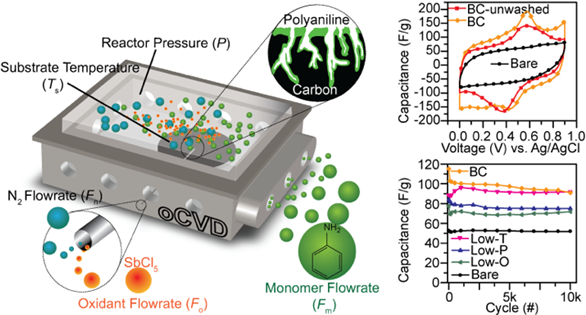
Figure 1. Left: oCVD process where the oxidant (SbCl5, orange) and monomer (aniline, green) vapors enter the reaction chamber and surface polymerize onto the porous electrode. Right: A comparison of the cyclic voltammograms and cycle life for both bare (black) CDC and oCVD PANI-CDC (colored) at various oCVD process conditions (at 20 mV/s).
See more of this Group/Topical: Topical Conference: Nanomaterials for Applications in Energy and Biology