
Simulation of Particle Dissolution using the Phase Field Approach
D. Sleziona1, D. R. Ely2, M. Thommes1
PURPOSE The aim of this work is to describe the dissolution behavior of single crystals with a numerical model. Already
existing analytical approaches for the description of crystal dissolution like
Fick’s law of diffusion1, the Nernst-Brunner equation2,3, the Hixson-Crowell cubic root law4 and
the Higuchi5 equation are suitable. However they do not take into
account the anisotropy or the particle shape. The motivation of this work is to
model the anisotropic dissolution behaviour of single crystal particles by
using a finite volume method. Dissolution is understood as the transformation
of a solid (crystalline state) in a liquid environment in a solution. This
process is divided into two parts. The phase transition and diffusion. The
first part can be modelled numerically with the so called phase field
simulation6. In this numerical tool a partial differential equation
is used to replace boundary conditions at the interface6. This leads
to an evolving ancillary field. In this field the state of the materials is
described by a non-conserved order parameter, which is a function of position
and time6. It models the phase as a continuous variable ranging from
disordered (liquid) to perfectly ordered (solid)6,7.
Also the second part, diffusion, can be calculated with a finite volume method.
This approach offers the advantage that no diffusion layer has to be
implemented. It is formed independently during the simulation. RESULTS An isotropic,
circular, two-dimensional Xylitol particle dissolving in water (25 °C) was
simulated as a model system. The time evolution of the phase (phase transition)
of the binary system could be described by the Allen-Cahn-equation6,8, as follows:
Equation 1 gives
the rate change of the phase (∂Φ/∂t) in
terms of the mobility of the phase (MΦ), the free
energy density (f) and the gradient energy coefficient of the phase (εΦ). The
corresponding concentration field (diffusion) was modelled using the approach
of Cahn and Hilliard8,9 given by the
equation,
As seen in
equation 2, the rate change of the concentration field (∂c/∂t) is
expressed as a function of the concentration mobility (Mc), the
free energy density (f) and the gradient energy coefficient of the
concentration (εc).
Equations 1 and 2 form a system of two coupled partial differential equations
linked via the free energy density f(Φ,c,T),
which is a function of phase, concentration, and temperature. The system was
solved numerically to obtain the phase transition and diffusion (concentration
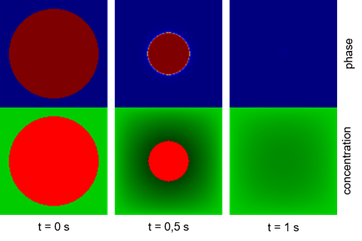
field) as a function of time as shown in Figure 1.
Figure 1:
dissolution of a 100 µm xylitol particle in water (25 °C) A simultaneously
evolving phase and concentration field could be observed. Because of the isotropic
properties of the simulated, two dimensional particle a validation of the
numerical results based on the previous mentioned Nernst-Brunner equation is
possible. Due to the fact that the Nernst-Brunner law describes the dissolution
behaviour of a three dimensional, isotropic spherical particle, a new
validation equation for the circular two dimensional, isotropic, Xylitol crystal
was derived.
This equation 3 represents
the dissolution process of an infinite long, three dimensional cylinder which
dissolves only over its lateral surface. There the particle radius (r) is a function of the starting radius
(r0), diffusion
coefficient (D), saturation
concentration (cS),
concentration (c), diffusion layer
thickness (d
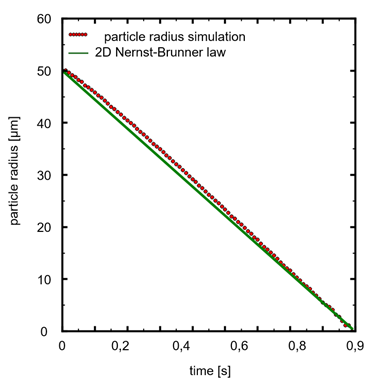
Figure 2:
particle radius of a 100 µm, circular, isotropic, two dimensional xylitol
particle in water (25 °C) So a successful
coupling of the Allen-Cahn and Cahn-Hilliard equation can be presented, which
leads to a simulation where the change in phase transition and diffusion can be
observed over time. CONCLUSION A finite volume
simulation was developed for the investigation of the dissolution behaviour of crystal
particles. Phase transition and diffusion could be coupled by linking the
Allen-Cahn- and Cahn-Hilliard-equation over the free energy density function f(Φ,c,T). The dissolution of a circular,
isotropic, two dimensional Xylitol particle in water at 25°C was simulated and
validated with a derived two dimensional Nernst-Brunner equation. The extension
of this simulation into the third dimension and incorporation of anisotropy
into this model is part of the ongoing work. REFERENCES 1. Fick, A. (1855) Ueber Diffusion, Annalen der Physik
170, 59-86. 2.
Nernst, W. (1904) Theory of
reaction velocity in heterogenous systems, Zeit. physikal. Chem 47, 52-55. 3.
Brunner, E.
(1903) Reaktionsgeschwindigkeit in heterogenen Systemen,
Georg-Augusts-Universitat, Gottingen. 4.
Hixson, A. and Crowell, J. (1931) Dependence of Reaction
Velocity upon surface and Agitation, Industrial & Engineering Chemistry 23,
923-931. 5.
Higuchi, T. (1961) Rate of release of medicaments from
ointment bases containing drugs in suspension, Journal of Pharmaceutical
Sciences 50, 874-875. 6.
Boettinger, W. J., Warren, J. A., Beckermann, C.,Karma, A.
(2002) Phase-field simulation of solidification, Annual review of materials
research 32, 163-194. 7.
Cui, Z., Gao, F., Cui, Z.,Qu, J. (2011) Developing a second
nearest-neighbor modified embedded atom method interatomic potential for
lithium, Modelling and simulation in materials science and engineering 20,
015014. 8.
Allen, S. M. and Cahn, J. W. (1979) A microscopic theory for
antiphase boundary motion and its application to antiphase domain coarsening,
Acta Metallurgica 27, 1085-1095. 9.
Cahn, J. W. and Hilliard, J. E. (1958) Free energy of a
nonuniform system. I. Interfacial free energy, The Journal of chemical physics
28, 258-267.


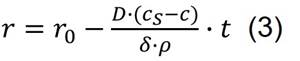
 ),
particle density (ρ
 ) and
time. Geometrically this reflects the two dimensional dissolution of the
simulated circular particle. Figure 2 shows the course of the simulated
remaining particle radius over the simulation time, which follows continuously the
derived validation equation and ends up in a similar total dissolution time.
See more of this Group/Topical: Pharmaceutical Discovery, Development and Manufacturing Forum