
Lignocellulosic biomass is an abundant and sustainable feedstock that can be used to produce biofuels and biobased commodity chemicals. However, the low oil price and the challenges in applying biorefinery technologies at scale hamper the commercial production of biofuels. In this presentation we will discuss a strategy to integrate the production of a high-value coproduct, 1,5-pentanediol (1,5-PDO), along with a typical bioethanol production process.
1,5-PDO and two other conventional α,ω-diols (e.g. 1,6-hexandiol and 1,4-butanediol), are building blocks for polyurethane and polyester plastics. These α,ω-diols are currently derived from petroleum and, as a group, represent an annual market over $6 billion. An economically viable approach of producing 1,5-PDO from biomass-derived furfural has been developed recently (Brentzel et al., 2017; Huang et al., 2017), which offers the potential to coproduce 1,5-PDO as a high value co-product of bioethanol manufacturing process to improve cellulosic biorefinery economics.
In this work, we propose a novel strategy that integrates lignocellulosic biomass fractionation with simultaneous conversion of cellulose and hemicellulose into ethanol and 1,5-PDO, respectively. First, we fractionate biomass into its three primary constituents— hemicellulose, cellulose, and lignin—using γ-valerolactone (GVL) as a solvent (Alonso et al., 2017), which also enables excellent yields of furfural by dehydration of xylose. The purified furfural is then used to produce 1,5-PDO (Huang et al., 2017), and the cellulose portion is converted to ethanol via enzymatic hydrolysis and fermentation (Humbird et al., 2011), while the lignin is combusted to generate steam and electricity. We have developed an experimentally based process simulation model (mass and energy balances) to determine the economic potential of the integrated strategy. If we consider a plant processing to 1,000 dry metric tonne per day white birch feedstock and producing 38,520 ton per year 1,5-PDO and 19.3 MMgal per year ethanol, the integrated strategy leads to a minimum ethanol selling price of $1.52 per gallon when 1,5-PDO is sold at $3,100 per ton (Figure 1). It is shown that this strategy could lower the cost of ethanol produced from biomass by more than two dollars per gallon. Finally, we perform sensitivity analysis to identify the major economic drivers of the process and suggest future research directions.
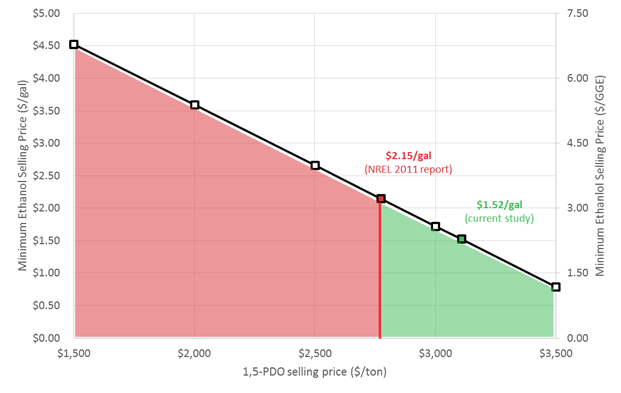
Figure 1. Minimum ethanol selling price as a function of 1,5-PDO selling price. The “green” region (1,5-PDO selling price > $2,775 per ton) indicates that the integrated strategy has favorable economics for ethanol production compared with the biochemical conversion process used in NREL 2011 report (Humbird et al., 2011).
References
1. Alonso, D. M.; Hakim, S.; Zhou, S.; Won, W.; Hosseinaei, O.; Tao J.; Garcia-Negron, V.; Motagamwala, A. H.; Mellmer, M. A., Huang, K.; Houtman C. J.; Labbé, N.; Harper, D. P.; Maravelias, C. T.; Runge T.; Dumesic, J. A. Increasing the revenue from lignocellulosic biomass: Maximizing feedstock utilization. Science Advances 2017.
2. Brentzel, Z. J.; Barnett, K. J.; Huang, K.; Maravelias, C. T.; George, W.; Dumesic, J. A.; Huber, G. W. Chemicals from Biomass: Combining Ring-opening Tautomerization and Hydrogenation Reactions to Produce 1,5-Pentanediol from Furfural. ChemSusChem 2017, 133, 12689.
3. Huang, K.; Brentzel, Z. J.; Barnett, K. J.; George, W.; Dumesic, J. A.; Huber, G. W.; Maravelias, C. T. Conversion of Furfural to 1,5-Pentanediol: Process Synthesis and Analysis. ACS Sustainable Chemistry & Engineering 2017.
4. Humbird, D.; Davis R.; Tao L.; Kinchin C.; Hsu D.; Aden A. Process Design and Economics for Biochemical Conversion of Lignocellulosic Biomass to Ethanol: Dilute-Acid Pretreatment and Enzymatic Hydrolysis of Corn Stover. NREL/TP-5100-47764. Golden, CO: National Renewable Energy Laboratory, 2011.
See more of this Group/Topical: Sustainable Engineering Forum