
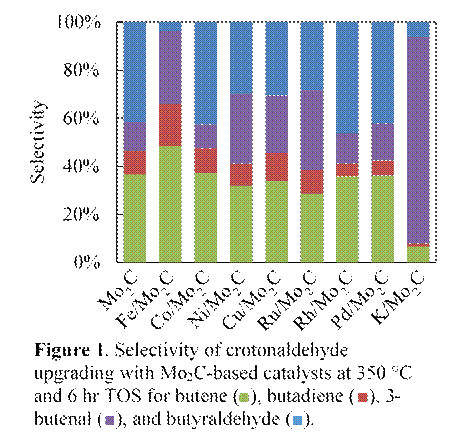
The upgrading of thermochemical biofuels could lead to cleaner, more homogeneous fuels[1], however, the processes and reactions are not very selective. For research described in this paper, we examine the use of various promoters on molybdenum carbide to improve the reaction selectivities. Crotonaldehyde is used as a model compound because it possesses multiple functionalities commonly found in pyrolysis bio-oils, while also allowing us to probe how changes to the catalyst affect selectivity to several different potential products[2].
 In previous work, we have shown that potassium addition to Mo2C
catalyst increased the base site density and decreased the acid site density,
and consequently shifted the crotonaldehyde and acetic acid conversion selectivities
in the presence of H2. The results suggested that the increase in
base sites was responsible for the increase in selectivities to 3-butenal and
acetone, respectively. In this paper, we report on how other metal promoters,
including Fe, shift the crotonaldehyde upgrading selectivity relative to Mo2C.
The Mo2C catalysts were synthesized by a temperature-programmed reaction method as described previously[3]. Metal salt was added to the native (unpassivated) Mo2C catalyst by incipient wetness in an oxygen-free, inert atmosphere. The catalysts were dried in H2 for 2 hrs at 110‹C, reduced in H2 for 4 hrs at 450‹C, and then passivated in 1% O2/He for at least 6 hrs at room temperature. All of the catalysts were characterized using x-ray powder diffraction, N2 physisorption, and inductively coupled plasma optical emission spectrometry. Base and acid site concentrations were measured via temperature programmed desorption of CO2 and NH3. The activities and selectivities were measured at atmospheric pressure and 275-350‹C in a flow reactor with a H2/crotonaldehyde ratio of 6. The ratio was selected because it is twice the stoichiometric amount of H2 required for complete saturation and deoxygenation of crotonaldehyde to butane.
While K shifted the selectivity to 3-butenal, Fe on Mo2C favored the formation of butene and suppressed formation of butyraldehyde at high temperatures. The model compound results presented in this paper will demonstrate the ability to tune the product selectivity of molybdenum carbide catalysts for specific desired reaction pathways by adding various metal promoters. Combining these results to promote Mo2C with a mixture of these promoters could offer a powerful way to tune the selectivity of Mo2C for bio-oil upgrading, depending on the desired character of the upgraded product.
[1] (a) Czernik, S.; Bridgwater, A.V.; Energy & Fuels, 2004, 18, 590-598; (b) Zhang, Q.; Chang, J.; Tiejun, W.; Yung, X. Energy Conversion and Management, 2007, 48, 87-92.
[2] Mullen, C.A.; Strahan, G.D.; Boateng, A.A. Energy & Fuels, 2009, 23, 2707-2718.
[3] Schaidle, J.A.; Schweitzer, N.M.; Ajenifujah, O.T.; Thompson, L.T. J. Catalysis, 2012, 289, 210-217.
See more of this Group/Topical: Catalysis and Reaction Engineering Division