
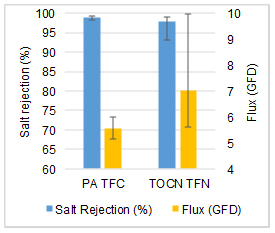
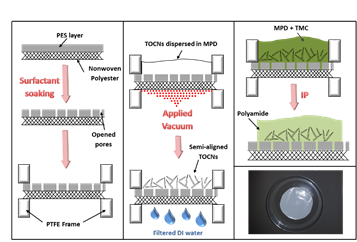
Improvement of current reverse osmosis membranes poses an intricate challenge that, if solved, could affect global access to clean water. Thin film composite (TFC) membranes are used commonly in industrial desalination processes, relying on a polyamide layer for selectivity. It is desired to improve the energy efficiency of these membranes in order to lower the production cost of clean water. Recent studies in our research group involving the addition of functionalized carbon nanotubes to the selective polymer layer of existing TFC membranes have shown promising results, yielding higher water permeance (flux), improved chemical resistance, anti-biofouling properties, and mechanical property enhancement. These thin film nanocomposite (TFN) membranes are often cost-ineffective, prompting the search for an economically viable alternative. TEMPO-oxidized cellulose nanocrystals (TOCNs) have been investigated as a possible TFC additive due to their hydrophilicity, availability, and low cost. In the current work, TOCNs are deposited within the selective aromatic polyamide layer of an established TFC membrane design and subjected to reverse osmosis conditions to determine the water flux and salt rejection, and to observe the properties of the surface. Significant increases in water permeance have been observed while maintaining high salt rejection when compared to a control polyamide (PA) TFC membrane. The improved flux confirms that high aspect ratio nanoparticles can be used to improve transport in membranes via the creation of pathways for rapid transport at the interface between the particles and polymer matrix. This suggests that membrane properties can be controlled and optimized via careful control of the nanoparticle/polymer interface (i.e. through control of nanoparticle surface functionality and polymer matrix properties.
\s
See more of this Group/Topical: Liaison Functions