
Gallium-platinum promoted HZSM-5 is found to be a promising catalyst for ethane dehydroaromatization reaction. In the present work, the influence of Pt as a promoter on the activity of Ga/HZSM-5 catalyst for ethane dehydroaromatization has been investigated. Also comparative study is performed between bimetallic Ga-Pt based (GaPt/HZSM-5) and Mo based HZSM-5, where the GaPt/HZSM-5 showed better aromatic and hydrogen selectivity. Pt promoted Ga/HZSM-5 catalyst exhibited higher activity compared to pure Ga/HZSM-5 catalyst. The presence of platinum in the gallium zeolite considerably accelerates dehydrogenation step in ethane aromatization. In addition, GaPt/HSZM-5 deactivates significantly slower than well-known dehydroaromatization catalyst such as Mo/HZSM-5 and Ga/HZSM-5. TPO study of spent catalysts [Figure 1] revealed that carbonaceous deposit on GaPt/HZSM-5 catalyst were burnt off at lower temperature compared to pure Ga/HZSM-5 catalyst. This happened because the presence of Pt metal on the catalyst facilitates hydrogen spillover resulting in the hydrogenolysis of coke and hence it can moderate the coke deposition. This property of Pt improves the stability of the GaPt/HZSM-5 catalyst. The reaction mechanism associated with aromatic formation is postulated based on the correlation between catalytic performance and surface characterization.
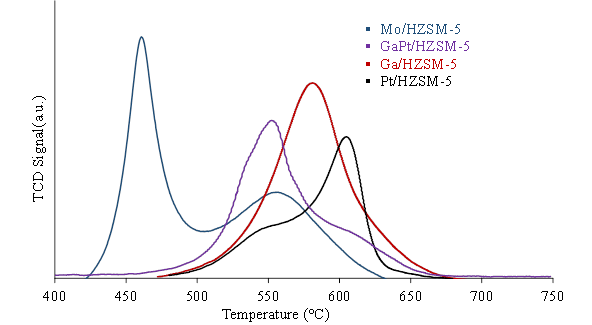
Figure 1: TPO profiles of spent catalysts after running the reaction for 5 h.
See more of this Group/Topical: Topical Conference: Advances in Fossil Energy R&D