
Modeling and Simulation Challenges for Process Intensification
Efstratios N. Pistikopoulos1,2, David Sholl3, M. M. Faruque Hasan1,2, Salih E. Demirel1,2 and Yuhe Tian1,2, (1)Artie McFerrin Department of Chemical Engineering, Texas A&M University, College Station, TX, (2)Texas A&M Energy Institute, Texas A&M University, College Station, TX, (3)School of Chemical & Biomolecular Engineering, Georgia Institute of Technology, Atlanta, GA
The recently established Rapid Advancement in Process Intensification Deployment (RAPID) Manufacturing Institute aims to transform the U.S. industry by developing the next generation of modular, intensified, and innovative manufacturing technologies and processes. The RAPID Modeling and Simulation Focus Area will in particular address the development of strategies and tools for the multi-scale representation, modeling, optimization, and control of intensified systems. In this presentation, we provide an overview of the challenges towards a systematic synthesis, modeling, and simulation approach for process intensification, as well as an exclusive review of process intensification synthesis approach methods in the open literature, such as the ones included in [1-5]. We also introduce an integrated framework for process intensification incorporating operability, control and safety (illustrated in Figure 1).
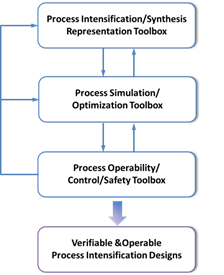
Figure 1: An Integrated Framework for Process Intensification Incorporating Operability, Control and Safety
[1] Demirel, S. E., Li, J., & Hasan, M. F. (2017). Systematic process intensification using building blocks. Computers & Chemical Engineering. http://doi.org/10.1016/j.compchemeng.2017.01.044.
[2] Baldea, M. (2015). From process integration to process intensification. Computers & Chemical Engineering, 81, 104-114.
[3] Tula, A. K., Babi, D. K., Bottlaender, J., Eden, M. R., & Gani, R. (2017). A computer-aided software-tool for sustainable process synthesis-intensification. Computers & Chemical Engineering. http://doi.org/10.1016/j.compchemeng.2017.01.001
[4] Papalexandri, K. P., & Pistikopoulos, E. N. (1996). Generalized modular representation framework for process synthesis. AIChE Journal, 42(4), 1010-1032.
[5] Ismail, S. R., Proios, P., & Pistikopoulos, E. N. (2001). Modular synthesis framework for combined separation/reaction systems. AIChE Journal, 47(3), 629-649.
See more of this Group/Topical: Sustainable Engineering Forum