
Circulating fluidized beds are widely employed in industry for gas-solid contacting operations. In this systems, the riser is the core part, where usually the main reaction takes place. Our previous research showed that the particles clustering hindered the sufficient contact between the gas and the catalyst particles, which affected the reactions. However, most of researchers studied the impacts of a static cluster on reactions instead of a dynamic cluster, and the lifetime of cluster which may be the rate-controlled step was ignored. Thus, in order to investigate the conditions required to disperse a cluster, the present study investigates the dynamic structure of particle clusters using CFD-DEM model, in which the solids is obtained by the Discrete Element Method (DEM) applies Newton's laws of motion to every particle and the fluid phase is described by the local averaged Navier-Stokes equations that can be solved by the traditional Computational Fluid Dynamics (CFD).
Based on the research, the effects of cluster with different voidage (from 0.750 to 0.995) and size (5, 10 and 15 mm) on the gas-solid behavior were studied. The results show that with a decrease of voidage or with an increase of cluster size, the gas is harder to pass through the cluster and the cluster dispersed slowly, which means the lifetime of cluster is longer because of the stronger force between particles. Besides, as shown in Fig. 1, it is noted that cluster being eroded at the outer by the air flow and particles being scattered upward at beginning. Because air flow avoids the cluster which behaves as a rigid sphere at first, the velocity becomes a maximum at the sides of the sphere, this allows particles to more easily leave the cluster. Furthermore, at t=0.20 s, particles at the bottom of the cluster still have a low velocity and the cluster was not dispersed completely, which means the lifetime of cluster was too long to generate a poor contacting between the gas and solids phase and lead to severe process efficiency losses. However, at a very high voidage (i.e. ¦Å=0.995, show in Fig. 2), particles under the surface and at the side of the cluster have a relatively high velocity at t=0.05 s and the lifetime of cluster was much shorter, which means each particle moves under the influence of air flow because of the little force among particles.
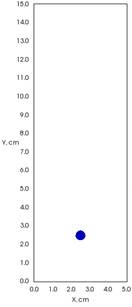
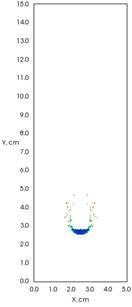
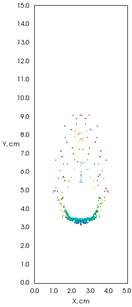
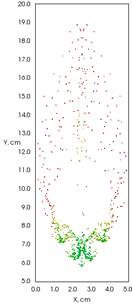
t=0.00s t=0.05s t=0.10s t=0.20s
Fig. 1 Particle flow in different time at ¦Å=0.920
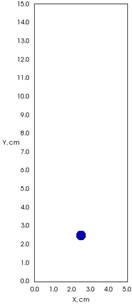
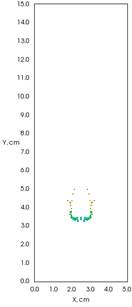
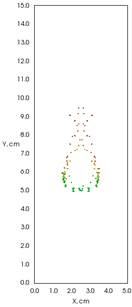
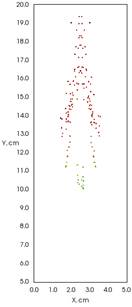
t=0.00s t=0.05s t=0.10s t=0.20s
Fig. 2 Particle flow in different time at ¦Å=0.995
Therefore, the large particle with low voidage clusters is deemed to have a long lifetime, which may affect the reaction and result in low yields of products.
See more of this Group/Topical: Particle Technology Forum