
Single-atom catalyst (SAC), which refers to a class of catalysts where bare metal atoms are atomically dispersed or anchored on the support, has recently emerged as a new frontier in heterogeneous catalysis.[1] A key challenge encountered is to stabilize isolated metals on a support without compromising catalytic activity. As the surface energy of single metal atoms is higher than corresponding metal clusters and nanoparticles, the atoms are highly mobile and tend to form aggregates during synthetic procedures.[2] Keeping the metal loading at a very low level to minimize agglomerations is a common practise to tackle the problem. Another strategy is to anchor single atoms on a support with stronger metal-support interaction.[3] Nevertheless, it remains difficult to effectively stabilize isolated atoms at increased metal loading, which would hinder the applications of SACs. Inspired by the classic coordination chemistry that four-coordinate metal complexes in square-planar or tetrahedron geometry are intrinsically more stable, we propose constructing or introducing four-coordinating anchoring sites with suitable geometry onto a support to prepare high loading, stable SACs.[4] In this work, phosphotungstic acid (PTA, H3PW12O40) was selected to examine the feasibility of the approach.[5]
PTA has a classical Keggin structure with one P atom in the center and caged by 12 octahedral WO6-units linked together by 24 bridging oxygen atoms (Obr). There are another 12 corner oxygen atoms (Oc), each of which is double-bonded with an addenda W atom. With 36 oxygen atoms exposed PTA furnishes a range of coordination sites, including the single corner site, the bridge site (e.g., the Oc-Obr-bridge site), the three-fold hollow site (3-H_Oc and 3-H_Obr), and the four-fold hollow site (4-H). Thus, it represents an ideal platform to differentiate the ability of various sites to stabilize SACs. Previously, there are studies on the combination of metal complexes with heteroply acids. To our knowledge, there has been no report on active SACs on PTA, with the accurate location, electronic state and catalytic mechanism of single metal atoms being determined.
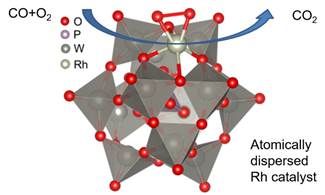
Figure 1. The configuration of the atomically dispersed Rh catalyst and its catalytic application.
Herein, atomically dispersed Rh catalysts supported on PTA with Rh loading up to 0.9 wt% were prepared through a self-assembly method. As shown in Figure 1, Rh stays exclusively as single atom species coordinated to six oxygen atoms, plausibly located at the 4-fold hollow site on one PTA molecule together with a chemically adsorbed O2 molecule. The catalyst is active in CO oxidation affording turnover frequencies between 0.2 and 1.7 s−1 from 165 to 195 ¡ãC, with an apparent activation energy of 127 kJ/mol. The catalyst is highly stable, well maintaining the Keggin structure of PTA as well as the single-atom identity of Rh after three catalytic cycles (50 to 400 ¡ãC). CO activation is mainly achieved on Rh via the formation of dicarbonyl species, while oxygen activation and transfer mainly occur through PTA. The proposed catalytic cycle consists of an alternation of Rh(CO)23+ species and Rh(CO)21+ species on PTA, during which CO transforms into CO2 with oxygen activation being rate-determining.
[1] a) B. Qiao, A. Wang, X. Yang, L. F. Allard, Z. Jiang, Y. Cui, J. Liu, J. Li, T. Zhang, Nat. Chem. 2011, 3, 634-641; b) M. Flytzani-Stephanopoulos, B. C. Gates, Annu. Rev. Chem. Biomol. Eng. 2012, 3, 545-574; cJ. M. Thomas, Nature 2015, 525, 325-326.
[2] a) A. Corma, P. Concepci¨®n, M. Boronat, M. J. Sabater, J. Navas, M. J. Yacaman, E. Larios, A. Posadas, M. A. L¨®pez-Quintela, D. Buceta, E. Mendoza, G. Guilera, A. Mayoral, Nat. Chem. 2013, 5, 775-781; b) K. Ding, A. Gulec, A. M. Johnson, N. M. Schweitzer, G. D. Stucky, L. D. Marks, P. C. Stair, Science 2015, 350, 189-192.
[3] G. Vil¨¦, D. Albani, M. Nachtegaal, Z. Chen, D. Dontsova, M. Antonietti, N. L¨®pez, J. P¨¦rez-Ram¨ªrez, Angew. Chem. Int. Ed. 2015, 54, 11265-11269.
[4] B. Zhang, H. Asakura, J. Zhang, J. Zhang, S. De, N. Yan, Angew. Chem. Int. Ed. 2016, 55, 8319-8323.
[5] B. Zhang, H. Asakura, N. Yan, Ind. Eng. Chem. Res. 2017, 56, 3578-3587.
See more of this Group/Topical: Catalysis and Reaction Engineering Division