
Cell signaling is the process by which extracellular information is transmitted into the cell. Cell signaling pathways are interconnected networks of signaling proteins that communicate through complex molecular mechanisms. As a case in point, ERK (extracellular signal-regulated kinases) signaling plays an important role in numerous cellular processes such as proliferation, apoptosis, DNA synthesis and differentiation. Signaling faults due to mutations and failures in the regulatory mechanisms are known to result in different types of cancers. A complex network of cellular interactions and feedback loops are usually arranged in a hierarchical fashion in space and time to transform the information content of extracellular signals to the DNA in the nucleus of the cell which in turn leads to several cellular functions (see Fig.1).
Activation of EGFR (Epidermal Growth Factor Receptor) by binding of its specific ligands, namely epidermal growth factor and transforming growth factor α (TGF α), starts ERK signaling pathway, as shown in Fig.1.Upon ligand binding, two subunits of EGFR are dimerized, leading to increase in the enzymatic activity of its cytoplasmic tyrosine kinase domain. Adaptor protein Grb2 binds to the phosphorylated RTK (Receptor tyrosine kinase) followed by recruitment of SOS forming Grb2-SOS complex Membrane-bound protein Ras, which is a small GTP binding protein, interacts with Grb2-SOS complex, and it is transformed to its active conformation by exchanging GDP for GTP. Active Ras acts as an important switch which starts the sequential phosphorylation of MAPK pathway that consists of the Raf/MEK/ERK signaling cascade.
Activated ERK, when translocated to the nucleus, phosphorylates nuclear transcription factors (e.g. Myc), that govern cellular responses. Phosphorylated transcription factors stimulate transcription of genes which are responsible for encoding different proteins, including ones required for cell cycle progression (e.g. Cyclin D)
We decompose and analyze the ERK signaling pathway in two interacting functional subsystems with distinct characteristics: First, EGFR-Ras-MAPK subsystem, and second nuclear reactions triggered by activated ERK, including transcriptional processes. These subsystems operate at different time scales (e.g. the nuclear reactions are much slower than EGFR signaling throughout cytoplasm) and they interact with each other via several inhibiting and activating feedback loops. For instance, autocrine loop with positive feedback regulates amplitude and duration of MAPK activation, by incorporating a ligand-releasing protease (i.e. TACE). We have modeled the complete ERK signaling pathway shown in Fig.1 using mass-action kinetics and conservation laws. Numerous models exist in the literature for different parts of the pathway. Our model is more comprehensive as it combines all the significant parts and treats the system as a whole. It is well-established that each specific cellular response is determined by the duration, magnitude, frequency and localization of ERK signaling.
The developed dynamic nonlinear model exhibits very rich dynamics that is needed to tune the steady-state and dynamic characteristics of ERK signaling. Simulations show that ERK signaling can be modulated by a nested set of negative and positive feedback loops to deliver the desired cellular action. Bistability (i.e. ability to switch between two stable steady-states separated by an unstable steady-state) is the hallmark of cellular responses. Using bifurcation analysis, we establish conditions for the existence of bistability in different parts of the network and illustrate how the desired cellular function can be regulated by modulating the bistability characteristics and on-off switching behavior of ERK signaling.
Using this model, we are able to explain the biological phenomena and the clinical observations reported in the literature and postulate possible new mechanisms to improve understanding of an important cellular signaling network.
Avraham, R., & Yarden, Y. (2011). Feedback regulation of EGFR signaling: decision making by early and delayed loops. Nature Reviews. Molecular Cell Biology, 12(2), 104–17. https://doi.org/10.1038/nrm3048.
Dhillon, A., Hagan, S., Rath, O., & Kolch, W. (2007). MAP kinase signalling pathways in cancer. Oncogene, 26, 3279–3290. https://doi.org/10.1038/sj.onc.1210421
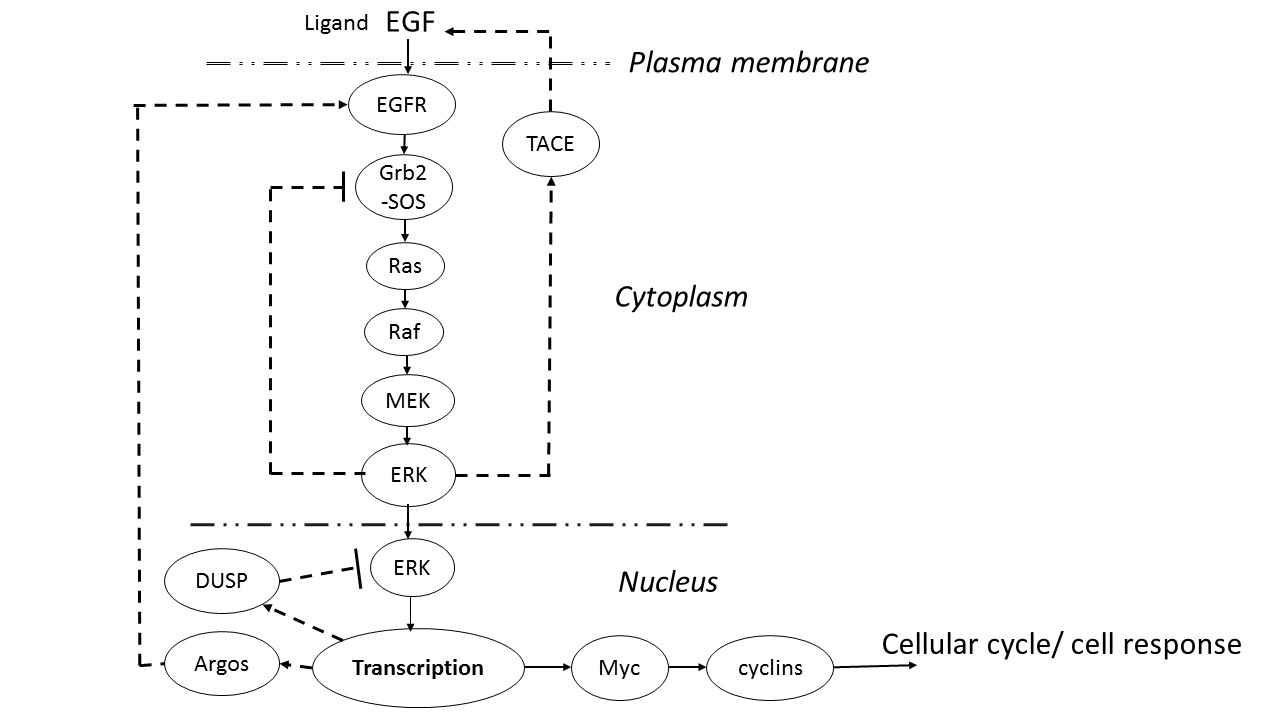
Figure 1. The hierarchy of ERK signaling. Dashed lines represent the feedback signals with arrow ends for activation and blunt ends for inhibition. DUSP: Dual-specificity phosphatase; TACE: (TNF)-alpha converting enzyme, also called ADAM17.
See more of this Group/Topical: Computing and Systems Technology Division