
Element sustainability has become a global issue. Maintaining current consumption rate, there are 22 elements facing depletion within the coming 50 years, including almost all Platinum Group metals that are crucial catalyst component[1]. Despite the critical role of Pt in catalysis[2], it is rare, in short supply in recent years, and has no adequate alternatives. In this regard, single-atom catalysts (or atomically dispersed catalysts), in which all the metal atoms are exposed on the support available for catalytic reactions, could help to address the problem[3]. The electronic properties of isolated metal atoms may be distinctly different from the active sites in bulk materials and nanoparticles, potentially triggering innovative applications and enabling more effective usage of noble metal elements[4].
A challenge in the development of single-atom catalysts is the increasing difficulty to stabilize single-atom species under drastic reaction conditions. Many industrially important catalytic processes involving Pt catalysts, such as reforming of hydrocarbons in petroleum refineries, are operated at several hundred degrees under oxidative or reductive atmosphere[5]. In this context, single-atom catalysts that are able to withstand harsh reaction conditions are highly desirable. Recent studies highlight the importance of manipulating the interactions between metal atoms and the host support to achieve high stability without losing reactivity in single-atom catalysis.
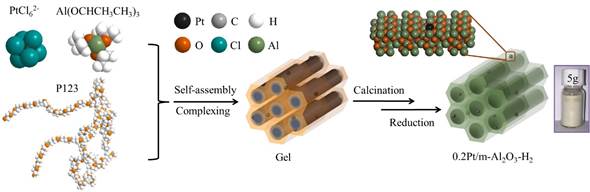
Figure 1 | Schematic illustration of the 0.2Pt/m-Al2O3-H2 synthesis process.
Herein, we report a synthetic strategy for Pt single-atom catalysts with outstanding stability in a series of reactions under demanding conditions. The Pt−Al−O system is chosen because Al2O3 is a common support for Pt in industrial and environmental applications. The catalyst was prepared by a modified sol-gel solvent vaporization self-assembly method[6], followed by calcination in air and reduction with H2 (Fig. 1).The Pt atoms are firmly anchored in the internal surface of mesoporous Al2O3 enriched with coordinatively unsaturated pentahedral Al3+ centers. Activity was fully maintained in CO oxidation after 60 cycles between 100 oC and 400 oC over a one-month period without any metal aggregation or support deterioration. The catalyst also kept its structural integrity and excellent performance for the selective hydrogenation of 1,3-butadiene after exposure to a reductive atmosphere at 200 ¡ãC for 24 h. Compared to commercial Pt nanoparticle catalyst on Al2O3 and control samples, this system also exhibited significantly enhanced stability and performance for n-hexane hydro-reforming at 550 ¡ãC for 48 h.
[1] A. J. Hunt, A. S. Matharu, A. H. King, J. H. Clark, Green. Chem. 2015, 17, 1949-1950.
[2] Forecast of Platinum SUPPLY & DEMAND IN 2015, Johnson Matthey, 2015.
[3] a) X. F. Yang, A. Wang, B. Qiao, J. Li, J. Liu, T. Zhang, Acc. Chem. Res. 2013, 46, 1740-1748; b) J. M. Thomas, Nature 2015, 525, 325-326; c) M. Flytzani-Stephanopoulos, B. C. Gates, Annu. Rev. Chem. Biomol. Eng. 2012, 3, 545-574.
[4] a) F. Dvorak, M. Farnesi Camellone, A. Tovt, N. D. Tran, F. R. Negreiros, M. Vorokhta, T. Skala, I. Matolinova, J. Myslivecek, V. Matolin, S. Fabris, Nat. Commun. 2016, 7, 10801; b) P. Liu, Y. Zhao, R. Qin, S. Mo, G. Chen, L. Gu, D. M. Chevrier, P. Zhang, Q. Guo, D. Zang, B. Wu, G. Fu, N. Zheng, Science 2016, 352, 797-801; c) J. Liu, F. R. Lucci, M. Yang, S. Lee, M. D. Marcinkowski, A. J. Therrien, C. T. Williams, E. C. Sykes, M. Flytzani-Stephanopoulos, J. Am. Chem. Soc. 2016, 138, 6396-6399.
[5] S. H. Joo, J. Y. Park, C. K. Tsung, Y. Yamada, P. Yang, G. A. Somorjai, Nat. Mater. 2009, 8, 126-131.
[6] Q. Yuan, A. X. Yin, C. Luo, L. D. Sun, Y. W. Zhang, W. T. Duan, H. C. Liu, C. H. Yan, J. Am. Chem. Soc. 2008, 130, 3465-3472.
See more of this Group/Topical: Catalysis and Reaction Engineering Division