
Introduction
Delivery of medicinal products through the lungs has been the focus of a series of research projects in the last few years. Especially Dry Powder Inhaler (DPI) devices that utilize capsules as the dose-holding system represent one of the most rapidly expanding fields in pulmonary drug delivery in recent years (Islam and Gladki, 2008). Among the several low-dose capsule filling systems currently available, the dosator principle plays an important role in the filling of capsules for DPI application. One of the greatest challenges for successfully manufacturing high-quality low-dose inhalation products is dose uniformity (Islam and Cleary, 2012). In previous studies, the effect of critical material attributes and process parameters on a low-dose dosator capsule filling process was assessed (Faulhammer et al., 2014; Stranzinger et al., 2017). However, little work has been performed in understanding the filling process of powder blends (e.g., powder containing API and excipient) on the filling performance. For powder mixtures, it can be assumed that the machine vibration present at the powder drum (on all kind of capsule filling machines (dosator nozzle, dosing drum or tampin pin systems)) induces particle movement of the contained material, and thus, on the long time segregation can occur (Metzger et al., 2011; Rosato et al., 2002).
Thus, the objective of this study was (1) to get a deeper understanding of the behavior of powder mixtures during a low-dose capsule filling process by in-line monitoring of the powder layer and (2) to evaluate optimization strategies to reduce segregation. The gained knowledge will help improving the filling performance of challenging powders for DPI applications.
Materials and Methods
The carrier substance, i.e., α-lactose monohydrate (Lactohale 100), was supplied by DFE Pharma (Goch, Germany) and was used as received. Salbutamol sulphate USP (SS) was purchased from Selectchemie (Zurich, Switzerland) and used as the model API. In order to generate inhalable sized particles (1 µm – 5 µm), air-jet milling (micronization) was performed (Spiral Jet Mill 50 AS, Hosokawa Alpine AG, Augsburg, Germany). An injection pressure of 6 bar and a milling pressure of 3 bar were set and powder was fed manually at an estimated rate of 30 g/h.
Blend preparation and characterization
Adhesive mixtures of 5 wt% and 10 wt% API content were prepared. For the 5 wt% blend 285 g Lactohale 100 and 15 g SS were weighed in a plastic vessel, and for the 10 wt% blend 270 g of carrier and 30 g of API were used. In both cases, the sandwich method was used. More precisely, the carrier was first layered in the vessel followed by a layer of API in the middle and topped with a layer of the carrier. The powders were mixed in a Turbula® blender T2F (Willy A. Bachofen Maschinenfabrik, Muttenz, Switzerland) and for 60 min at 68 rpm.
The blend uniformity was assessed by analyzing the drug content in several aliquots of blends with reversed phase high performance liquid chromatography (HPLC) (Faulhammer et al., 2015). Furthermore, powder characteristics (such as particle size, friction angles, bulk and flowability properties) were determined for pure carrier, API and blends.
Capsule filling
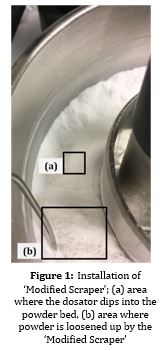
The powder blends were filled into hard gelatin capsules of size 3 (provided by Capsugel, Bornem, Belgium) with a lab-scale dosator nozzle capsule filler with special adjustments for low powder dosing (Labby, MG2, Bologna, Italy). A combination of the following process parameters was used: A dosing chamber length (dcl) of 5 mm, a dosator diameter (dia) of 1.9 mm a filling speed of 3000 capsules per hour (cph) and two powder bed heights (pbh) of 5 mm and 10 mm. For reconditioning the powder bed, an additional scraper made of steel was mounted (see Figure 1). The weight of filled and empty capsules was measured with a Denver SI-234A (Denver Instrument, Bohemia, NY, USA) scale.
In-line API Monitoring using RAMAN spectroscopy
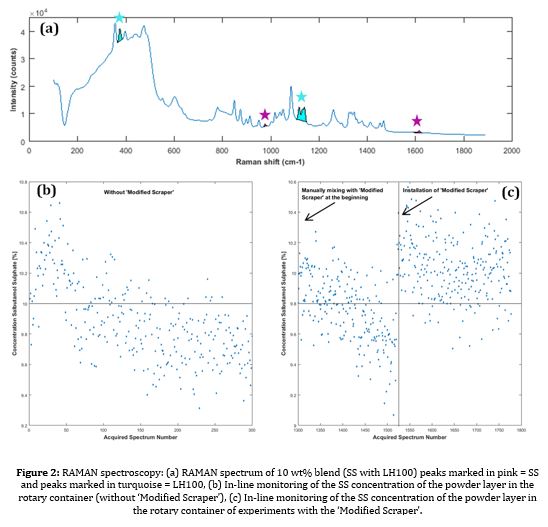
For the purpose of monitoring possible segregation during the process, RAMAN spectroscopy was applied. The in-line sampling system was a filtered fiber-optic probe with uniform global illumination (PhAT probe, Kaiser Optical Systems, Lyon, France). The PhAT probe can generate a 6 mm diameter spot. The position of the probe, which is a few centimeters above the powder layer and precisely horizontally centered allows a representative sampling of the region of interest, i.e., the position where the dosator dips into the powder bed.
Results and Discussion
Performance evaluation of the ‘Modified Scraper’
The segregation emerging during the regular set-up, now detectable in-line, was compared to a modified geometry including an additional scraper (a solution that MG2 already adopts to improve the capsule filling mass uniformity), with the intention of reducing segregation.
Figure 1 illustrates the installed ‘Modified Scraper’. A visual inspection of the powder layer revealed a mixing of the blend inside the rotary container, which is expected to lessen segregation of the API to the bottom. Figure 2a presents a RAMAN spectrum of the blend which demonstrates that peaks of SS and LH100 are clearly distinguishable and can therefore be used to monitor changes in the SS concentration during the process. Figure 2b shows a capsule filling process without using the ‘Modified Scraper’, showing clearly the signature of segregation. Figure 2c demonstrates that the ‘Modified Scraper’ can reduce the segregation tendency which results in a more homogeneous powder bed.
Conclusion and Outlook
The findings of this study suggest that for low-dose dosator capsule filling, it is strongly recommended to continuously control the powder layer to ensure high-quality products. Furthermore, the in-line Raman analysis proved to be valuable towards process optimization strategies and for improving the existing capsule filler set-up.
References
Faulhammer, E., Fink, M., Llusa, M., Lawrence, S.M., Biserni, S., Calzolari, V., Khinast, J.G., 2014. Low-dose capsule filling of inhalation products: Critical material attributes and process parameters. Int. J. Pharm. 473, 617–626. doi:10.1016/j.ijpharm.2014.07.050
Faulhammer, E., Wahl, V., Zellnitz, S., Khinast, Johannes, G., Paudel, A., 2015. Carrier-based dry powder inhalation: Impact of carrier modification on capsule filling processability and in vitro aerodynamic performance. Int. J. Pharm. 491, 231–242. doi:10.1016/j.ijpharm.2015.06.044
Islam, N., Cleary, M.J., 2012. Developing an efficient and reliable dry powder inhaler for pulmonary drug delivery - A review for multidisciplinary researchers. Med. Eng. Phys. 34, 409–427. doi:10.1016/j.medengphy.2011.12.025
Islam, N., Gladki, E., 2008. Dry powder inhalers (DPIs)—a review of device reliability and innovation. Int. J. Pharm. 360, 1–11.
Metzger, M.J., Remy, B., Glasser, B.J., 2011. All the Brazil nuts are not on top: Vibration induced granular size segregation of binary, ternary and multi-sized mixtures. Powder Technol. 205, 42–51. doi:10.1016/j.powtec.2010.08.062
Rosato, A.D., Blackmore, D.L., Zhang, N., Lan, Y., 2002. A perspective on vibration-induced size segregation of granular materials. Chem. Eng. Sci. 57, 265–275. doi:10.1016/S0009-2509(01)00380-3
Stranzinger, S., Faulhammer, E., Calzolari, V., Biserni, S., Dreu, R., Š, R., Paudel, A., Khinast, J.G., 2017. The effect of material attributes and process parameters on the powder bed uniformity during a low-dose dosator capsule filling process 516, 9–20. doi:10.1016/j.ijpharm.2016.11.010
See more of this Group/Topical: Pharmaceutical Discovery, Development and Manufacturing Forum