
Investigation of CO2 desorption performance in tri-solvent blends (MEA-AMP-PZ) with and without catalyst
a Joint International Center for CO2 Capture and Storage (iCCS), Provincial Hunan Key Laboratory for Cost-effective Utilization of Fossil Fuel Aimed at Reducing CO2 Emissions, College of Chemistry and Chemical Engineering, Hunan University, Changsha 410082, PR China
* Author for correspondence: Dr. Helei Liu: lhl0925@hotmail.com & Dr. Zhiwu Liang Email: zwliang@hnu.edu.cn
Abstract
Carbon dioxide (CO2) is widely considered as a predominant contributor of greenhouse gases. Thus, it is an urgent to mitigate CO2 from atmosphere. Chemical absorption technology using amine based solvent for capturing CO2 has attracted the most attention because of its cost-effectiveness, maturity and absorption large volumes of flue gas. However, a large quantity of energy is demanded during CO2 stripping which accounts for about 70-80% of the total cost of the CO2 capture system. The high energy penalty accompanying the high running cost is the biggest barrier for post-combustion CO2 capture by using chemical absorption.
Considerable research efforts have been devoted to reducing the regeneration energy requirement. Recently, some researchers have reported that the development of amines tri-solvent blends for CO2 capture is an effective method. Because it could not only dramatically utilize the potentials of the individual amine, but also address their individual problems. Nwaoha et al.1 studied the tri-solvent blend with two absorption rate promoters (i.e. piperazine (PZ) and monoethanolamine (MEA)) and a hindered amine 2-amino-2-methyl-1-propanol (AMP). The results indicated that the tri-solvent blends amines had faster desorption rate and lower regeneration heat duty in comparison with the commercial amine MEA. Based on their work, the tri-solvent blends amines could be considered as one of potential novel absorbents for CO2 capture in post-combustion processes. However, the heat duty of tri-solvent blends amines is still high. Idem et al. proposed that the addition of solid acid catalysts such as H-ZSM-5 into rich amine solution for CO2 stripping is an efficient method to decrease the heat duty2. However, the study of regeneration behavior of the amine tri-solvent blends with the catalysts is not available. Hence, the investigation on the tri-solvent blends amines with catalyst is interesting to present in order to further reduce of solvent regeneration energy requirement. In the present study, the test of MEA-AMP-PZ tri-solvent blends with four different acid catalysts (e.g. HZSM-5, gamma-Al2O3, SAPO-34, and SO42-/TiO2) and without catalyst were investigated in a batch reactor for understand the process of regeneration.
In this work, the experiments regeneration was studied by using a batch reactor, which was displayed in Figure 1. 2 L rich amine solutions with the desired CO2 loading were introduced into a 3 L four-necked flask, which was immersed in the oil bath (DF-101T). The rich CO2 loading of all amines was set at their equilibrium CO2 loading at absorption conditions of 313 K and 15.1% CO2 partial pressure1,2. 25 g catalyst were put into the amine solution. The time was not recorded until the amine solvent temperature reached at 338 K. The CO2 loadings of solution at time of at 0.25, 0.5, 0.75, 1, 1.5, 2, 4, 6, and 9 h were measured by using a Chittick apparatus3. The heat duty for the CO2 desorption was measured by an electric energy meter.
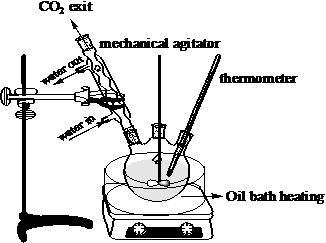
Figure 1. Schematic diagram of the batch reactor for CO2 desorption process
The heat duty (H, kJ/mol) is could be obtained by equation (1) .
 (1)
The relative heat duty (RH, %) was used in this work. The heat duty of 5M MEA without catalyst regeneration in first 2 h is considered as Hbaseline(kJ/mol). The heat duty of new systems regeneration in first 2 h was considered as Hi (kJ/mol). RH was calculated as the following equation (2).
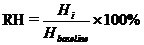 (2)
The typical CO2 desorption profile of the four amine systems (e.g. 5M MEA, 3M MEA-2.5M AMP-0.5M PZ, 3M MEA-2M AMP-1M PZ and 3M MEA-1.5M AMP-1.5M PZ) at the regeneration temperature of 369 K is shown in Figure 2. It is clear that all the studied tri-solvent blends show a faster desorption rate in comparison with the 5M MEA. The 3M MEA-2.5M AMP-0.5M PZ system shows the fastest CO2 desorption rate. As shown in Figure 2, the CO2 loading decreased dramatically in the first 2 h. In this work, the heat duty was calculated by considering the first 2 h of the regeneration process.
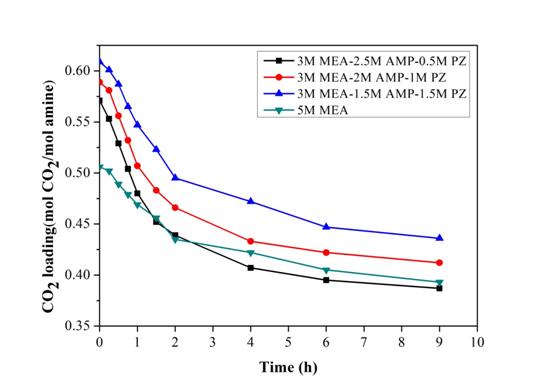
Figure 2. CO2 desorption in single and tri-solvent blends amines without catalyst at 369 K.
Figure 3 depicts the relative energy requirement of amine solvent regeneration. It is noted that all the studied tri-solvent blends show much lower regeneration heat duty than 5M MEA. The 3M MEA-2.5M AMP-0.5M PZ with AMP/PZ molar ratio of 5 requires the lowest regeneration heat duty. It could be found that the heat duty decreased with the increase of concentration of the AMP. Based on this result, the system of 3M MEA-2.5M AMP-0.5M PZ could be considered as the best blend solvent in term of CO2 desorption performance.
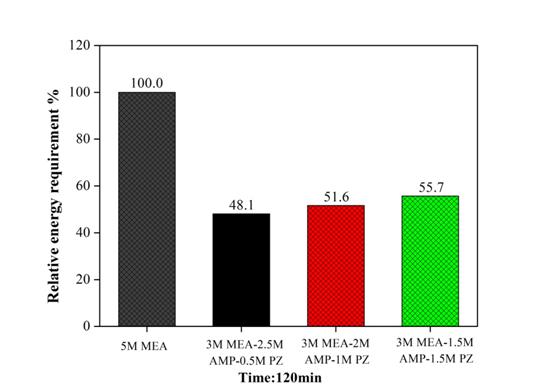
Figure 3. Relative heat duty for MEA-AMP-PZ tri-solvent blends and 5M MEA without catalyst at 369 K.
To further accelerate the CO2 desorption rate and reduce the heat duty, the regeneration behavior of 3M MEA-2.5M AMP-0.5M PZ system studied by adding four different catalysts (e.g. H-ZSM-5, gamma-Al2O3, SAPO-34, and SO42-/TiO2). The performance of CO2 desorption curves of this system with and without catalyst are shown in Figure 4. It can be seen that the lean loading value of different systems declined to be the same, which means that the catalyst can only change the reaction rate but will not alter the chemical equilibrium. However, the addition of four acid catalysts play an positive effect on CO2 desorption rate. The result proved that the catalyst can only accelerate the reaction rate without the effect on the chemical equilibrium. Figure 5 displays the relative regeneration heat duty of different amine-catalyst systems. The CO2 desorption performance in terms of the relative heat duty for different catalysts could be ranked as: H-ZSM-5 (38.4%) > gamma-Al2O3 (40.1%) > SAPO-34 (41.0%) > SO42-/TiO2 (42.8%) > the blank (48.1%). The result indicated that four catalysts further accelerated the CO2 desorption rate and reduced the heat duty in comparison with the blank test, and H-ZSM-5 showed the best catalytic performance of CO2 desorption. The addition of acid catalyst into the rich loading amine solution results in increasing proton concentration, which could react with the carbamate (i.e. Amine-COO-). Thereby, the improvement of CO2 desorption rate and the decrease of the heat duty were observed.
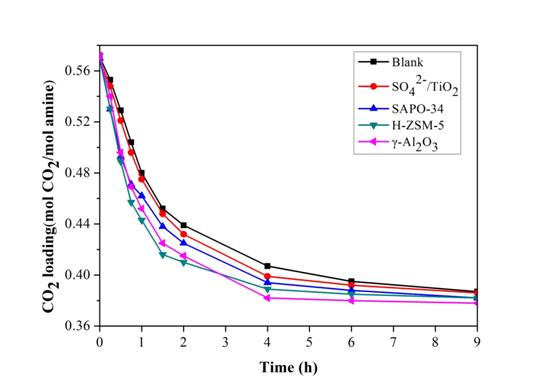
Figure 4. CO2 desorption in 3M MEA-2.5M AMP-0.5M PZ with and without catalyst at 369 K.
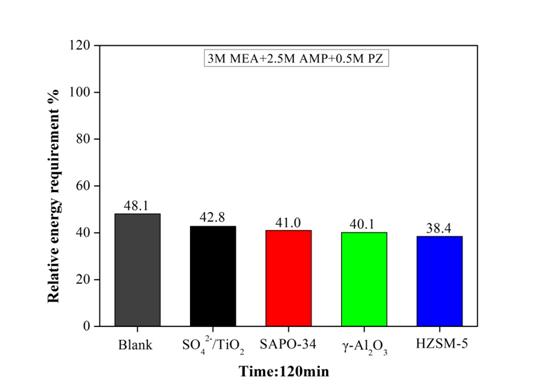
Figure 5. Relative heat duty for 3M MEA-2.5M AMP-0.5M PZ with and without catalyst at 369 K.
Acknowledgment: The financial support from the National Natural Science Foundation of China (Nos. 21476064, 21376067 and U1362112), National Key Technology R&D Program (Nos. 2012BAC26B01 and 2014BAC18B04), Innovative Research Team Development Plan-Ministry of Education of China (No. IRT1238), and China's State 'Project 985' in Hunan University-Novel Technology Research and Development for CO2 Capture as well as Hunan University to the Joint International Center for CO2 Capture and Storage (iCCS) are gratefully acknowledged.
References
See more of this Group/Topical: Liaison Functions