
Catalytic conversion of biomass derived lactones into fuels and chemicals
Md. Imteyaz Alam*, Shelaka Guptaa, Ashish Bohreb, Ejaz Ahmada, Tuhin S. Khana, Basudeb Sahab,c, M. Ali Haidera
a. REC Lab, Department of Chemical Engineering, Indian Institute of Technology Delhi, Hauz Khas, Delhi 110016, India
b. Laboratory of Catalysis, Department of Chemistry, University of Delhi, Delhi 110007, India
c. Catalysis Center for Energy Innovation, University of Delaware, Newark, DE 19713, USA
Tel:
+91-11-26591016, Fax: +91-11-2658-2037
E-mail: imteyaz84@gmail.com
6-amyl-α-pyrone (6PP) is a fermentation derived unsaturated lactone having considerable potential to be developed as a platform chemical. Due to the presence of different functional moities and the position of double bond in the ring, myriad of reactions can be performed giving useful chemicals. For instance, ring-opening and decarboxylation of 6PP in water yielded non-2-en-4-one (1) (Figure 1a) with 95% conversion and nearly 60% selectivity at 498 K, without using any catalyst. The activation barrier was calculated to be 180 kJ/mol in presence of water using DFT, which compares well with the experimental apparent activation barrier of 166 kJ/mol. The selectivity of decarboxylated product was further enhanced using acidic silica-alumina and γ-alumina giving around 65% selectivity and 75% conversion at a reduced temperature of 463 K. The measured apparent activation energy for γ-alumina ( 99 kJ/mol) was comparable to the DFT calculated intrinsic endothermicity of the proton transfer step 98 kJ/mol (Figure 1b), which was essential for obtaining the ring-opened intermediate. The hydrogenation of non-2-en-4-one over Pd/C catalyst was further experimented to yield 4-nonanone (3) which can serve as a solvent or an intermediate for other reactions. In order to produce longer chain hydrocarbons of diesel and jet fuel ranged fuels, mixed oxide (CaO-MgO) was synthesized and utilized as a catalyst for the C-C coupling reaction via aldol condensation reaction. The condensation of nonanone with furfural and 5-hydroxymethyl furfural (HMF) over CaO-MgO yielded upto 40% (5) and 60% (4) of the branched aldol products at 443 and 393 K (Figure 1a), which may further be hydrogenated to give liquid transportation fuel. Furthermore, 6PP along with other 2-pyrones with its structural analogous was allowed for the direct hydrogenatiopn using alkali metal hydride. Up to 73% of corresponding hydric alcohol from 6PP was obtained when the reaction was performed in dry tetrhydrofuran under nitrogen atmosphere.
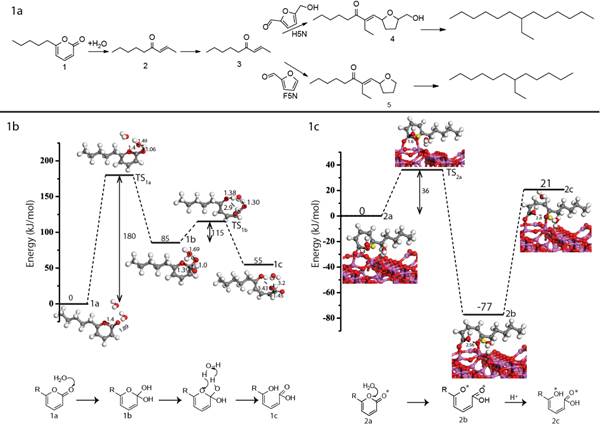
Figure 1. a) Reaction mechanism for the production of C15 fuel additives from 6PP, b) reaction energy diagram for the ring-opening of 6pp in water and c) acid catalysed system of γ-alumina.
See more of this Group/Topical: Topical Conference: Innovations of Green Process Engineering for Sustainable Energy and Environment