
Evaluation of Multi-scale Models for Steam Methane Reforming in a
Fixed Bed Reactor
Anthony G. Dixon
Department of Chemical Engineering, Worcester Polytechnic Institute,
Worcester, MA, USA, 01609
Models of chemical reactions in fixed bed reactors, even at steady-state, must take into account phenomena occurring over a wide range of scales, from the catalytic site, to the pellet pore, the catalyst particle and finally to the reactor tube scale. In reactor tubes of low tube-to-particle diameter ratio (N) the latter can be broken down further into the tube radius scale and the tube length scale. Conventional pseudo-homogeneous effective (porous) medium fixed bed models take into consideration one or both tube scales, while the particle scale is averaged by use of the effectiveness factor. Heterogeneous effective medium models which solve explicit equations for diffusion and reaction in the catalyst pellet also include the pellet scale. Even in these multi-scale models, the transport parameters must lump several phenomena at various length scales. The question of whether the models are adequate to predict reactor performance is usually addressed by comparison to experimental data, an approach which is compromised by uncertainties in the reaction kinetics and in the correlations used for the effective transport parameters.
In this work a different method for the evaluation of two-dimensional heterogeneous fixed bed reactor models is presented, using 3D CFD resolved particle simulations to generate a detailed benchmark solution at both the tube and particle scales. The CFD simulation is run for known kinetics and fluid/particle properties, which then can be used in the effective medium models, eliminating the uncertainty about whether the chosen kinetics truly represent the experimental reacting system. The effective transport parameters can be obtained from CFD runs in the same bed of particles without reaction, under conditions which mimic the usual experimental set-up to determine these parameters, for example flow through a heated-wall tube for the effective radial thermal conductivity, or mass transfer from coated particles for the particle-fluid mass transfer coefficient. In this way, transport properties which represent the fixed bed being modeled are used, instead of introducing a large degree of uncertainty by choosing one of the many literature correlations.
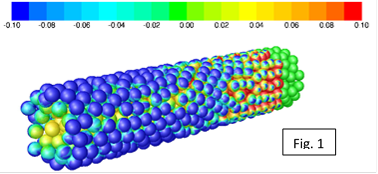 The methodology described in the preceding paragraphs
is illustrated in this talk for steam methane reforming in a packed bed of 807
spheres at N = 5.96, under conditions typical of the middle of a steam reformer
tube, with specified wall heat flux. The 3D CFD simulations show a detailed
picture of temperature, species and reaction rates at the level of a catalyst
particle or lower (See Fig. 1 for contours of the water-gas shift reaction rate).
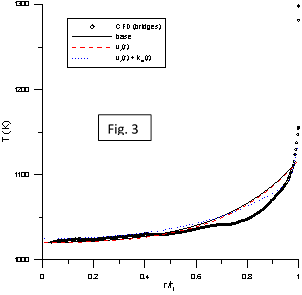
From the CFD simulations, it may be determined what level of detail is necessary for the 2D + 1D model to represent chosen features of the more detailed 3D model. The results show that the cross-sectional average profiles require detailed modeling of the reaction rate distribution (via the radial void fraction) as well as a radially-distributed axial velocity profile, but not a radially-varying effective radial thermal conductivity (see Fig. 2 for a comparison for fluid temperature).
 | |||
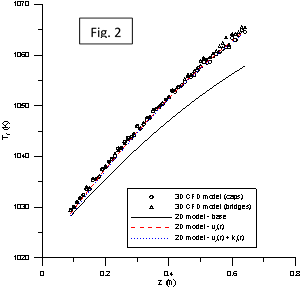 | |||
These models which take account of local scale structure and flow, do not reproduce the radial profiles well. On the other hand, if a model for the local radial variation of the effective radial thermal conductivity is used, then more promising results are obtained (see Fig. 3).
See more of this Group/Topical: Catalysis and Reaction Engineering Division