
Hydrogen is a clean fuel and is thus expected to play an important role as an energy carrier in a future decarbonized energy scenario that has a high share of renewable energy. However, global hydrogen production is currently dominated by fossil fuel-based processes with significant inefficiencies. Quantifying the source of these inefficiencies and designing novel efficient processes is essential to realizing a hydrogen-based energy economy. Further, these novel processes have to include carbon dioxide capture and storage (CCS).
Natural gas (containing predominantly methane) is a common feedstock for hydrogen production processes that use the steam-methane reforming (SMR) reaction followed by a water-gas shift (WGS) reaction. Methane is combusted in a furnace to provide heat for the endothermic reforming reaction. We simulate a state-of-the-art hydrogen production process in Aspen HYSYS, and then perform an exergy analysis of the model in order to pinpoint the unit operations responsible for the largest sources of inefficiency. The exergy analysis includes physical as well as mixing and chemical exergy parameters that are obtained using user-defined subroutines programmed into Aspen HYSYS. The results of the analysis show that the source of largest exergy destruction (and hence inefficiency) is the furnace (43.8%), followed by the steam generation heat exchanger (20.88%) and the reformer unit (13.73%). Using insight from the exergy analysis, we deduce that the cause of inefficiencies is incorrect operating conditions (temperature and pressure) of different unit operations such as the furnace, SMR and WGS reactors. However, it is not practical to design a more efficient process by merely changing the operating conditions of one unit operation since all interconnected unit operations would be affected by this change. Thus, it is necessary to employ a systematic methodology for conceptual design of an efficient hydrogen production process. This methodology should use a “systems-level” approach, i.e. it should concurrently consider all the unit operations in the process as well as their interconnections.
The objective of this paper is to use the systematic “G-H” methodology [1] for conceptual design of a novel hydrogen production process. The G-H methodology uses information about the change in Gibbs free energy (G) and enthalpy (H) at standard conditions for chemical reactions to derive the heat and work balances of the corresponding reactor. For instance, in our project, changes in G and H are established for SMR, WGS and methane combustion reactions at standard conditions in order to set up heat and work balances for each reactor. The heat and work balances of the overall process are obtained by summing up the contributions of each reactor unit operation weighted by the extent of the reaction taking place in each operation. A desirable operating point is chosen for the overall process and this fixes the operating conditions for the unit operations as well. The operating temperature for each unit is given by its “Carnot temperature” or “reversible temperature”, which is defined as the temperature at which the reaction work requirements are provided exactly by the heat supplied such that both requirements are met concurrently. Units operating at their Carnot temperatures are reversible and hence are efficient since they do not destroy any exergy. Herein lies the value of the G-H methodology: It uses the concept of reversibility to provide a target for the operating conditions that give the highest efficiency from the enormous choice of reactor unit operating conditions. In addition, the G-H methodology is applied at the systems-level ensuring that the entire process is highly efficient rather than focusing on the efficiency of individual unit operations.
The Carnot temperatures of the SMR, WGS and methane combustion reactions in the furnace are calculated to be 960.83 K, 974.67 K and 145,866.25 K respectively, though the furnace is designed to operate at a more realistic temperature of 1000.00 K. The flow compositions of the material streams are determined from the extent of reaction of the corresponding unit operations, and a block diagram of the flowsheet is shown in Figure 1 below.
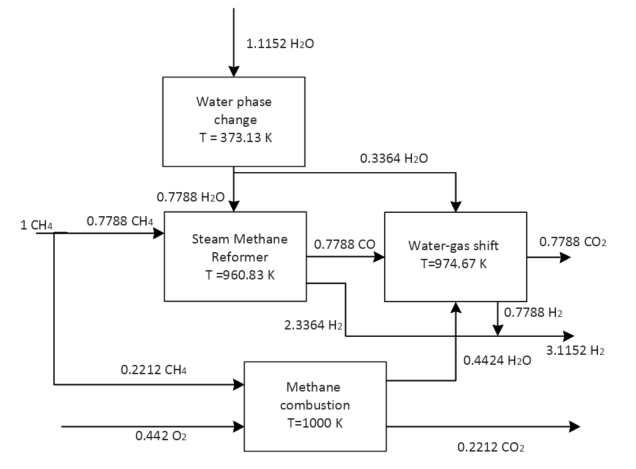 |
Figure 1: Block diagram of a process for hydrogen production from natural gas
While the G-H methodology ensures a high efficiency, it does not take conversion of the reactions into consideration. In this paper, we extend the G-H methodology by investigating alternative ways of achieving maximum conversion. Specifically, we study two options: separation and recycling of the unreacted feed and integrated separation and reaction in a hydrogen membrane reactor. For the first case, we model the process with separation and recycle of unreacted products for both the SMR and WGS reaction in Aspen HYSYS. We examine how the conversion of each reaction varies with the separation split ratio, and design a flowsheet that gives complete conversion.
For the second case, we formulate a novel procedure to determine the conversion of a hydrogen membrane reactor given the reactor operating conditions and membrane parameters. The problem can be stated as follows: Assume that the SMR and WGS membrane reactors run at the operating conditions obtained from the G-H methodology; what is the expected range of achievable conversion for a particular set of hydrogen membrane characteristics - permeability, thickness of the membrane layer, hydrogen partial pressure profiles at both the feed and retentate side, hydrogen flux and the hydrogen permeation rate-determining step. The procedure involves dividing the membrane reactor into a series of reaction steps followed by membrane separation steps. In each reaction step, the change in conversion is calculated analytically for the membrane reactor operating temperature, and the products of this reaction step are the feed of the next separation step. We assumed a palladium membrane for hydrogen permeation and modelled the separation step according to Sievert's law [2]. Each separation step is further divided into a number of sub-steps in which the feed partial pressure of hydrogen is updated. The final retentate concentration forms the feed of the next reaction step. The results of this procedure give an attainable region of conversion for the SMR and WGS reactions. This attainable region is used to develop a framework for estimating required membrane areas by plotting area contours for different reactor operating pressures. Finally, we show how this procedure fits into the G-H methodology.
Thus, we present two alternative flowsheets showing conceptual design of novel hydrogen production processes from natural gas. These processes are more efficient than the state-of-the-art showing the value of the systematic G-H methodology.
References:
[1] James Alistair Fox, Diane Hildebrandt, David Glasser, and Bilal Patel. "A Graphical Approach to Process Synthesis and its Application to Steam Reforming." AIChE Journal 59, no. 10 (2013): 3714-3729.
[2] Samhun Yun, and S. Ted Oyama. "Correlations in palladium membranes for hydrogen separation: a review." Journal of membrane science 375, no. 1 (2011): 28-45.
See more of this Group/Topical: Sustainable Engineering Forum